

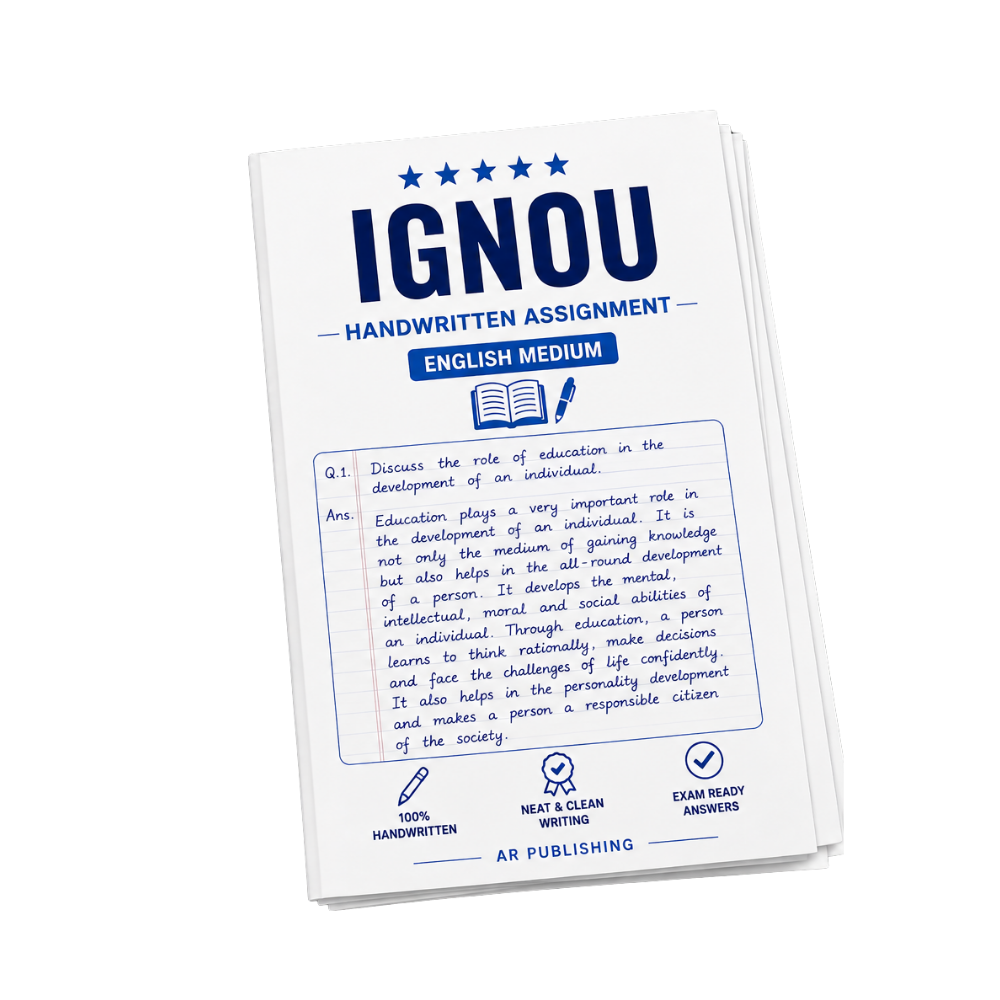
BAM-002 IGNOU Handwritten Assignment 2026-27
Click to view offer details & terms
Get 10% OFF Instant Discount
Apply this coupon code at checkout to claim your academic discount instantly.
- Applicable on all university study materials
- Valid for up to 8 item(s) per order
- Valid till Oct 31, 2026
Enrolled in other IGNOU subjects?
Link your Enrollment No. to auto-map all your semester courses & free question papers.
Frequently Bought Together
Popular course materials frequently ordered together
Syllabus & Overview
BAM-002 Handwritten Assignment Physical Hard Copy (80 GSM A4 Ruled Paper)
This assignment is a 100% physical handwritten hard copy designed strictly for IGNOU’s BAM-002: Institutional Support For Agricultural Development, adhering to the official curriculum structure. The content is written by experienced academic scribes on high-quality ruled paper, ready for submission via Speed Post. Below are the key syllabus blocks covered in this assignment:
Covered Syllabus Blocks (Official IGNOU BAM-002 Curriculum)
-
Block-1: Education, Research and Extension Support
In-depth analysis of agricultural education systems, research institutions (e.g., ICAR, State Agricultural Universities), and extension services (e.g., Krishi Vigyan Kendra). Covers case studies on farmer training programs and technology dissemination models.
- Role of ICAR in agricultural research and policy formulation.
- Extension mechanisms: KVKs, mass media, and digital platforms.
- Comparative study of traditional vs. modern extension methods.
-
Block-2: Financial and Marketing Support in Agriculture
Explores agricultural credit systems (e.g., Kisan Credit Cards, NABARD), marketing infrastructure (APMCs, e-NAM), and supply chain logistics. Includes solved numerical problems on cost-benefit analysis of marketing interventions.
- Functioning of NABARD and its role in rural credit.
- Analysis of APMC reforms and their impact on farmer incomes.
- Case study: Success of contract farming in Punjab/Haryana.
-
Block-3: Cooperatives and Farmers’ Organizations
Focuses on cooperative societies (e.g., dairy cooperatives, sugar cooperatives), their legal framework (Cooperative Societies Act), and financial sustainability. Includes model answers for essay-type questions on cooperative failures/successes.
- Types of agricultural cooperatives and their functions.
- Challenges faced by primary agricultural cooperatives (PACs).
- Role of cooperatives in input/output procurement (e.g., Amul, IFFCO).
-
Block-4: Agricultural Marketing
Covers marketing channels, grading standards (AGMARK), and government schemes like PM-KISAN and Agri-Infrastructure Fund. Includes solved questions on marketing margins and farmer producer organizations (FPOs).
- Primary, secondary, and tertiary marketing channels.
- AGMARK certification: Process and significance.
- Impact of e-NAM on price discovery and transparency.
-
Block-5: Support Schemes and Institutions for Agriculture and Allied Sectors
Detailed explanation of central/state schemes (e.g., Pradhan Mantri Fasal Bima Yojana, Rashtriya Krishi Vikas Yojana) and allied sector supports (e.g., livestock insurance, sericulture promotion). Includes flowcharts for scheme eligibility.
- Comparison of crop insurance schemes (PMFBY vs. state-specific models).
- Role of NABARD in allied sector financing.
- Case study: Success of organic farming subsidies in Uttarakhand.
Subject-Specific FAQs
- Q: How are KVKs different from Krishi Bhavans?
The Krishi Vigyan Kendra (KVK) is a decentralized agricultural extension arm of ICAR, focusing on on-farm demonstrations and farmer participatory research. In contrast, Krishi Bhavans are state-level agricultural research institutes promoting hybrid varieties and modern techniques, often linked to universities but not extension-focused.
- Q: What is the significance of the Cooperative Societies Act, 1912?
The Act provides the legal framework for forming cooperatives in India, emphasizing democratic governance, mutual aid, and economic equality. It mandates one-person-one-vote principles and regulates capital contributions, ensuring farmer cooperatives remain community-driven rather than profit-oriented.
Assignment Delivery Details
The assignment is a physical hard copy written by hand on 80 GSM A4 ruled paper, packaged with:
- Official IGNOU front page (pre-filled with student details).
- Printed question paper (as per IGNOU guidelines).
- Neat, legible handwriting for easy reading.
- Attached Speed Post envelope for direct submission.
Note: This is a ready-to-submit assignment—no digital files or PDFs are included. Delivered exclusively via Indian Speed Post to your registered address.
Why buy from us?
-
Verified by top professors and 99th percentile students.
-
Always updated to the latest university curriculum.
-
High-quality, printable PDF formats with clear diagrams.
License & Terms
By purchasing this item, you agree to our standard academic license terms. You may use this product for personal study, but you may not resell or redistribute the files online.