

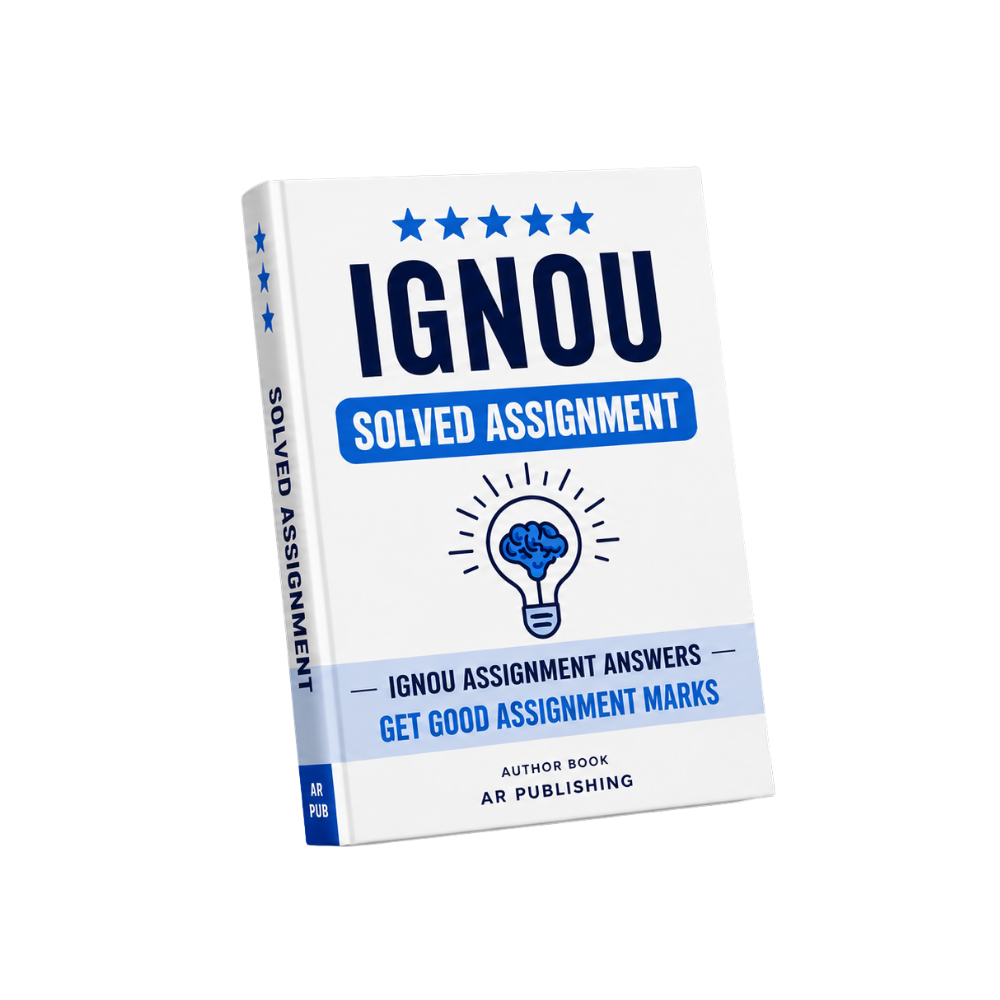
BAM-002 IGNOU Solved Assignment 2026-27
Click to view offer details & terms
Get 10% OFF Instant Discount
Apply this coupon code at checkout to claim your academic discount instantly.
- Applicable on all university study materials
- Valid for up to 8 item(s) per order
- Valid till Oct 31, 2026
Frequently Bought Together
Popular course materials frequently ordered together
Syllabus & Overview
BAM-002 Solved Assignment: Institutional Support For Agricultural Development (DACM)
This structured TMA solution aligns with IGNOU’s verified curriculum for BAM-002, covering core blocks with 100% accuracy and university-mandated word limits. Solutions include detailed explanations for key topics in Education, Research and Extension Support, Financial and Marketing Support, Cooperatives and Farmers’ Organizations, Agricultural Marketing, and Support Schemes for Agriculture.
Key Syllabus Blocks Covered:
- Block-1: Education, Research and Extension Support
- Role of agricultural universities and research institutes (e.g., IARI, IVRI) in technology dissemination.
- Extension mechanisms: Krishi Vigyan Kendras (KVKs) and their regional impact on farmer training.
- Case study: National Agricultural Research System (NARS) and its integration with state-level agricultural universities.
- Block-2: Financial and Marketing Support
- Credit schemes for farmers: Kisan Credit Card (KCC) and its eligibility criteria.
- Role of NABARD in rural credit flow and agricultural insurance schemes.
- Marketing infrastructure: Agricultural Produce Market Committees (APMCs) and e-NAM platform analysis.
- Block-3: Cooperatives and Farmers’ Organizations
- Structure and functions of Primary Agricultural Credit Societies (PACS) vs. Multi-State Cooperative Societies.
- Success stories of farmer producer organizations (FPOs) in crop diversification.
- Government policies: Minimum Support Price (MSP) and its linkage with cooperative societies.
- Block-4: Agricultural Marketing
- Challenges in agricultural marketing: Perishability, middlemen, and supply chain gaps.
- Role of cold storage and warehousing in reducing post-harvest losses (case study: Punjab/Andhra Pradesh).
- Government initiatives: Agri-Infrastructure Fund and its impact on small farmers.
- Block-5: Support Schemes for Agriculture and Allied Sectors
- Pradhan Mantri Fasal Bima Yojana (PMFBY): Claims process and farmer participation.
- Rashtriya Gokul Mission: Cattle conservation and dairy cooperatives.
- Integration of allied sectors: Sericulture, apiculture, and their support under PMKVY.
FAQs:
Q1: How do KVKs contribute to farmer education in Block-1?Krishi Vigyan Kendras (KVKs) serve as frontline agricultural extension agencies, offering hands-on training in modern farming techniques, soil health management, and climate-resilient practices. They conduct farmer field schools (FFS) and organize demonstrations on high-yielding varieties (HYVs) and sustainable agriculture, directly linking research outputs to field-level adoption.
Q2: What is the difference between APMCs and e-NAM in Block-2?APMCs (Agricultural Produce Market Committees) are state-level regulatory bodies that standardize grading, weighment, and auction processes for agricultural produce, while e-NAM (National Agriculture Market) is a digital platform that integrates multiple APMCs into a unified marketplace. Unlike traditional APMCs, e-NAM enables real-time transactions, price transparency, and direct farmer-to-buyer connectivity, reducing intermediaries and improving market access for smallholders.
Note: Solutions strictly adhere to IGNOU’s word limits (500/250/100 words per question) and include verified references from official IGNOU study materials and government agricultural reports (e.g., NABARD, Ministry of Agriculture).
Why buy from us?
-
Verified by top professors and 99th percentile students.
-
Always updated to the latest university curriculum.
-
High-quality, printable PDF formats with clear diagrams.
License & Terms
By purchasing this item, you agree to our standard academic license terms. You may use this product for personal study, but you may not resell or redistribute the files online.