

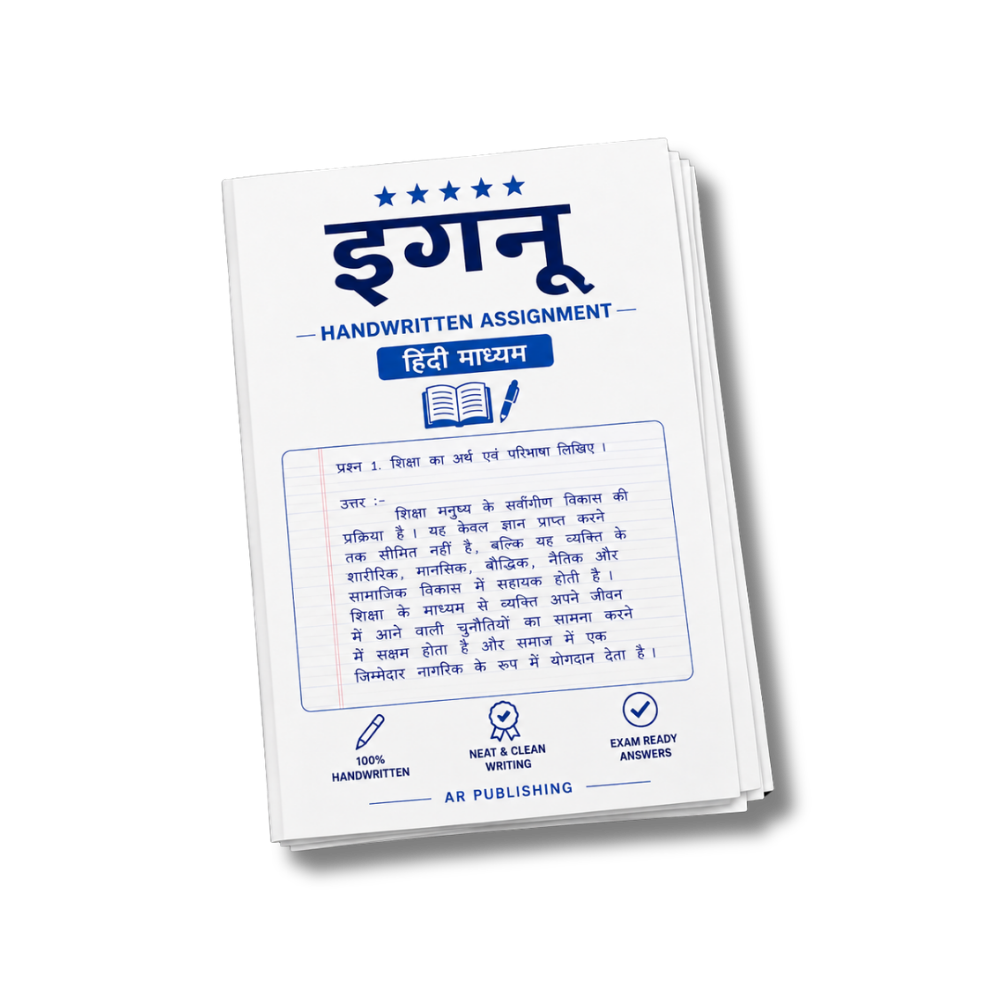
BAPI-003 IGNOU Handwritten Assignment 2026-27
Click to view offer details & terms
Get 10% OFF Instant Discount
Apply this coupon code at checkout to claim your academic discount instantly.
- Applicable on all university study materials
- Valid for up to 8 item(s) per order
- Valid till Oct 31, 2026
Enrolled in other IGNOU subjects?
Link your Enrollment No. to auto-map all your semester courses & free question papers.
Frequently Bought Together
Popular course materials frequently ordered together
Syllabus & Overview
Course Scope and Academic Objectives in BAPI-003: Economics and Marketing of Organic Produce
BAPI-003 is a specialized module within IGNOU’s Certificate in Organic Farming (COF) curriculum, designed to equip students with a rigorous understanding of the economic principles governing organic agricultural production and its commercialization. This course bridges theoretical frameworks with practical applications, emphasizing sustainable production systems, market dynamics, and strategic marketing approaches tailored to organic produce. Through structured analysis of cost-benefit assessments, demand-supply chains, and regulatory frameworks, students gain insights into optimizing resource allocation while adhering to organic certification standards. The curriculum ensures alignment with global organic trade trends, preparing learners to navigate challenges in certification, pricing strategies, and consumer behavior within the organic sector.Key Syllabus Units and Topics
- Block-1 Economics of Production: This unit explores the foundational economic theories underpinning organic farming, including cost analysis of organic inputs, labor efficiency, and land-use optimization. Students examine how organic production systems differ from conventional agriculture in terms of yield economics, risk management, and long-term sustainability metrics.
- Organic Farming Cost-Benefit Analysis: Focuses on methodologies for evaluating profitability in organic farming, incorporating variables like organic certification costs, premium pricing strategies, and government subsidies. The unit also covers break-even analysis and financial viability assessments for small-scale and large-scale organic operations.
- Block-2 Markets and Marketing: Delves into the structure of organic markets, including domestic and international trade dynamics, consumer preferences, and branding strategies. Topics include supply chain logistics, certification processes (e.g., USDA Organic, EU Organic), and the role of intermediaries in organic produce marketing.
- Consumer Behavior and Demand Elasticity: Analyzes how organic produce markets respond to price fluctuations, health trends, and ethical consumerism. The unit integrates economic models to predict demand shifts and design targeted marketing campaigns that leverage organic product differentiation.
- Regulatory Frameworks and Trade Policies: Examines the legal and policy environment governing organic trade, including import/export regulations, tariffs, and non-tariff barriers. Students explore how compliance with organic standards influences market access and competitive positioning in global organic supply chains.
Frequently Asked Questions
Q: What is the marking scheme for the BAPI-003 assignment, and how many marks are allocated to each section?
A: The BAPI-003 assignment carries a total of 30 marks, distributed across different units as per the IGNOU evaluation criteria. Typically, each block (e.g., Block-1 and Block-2) may account for 15 marks, with internal distribution based on the weightage of theoretical questions, case studies, and practical applications outlined in the assignment question paper.
Q: Are there specific pass marks required for the BAPI-003 assignment, and how does it contribute to the final course grade?
A: The pass marks for the BAPI-003 assignment are 50% of the total marks (i.e., 15 out of 30). While the assignment contributes significantly to the final grade, it is combined with the term-end examination (TEE) to determine the overall course result. The final grade is calculated based on a weighted average of the assignment and TEE scores, as per IGNOU’s evaluation policy.
Why buy from us?
-
Verified by top professors and 99th percentile students.
-
Always updated to the latest university curriculum.
-
High-quality, printable PDF formats with clear diagrams.
License & Terms
By purchasing this item, you agree to our standard academic license terms. You may use this product for personal study, but you may not resell or redistribute the files online.