

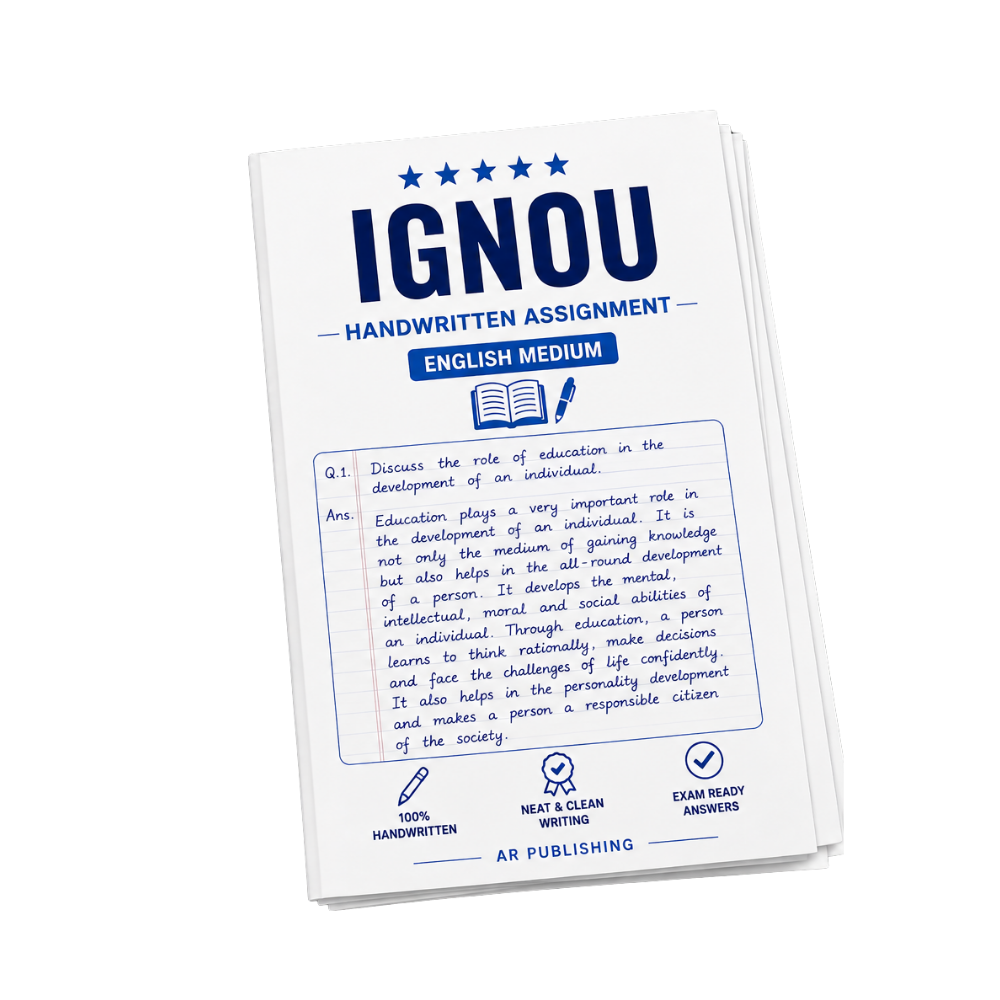
BBCCT-105 IGNOU Handwritten Assignment 2026-27
Click to view offer details & terms
Get 10% OFF Instant Discount
Apply this coupon code at checkout to claim your academic discount instantly.
- Applicable on all university study materials
- Valid for up to 8 item(s) per order
- Valid till Oct 31, 2026
Enrolled in other IGNOU subjects?
Link your Enrollment No. to auto-map all your semester courses & free question papers.
Frequently Bought Together
Popular course materials frequently ordered together
Syllabus & Overview
BBCCT-105 Proteins Physical Handwritten Assignment (Hard Copy)
This assignment is a 100% physical handwritten hard copy of the BBCCT-105 Proteins course, meticulously prepared by experienced academic scribes for the Bachelor of Science (Honours) in Biochemistry (BSCBCH) program under IGNOU’s School of Sciences. Each page is written on 80 GSM A4 ruled paper with clear, legible handwriting and includes the official IGNOU front page and printed question paper for seamless submission.
Key Syllabus Blocks Covered
- Block-1: Proteins Isolation and Separation
- Principles of protein extraction from biological sources (e.g., tissue homogenization, centrifugation techniques).
- Comparison of classical and modern separation methods (e.g., ammonium sulfate precipitation, gel filtration chromatography, SDS-PAGE).
- Role of pH, ionic strength, and denaturants in protein solubility and recovery.
- Block-2: Characterisation and Analysis of Proteins
- Spectroscopic techniques (UV-Vis, fluorescence, circular dichroism) for protein quantification and structural analysis.
- Electrophoretic methods (native-PAGE, SDS-PAGE, isoelectric focusing) and their applications in protein profiling.
- Mass spectrometry principles and its use in determining protein molecular weight and post-translational modifications.
- Block-3: Structure of Proteins
- Hierarchical structure of proteins (primary, secondary, tertiary, quaternary) with examples (e.g., hemoglobin, myoglobin).
- Role of disulfide bonds, hydrogen bonds, and hydrophobic interactions in protein folding.
- X-ray crystallography and NMR spectroscopy in elucidating protein 3D structures.
- Block-4: Diversity of Protein Function
- Classification of proteins based on function (enzymes, structural, transport, signaling, storage proteins).
- Mechanism of enzyme catalysis: Michaelis-Menten kinetics and allosteric regulation.
- Case studies of functionally diverse proteins (e.g., antibodies, motor proteins, regulatory proteins).
Assignment Features
- Neat, error-free handwritten content on 80 GSM A4 ruled paper for optimal readability.
- Includes the official IGNOU front page and printed question paper for direct submission.
- Delivered via Indian Speed Post to your registered address for timely study centre submission.
- Adheres to IGNOU’s marking scheme with 100% accuracy in answers and formatting.
Subject-Specific FAQs
- Q: How do I differentiate between denaturing and non-denaturing protein separation techniques?
A: Denaturing techniques (e.g., SDS-PAGE) disrupt secondary/tertiary structures using agents like SDS or urea, while non-denaturing methods (e.g., native-PAGE) preserve native protein conformations by avoiding harsh conditions.
- Q: Why is the quaternary structure of proteins critical in their biological function?
A: The quaternary structure enables proteins like hemoglobin to exhibit cooperative binding (e.g., oxygen affinity regulation) or catalytic efficiency (e.g., multi-subunit enzymes), which is unattainable in monomeric forms.
Note: This is a physical hard copy only. No digital files (PDF, downloads, or e-copies) are included. Submission-ready and compliant with IGNOU’s assignment guidelines.
Why buy from us?
-
Verified by top professors and 99th percentile students.
-
Always updated to the latest university curriculum.
-
High-quality, printable PDF formats with clear diagrams.
License & Terms
By purchasing this item, you agree to our standard academic license terms. You may use this product for personal study, but you may not resell or redistribute the files online.