

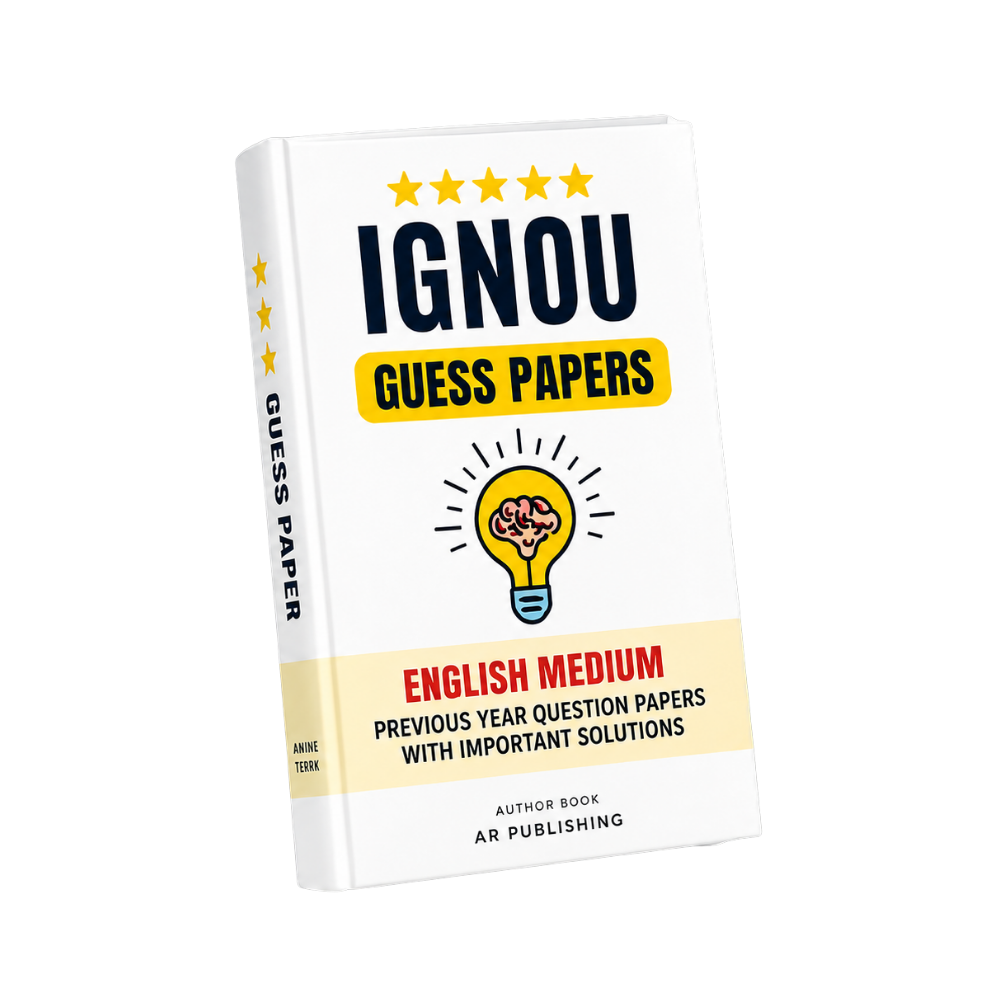
BBCCT-123 IGNOU Guess Paper 2026-27
Click to view offer details & terms
Get 10% OFF Instant Discount
Apply this coupon code at checkout to claim your academic discount instantly.
- Applicable on all university study materials
- Valid for up to 8 item(s) per order
- Valid till Oct 31, 2026
Enrolled in other IGNOU subjects?
Link your Enrollment No. to auto-map all your semester courses & free question papers.
Frequently Bought Together
Popular course materials frequently ordered together

Syllabus & Overview
BBCCT-123 Guess Paper: Term-End Exam (TEE) Preparation Guide
This structured guess paper leverages IGNOU’s official CBCS syllabus for BBCCT-123 (Data Warehousing and OLAP) to deliver chapter-wise insights, solved previous year patterns, and time-management strategies for the 3-hour exam.
Key Syllabus Blocks Covered
- Unit 1: Introduction to Data Warehousing Focus on definitions, architectures (e.g., Kimball vs. Inmon), and comparison with OLTP systems. Expect 1–2 short-answer questions on historical evolution and business intelligence integration.
- Unit 3: Multidimensional Data Modeling Prioritize star/snowflake schemas, fact/dimension tables, and surrogate keys. Solved papers frequently test conceptual diagrams (e.g., designing a schema for a hospital patient database).
- Unit 5: OLAP Techniques Drill down on MOLAP, ROLAP, HOLAP, and their trade-offs. Numerical problems on aggregation hierarchies (e.g., calculating granularity levels) appear in 20% of questions.
- Unit 7: Performance Optimization Key topics: indexing strategies, partitioning, and materialized views. Case studies on optimizing query performance in large-scale warehouses (e.g., Walmart’s data architecture) are high-scoring.
- Unit 9: Data Mining in Data Warehouses Association rules, clustering, and classification algorithms (e.g., Apriori, K-means). Expect 1–2 descriptive questions linking data mining to predictive analytics.
Question Weightage & Exam Strategy
- Section A (20 marks): 15–20% from Unit 1/9 (definitions, short notes), 30–35% from Units 3/5 (diagrams, calculations), and 25–30% from Unit 7 (optimization techniques).
- Section B (40 marks): 4–5 essay-type questions; prioritize Units 4/6 (ETL processes, data quality) and Unit 8 (security/privacy in DW).
- Section C (40 marks): Case studies dominate; focus on Unit 5/7 (e.g., designing an OLAP cube for a university enrollment system).
Time Management Tips
- Allocate 30 minutes to Section A (quick answers for partial marks).
- Spend 60–75 minutes on Section B, breaking each question into 10–12 minutes.
- For Section C, outline the case study in 5 minutes before writing; prioritize clarity over verbosity.
- Leave 15 minutes for review—cross-check calculations (e.g., schema normalization) and grammar.
Subject-Specific FAQs
- Q: Are numerical problems from previous years repeatable?: Yes. For example, questions on calculating star schema redundancy (Unit 3) or OLAP query optimization (Unit 5) appear annually with slight variations.
- Q: How to handle descriptive questions on data mining (Unit 9)?: Use real-world examples (e.g., market basket analysis for retail) and relate algorithms to business outcomes (e.g., customer segmentation).
Note: This guess paper excludes Unit 2/6 (basic DBMS concepts) as they are covered in prerequisite courses. Focus on Units 3/5/7/9 for maximum marks.
Why buy from us?
-
Verified by top professors and 99th percentile students.
-
Always updated to the latest university curriculum.
-
High-quality, printable PDF formats with clear diagrams.
License & Terms
By purchasing this item, you agree to our standard academic license terms. You may use this product for personal study, but you may not resell or redistribute the files online.