

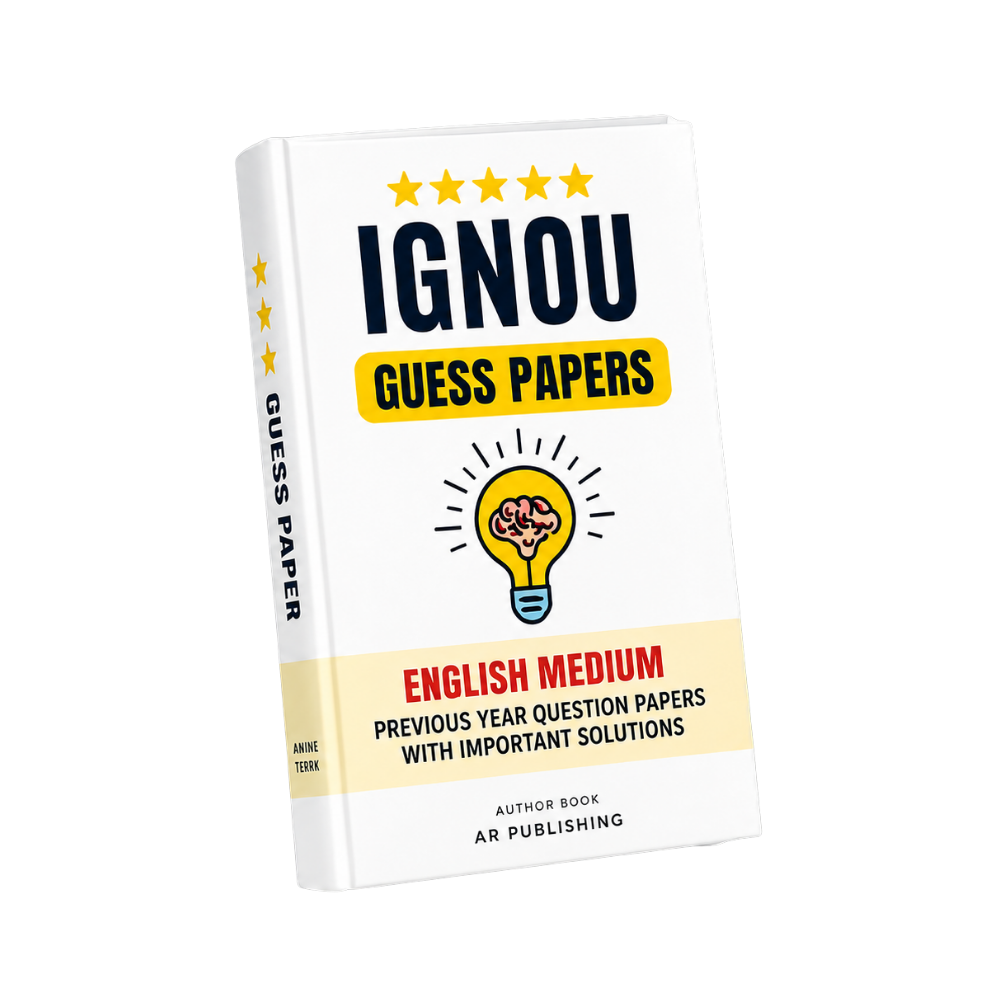
BCOE-142- IGNOU Guess Paper 2026-27
Click to view offer details & terms
Get 10% OFF Instant Discount
Apply this coupon code at checkout to claim your academic discount instantly.
- Applicable on all university study materials
- Valid for up to 8 item(s) per order
- Valid till Oct 31, 2026
Frequently Bought Together
Popular course materials frequently ordered together

Syllabus & Overview
BCOE-142 Management Accounting Term-End Exam (TEE) Guess Paper (June/Dec Sessions)
This structured guess paper aligns with the official IGNOU BCOE-142 syllabus and leverages trends from the last 5–10 years of Term-End Examinations (June/December sessions). It prioritizes high-weightage topics, question patterns, and time allocation to maximize scores in the 3-hour exam.
Key Syllabus Blocks Covered
- Block-1: Management Accounting Introduction and Basic Techniques
- Definition, objectives, and limitations of Management Accounting.
- Cost classification (direct/indirect, fixed/variable) with practical examples.
- Cost-volume-profit (CVP) analysis fundamentals (break-even point, margin of safety).
- Block-2: Budgeting and Budgetary Control
- Types of budgets (master budget, flexible budget) and their preparation.
- Budgetary control systems, variances (favorable/unfavorable), and corrective actions.
- Case studies on budgetary control in manufacturing and service sectors.
- Block-3: Standard Costing and Variance Analysis
- Standard cost systems, material, labor, and overhead variances.
- Analysis of variances (e.g., material price variance, labor efficiency variance).
- Applications of variance analysis in decision-making (e.g., cost reduction strategies).
- Block-4: Marginal Costing and Cost-Volume-Profit Analysis
- Marginal costing vs. absorption costing, contribution margin, and p/v ratio.
- Break-even analysis with graphical and mathematical methods.
- Multi-product break-even scenarios and sensitivity analysis.
- Block-5: Decision Making
- Relevant costs for short-term decisions (e.g., make-or-buy, special orders).
- Capital budgeting techniques (NPV, IRR, payback period) with case applications.
- Ethical considerations in managerial decision-making.
Exam Pattern & Question Weightage (Based on Previous Years)
The TEE typically follows this distribution:
- Block-1 & Block-2: 25% weightage (short answer questions on definitions, classifications, and basic calculations).
- Block-3 & Block-4: 40% weightage (long answer questions on variance analysis, CVP, and case studies).
- Block-5: 15% weightage (short/long answers on decision-making scenarios).
- Case Study/Application-Based Questions: 20% (integrated questions spanning 2–3 blocks).
3-Hour Exam Time Management Tips
- First 30 minutes: Skim the entire paper, allocate time per section (e.g., 40 mins for Block-3, 30 mins for Block-5).
- Short Answer Questions (SAQs): Answer 5–6 SAQs first (15–20 mins each), focusing on Blocks 1 and 2.
- Long Answer Questions (LAQs): Prioritize Blocks 3 and 4 (e.g., CVP analysis or variance explanation).
- Case Studies: Spend 40–45 mins on the highest-weightage case, using diagrams/graphs where applicable.
- Review Time: Allocate 10–15 mins at the end to cross-check calculations and clarity of answers.
Subject-Specific FAQs
- Q: How do I differentiate between absorption and marginal costing?
A: Absorption costing includes all manufacturing costs (fixed + variable) in inventory valuation, while marginal costing only variable costs. Marginal costing is preferred for short-term decision-making (e.g., special orders).
- Q: What are the common mistakes in CVP analysis?
A: Misclassifying costs (e.g., treating fixed costs as variable), ignoring tax implications, or incorrect break-even formula application. Always verify assumptions (e.g., linear demand).
Sample Question Patterns (Based on TEE Trends)
- Block-1: Explain the role of Management Accounting in cost control with an example. (10 marks)
- Block-2: Prepare a flexible budget for XYZ Ltd. for Q2 2024, given actual and planned activity levels. (15 marks)
- Block-3: Calculate material and labor variances for a manufacturing unit with given data. (12 marks)
- Block-4: Determine the break-even point for a company selling two products with different selling prices. (15 marks)
- Block-5: Evaluate whether to accept a special order using marginal costing principles. (10 marks)
Why buy from us?
-
Verified by top professors and 99th percentile students.
-
Always updated to the latest university curriculum.
-
High-quality, printable PDF formats with clear diagrams.
License & Terms
By purchasing this item, you agree to our standard academic license terms. You may use this product for personal study, but you may not resell or redistribute the files online.