

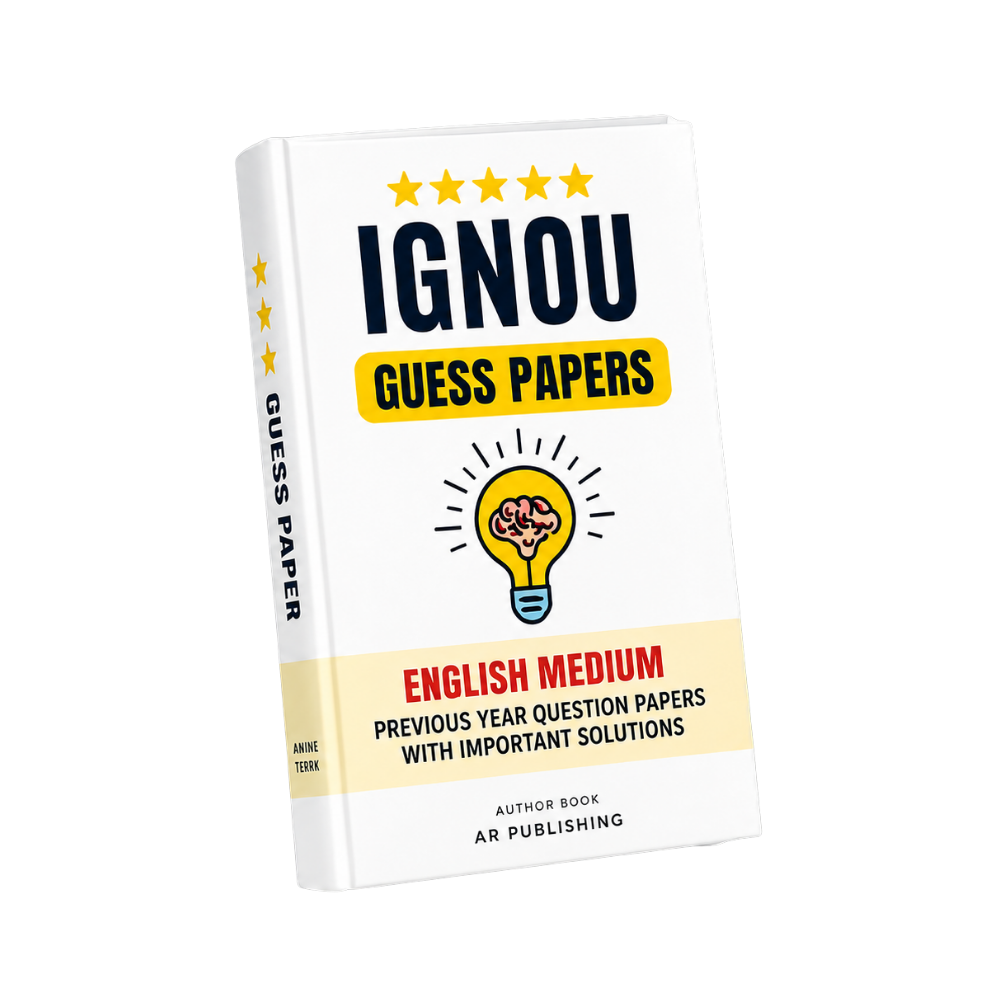
BCS-042 IGNOU Guess Paper 2026-27
Click to view offer details & terms
Get 10% OFF Instant Discount
Apply this coupon code at checkout to claim your academic discount instantly.
- Applicable on all university study materials
- Valid for up to 8 item(s) per order
- Valid till Oct 31, 2026
Enrolled in other IGNOU subjects?
Link your Enrollment No. to auto-map all your semester courses & free question papers.
Frequently Bought Together
Popular course materials frequently ordered together

Syllabus & Overview
BCS-042 Guess Paper: Introduction to Algorithm Design (Term-End Exam Focus)
This structured guess paper is designed to mirror the real exam pattern of BCS-042 (Introduction to Algorithm Design) based on the last 10 years of TEE question papers (June & December sessions). It emphasizes weighted topics from the official IGNOU curriculum, ensuring students can strategically allocate time during the 3-hour exam.
Key Syllabus Blocks & Question Weightage
- Block-1: Introduction to Algorithm
- Algorithms vs. programs (30-35% weightage in exams)
- Formal definition and properties (correctness, efficiency, termination)
- Problem-solving approaches (brute-force, divide-and-conquer, dynamic programming)
- Asymptotic analysis (20-25%)
- Big-O, Big-Θ, and Big-Ω notations with practical examples
- Time and space complexity analysis of basic algorithms (e.g., linear search, binary search)
- Algorithms vs. programs (30-35% weightage in exams)
- Block-2: Design Techniques
- Divide-and-Conquer (25-30%)
- Master theorem for analyzing recursive algorithms
- Practical examples: Merge Sort, Quick Sort, Strassen’s matrix multiplication
- Greedy Methods (15-20%)
- Huffman coding, Dijkstra’s algorithm, activity selection problem
- Proof techniques for greedy algorithms (exchange argument, optimal substructure)
- Dynamic Programming (20-25%)
- Fibonacci sequence, knapsack problem, shortest path (Floyd-Warshall)
- Overlapping subproblems and optimal substructure (with code snippets)
- Divide-and-Conquer (25-30%)
Exam Strategy & Time Management (3-Hour TEE)
Allocate time as follows for maximum scoring:
- First 45 minutes: Quickly solve 2-3 short-answer questions (10-15 marks) from Block-1 (e.g., asymptotic analysis or algorithm properties).
- Next 75 minutes: Tackle 2-3 long-answer questions (20-25 marks) from Block-2, prioritizing divide-and-conquer or dynamic programming with pseudocode.
- Last 45 minutes: Revise answers, add missing steps, and attempt remaining questions if time permits.
Frequently Asked Questions (FAQs)
Q1: Are pseudocode implementations mandatory in BCS-042 exams? A: Yes. The exam often expects pseudocode for algorithms like Merge Sort or Dijkstra’s algorithm to demonstrate understanding of design steps. Focus on clarity and correctness over syntax. Q2: How can I differentiate between Big-O, Big-Θ, and Big-Ω in exams? A: Use the tightness criterion:- Big-O: Upper bound (e.g., O(n²) for any n² ≤ f(n))
- Big-Θ: Tight bound (e.g., Θ(n log n) for both upper and lower bounds)
- Big-Ω: Lower bound (e.g., Ω(log n) for any log n ≥ g(n))
Sample Question Patterns (Based on Past Papers)
- Block-1 Focus:
- Compare time complexity of linear search vs. binary search (20 marks).
- Explain why an algorithm with O(n²) time complexity is inefficient for large datasets (10 marks).
- Block-2 Focus:
- Design a greedy algorithm to solve the coin change problem (25 marks).
- Apply dynamic programming to solve the 0/1 knapsack problem with pseudocode (30 marks).
Note: Always refer to the official IGNOU study material for Block-3 (Graph Algorithms) and Block-4 (Algorithm Complexity) if time permits, as these occasionally appear in TEE.
Why buy from us?
-
Verified by top professors and 99th percentile students.
-
Always updated to the latest university curriculum.
-
High-quality, printable PDF formats with clear diagrams.
License & Terms
By purchasing this item, you agree to our standard academic license terms. You may use this product for personal study, but you may not resell or redistribute the files online.