

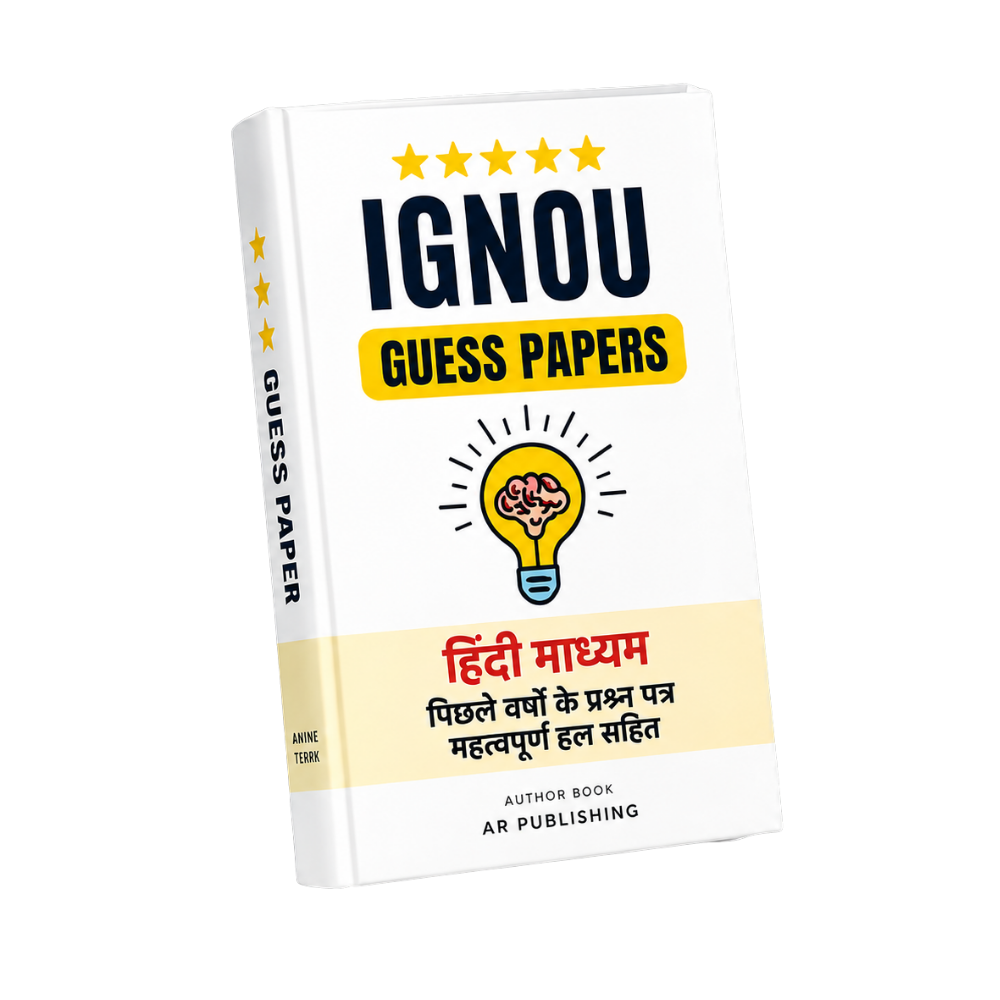
BCSL-159 IGNOU Guess Paper 2026-27
Click to view offer details & terms
Get 10% OFF Instant Discount
Apply this coupon code at checkout to claim your academic discount instantly.
- Applicable on all university study materials
- Valid for up to 8 item(s) per order
- Valid till Oct 31, 2026
Enrolled in other IGNOU subjects?
Link your Enrollment No. to auto-map all your semester courses & free question papers.
Frequently Bought Together
Popular course materials frequently ordered together
Syllabus & Overview
Course Scope & Syllabus Overview
BCSL-159: Introduction to Algorithm Design Lab is a hands-on course within the IGNOU Bachelor of Computer Applications (BCA_New) curriculum, designed to bridge theoretical algorithmic principles with practical implementation. This lab-based subject focuses on developing foundational skills in designing, analyzing, and optimizing algorithms—critical for software development, system performance tuning, and problem-solving in computational domains. The course emphasizes iterative problem decomposition, pseudocode formulation, and real-time debugging, aligning with the School of Computer and Information Sciences’ (SOCIS) emphasis on applied learning. This guide leverages solved past question papers to help students internalize core concepts like time/space complexity, greedy algorithms, and divide-and-conquer strategies, ensuring exam readiness through targeted revision.Key Syllabus Units & Topics
- Unit 1: Algorithm Design Techniques: Covers fundamental paradigms including brute-force, divide-and-conquer, dynamic programming, and greedy methods. Students analyze classic examples like the Tower of Hanoi, knapsack problem, and shortest-path algorithms to grasp trade-offs between efficiency and correctness.
- Unit 2: Complexity Analysis & Asymptotic Notation: Explores Big-O, Omega, and Theta notations to quantify algorithmic performance. Practical exercises involve deriving time/space complexities for sorting algorithms (e.g., QuickSort, MergeSort) and graph traversals (BFS/DFS).
- Unit 3: Recursion & Backtracking: Focuses on recursive problem-solving (e.g., Fibonacci sequence, factorial) and backtracking techniques for constraint satisfaction (e.g., N-Queens puzzle). Lab assignments simulate recursive implementations in programming languages.
- Unit 4: Graph Algorithms & Applications: Introduces graph representations (adjacency matrix/list), traversal algorithms, and pathfinding (Dijkstra’s, Prim’s). Practical sessions include modeling real-world networks (e.g., social graphs, transportation routes).
- Unit 5: Heuristics & Metaheuristics: Examines approximation algorithms (e.g., for NP-hard problems) and metaheuristics like genetic algorithms. Students evaluate trade-offs between exact solutions and practical feasibility in computational scenarios.
Frequently Asked Questions
Q: How are marks distributed in the BCSL-159 Term-End Examination (TEE), and what weightage does the practical component carry?
A: The TEE for BCSL-159 typically follows a 70% theory + 30% practical split, with the lab component assessing coding assignments, algorithmic debugging, and time complexity analysis. Refer to the latest IGNOU syllabus for cycle-specific updates, as weightage may vary slightly.
Q: Are there recurring questions in past TEE papers for BCSL-159, and how can I identify high-probability topics?
A: Yes, questions on dynamic programming (e.g., Fibonacci sequence optimization) and graph algorithms (e.g., shortest path proofs) frequently repeat. This guide highlights such patterns, along with chapter-wise question weightage, to prioritize revision based on empirical data from the last 5–10 years’ papers.
Why buy from us?
-
Verified by top professors and 99th percentile students.
-
Always updated to the latest university curriculum.
-
High-quality, printable PDF formats with clear diagrams.
License & Terms
By purchasing this item, you agree to our standard academic license terms. You may use this product for personal study, but you may not resell or redistribute the files online.