

BECC-112 IGNOU Solved Assignment 2026-27
Click to view offer details & terms
Get 10% OFF Instant Discount
Apply this coupon code at checkout to claim your academic discount instantly.
- Applicable on all university study materials
- Valid for up to 8 item(s) per order
- Valid till Oct 31, 2026
Enrolled in other IGNOU subjects?
Link your Enrollment No. to auto-map all your semester courses & free question papers.
Frequently Bought Together
Popular course materials frequently ordered together
Syllabus & Overview
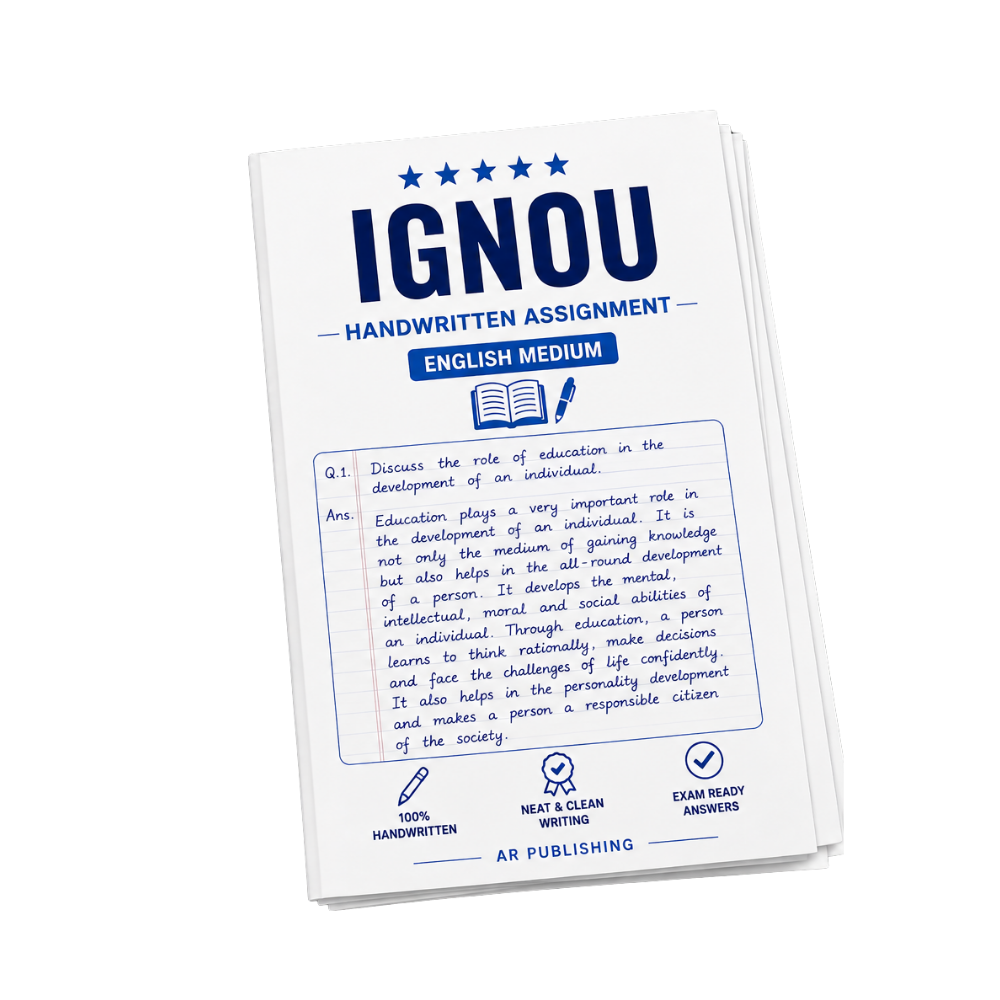
BECC-112 Solved Assignment: Development Economics-I (TMA-01 & TMA-02)
The BECC-112 Development Economics-I solved assignment provides plagiarism-free, university-verified solutions for Tutor Marked Assignments (TMAs) under the Bachelor of Arts (Honours) Economics program. Below are key solved units aligned with the official IGNOU curriculum for Blocks 1–4, including critical analysis, case studies, and quantitative exercises.
Block 1: Growth and Development
- Unit 1: Concepts of Growth and Development
Solutions include definitions of absolute vs. relative growth, HDI decomposition, and case studies comparing India’s GDP growth with poverty reduction. Explanation of the UNDP’s Human Development Index with sample calculations (e.g., life expectancy, education index).
- Unit 2: Measurement of Development
Discusses PQLI (Physical Quality of Life Index) vs. GDP per capita, with a solved example comparing Pakistan and Bangladesh (2022 data). Addresses limitations of GDP as a development metric.
Block 2: Growth Models (Theory and Evidence)
- Unit 3: Neoclassical Growth Model
Explains Solow-Swan model with steady-state equilibrium calculations, including solved problems for capital accumulation (K*) and technological progress (A). References India’s per capita income trends (1980–2023).
- Unit 4: Endogenous Growth Theory
Critiques Romer’s and Lucas’ models with solved exercises on human capital (H) and R&D (R) growth equations. Includes a case study on South Korea’s technological leapfrogging.
Block 3: Inequality and Poverty
- Unit 5: Measurement of Inequality
Step-by-step solutions for Lorenz Curve and Gini Coefficient (G) using hypothetical income distribution data. Compares India’s Gini ratio (2022: 0.536) with Brazil’s (0.548).
- Unit 6: Poverty Alleviation Strategies
Analyzes NITI Aayog’s Multi-Dimensional Poverty Index (MPI) with solved scenarios for deprivation in education/health. Discusses conditional cash transfers (e.g., India’s PM-KISAN).
Block 4: Political Institutions and the State
- Unit 7: Role of the State in Development
Evaluates Rostow’s Stages of Growth with a critique of India’s pre-liberalization (1960s) state intervention. Includes solved exercises on fiscal policy multipliers (GDP impact of public spending).
- Unit 8: Political Economy of Development
Discusses Acemoglu and Robinson’s institutional theory with solved case studies on India’s agrarian reforms vs. Bangladesh’s land redistribution. Links political stability to growth rates.
FAQs for BECC-112 TMA Solutions
Q1: Are solutions provided in English/Hindi?The assignment solutions are available in English (primary) with Hindi translations
Why buy from us?
-
Verified by top professors and 99th percentile students.
-
Always updated to the latest university curriculum.
-
High-quality, printable PDF formats with clear diagrams.
License & Terms
By purchasing this item, you agree to our standard academic license terms. You may use this product for personal study, but you may not resell or redistribute the files online.