

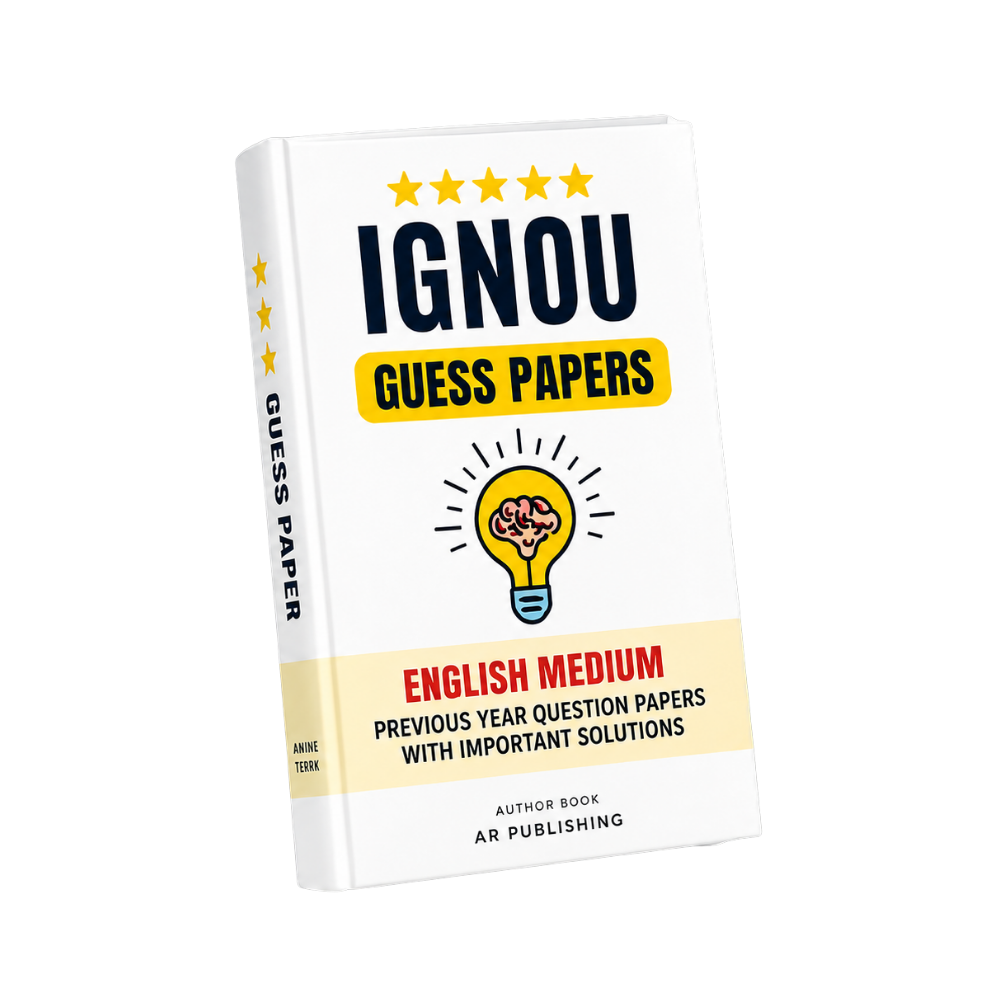
BECE-002 IGNOU Guess Paper 2026-27
Click to view offer details & terms
Get 10% OFF Instant Discount
Apply this coupon code at checkout to claim your academic discount instantly.
- Applicable on all university study materials
- Valid for up to 8 item(s) per order
- Valid till Oct 31, 2026
Frequently Bought Together
Popular course materials frequently ordered together
Syllabus & Overview
Course Scope & Syllabus Overview for BECE-002: Indian Economic Development: Issues and Perspectives
BECE-002 is a core course under IGNOU’s Bachelor’s Degree in Arts (English) within the School of Social Sciences, designed to critically examine India’s economic trajectory from historical perspectives to contemporary challenges. Aligned with the CBCS framework, this course explores macroeconomic policies, sectoral dynamics, and developmental disparities while integrating theoretical frameworks with empirical evidence. The syllabus emphasizes analytical thinking, policy evaluation, and evidence-based problem-solving, equipping students to assess India’s economic growth, resource allocation, and social equity through structured academic blocks.Key Syllabus Units & Topics
- Block-1: Approaches to Development: Evaluates diverse theoretical models—such as Rostow’s stages of growth, dependency theory, and structuralist perspectives—to analyze India’s developmental pathways, highlighting their strengths and limitations in explaining economic transformation.
- Block-2: Resources for Development: Examines the role of natural, human, and financial resources in sustaining economic growth, with a focus on India’s demographic dividend, land reforms, and fiscal strategies for resource mobilization.
- Block-3: Fiscal and Monetary Issues: Analyzes government budgets, taxation policies, and monetary tools (e.g., RBI interventions) to address inflation, fiscal deficits, and inclusive growth, using case studies of India’s Five-Year Plans.
- Block-4: Agricultural Sector: Assesses agrarian reforms, Green Revolution impacts, and challenges like land fragmentation and rural poverty, while exploring policy reforms under the National Food Security Act.
- Block-6: External Sector: Investigates trade policies, balance of payments, and foreign direct investment (FDI) trends, critiquing India’s globalization strategies and their implications for employment and industrialization.
Frequently Asked Questions
Q: What is the marking scheme for BECE-002 Term-End Examination (TEE), and how are internal assignments weighted?
A: The TEE for BECE-002 carries 100 marks, with assignments (typically 2–3) accounting for 30% of the total grade, while the final exam constitutes 70%. Assignments focus on case studies and short essays, requiring precise application of course concepts.
Q: Are there recurring themes in BECE-002 exams, and how can students prioritize revision based on past papers?
A: Themes like fiscal policy impacts, agricultural sustainability, and external sector challenges frequently recur. Prioritize revision by analyzing 5–10 years of solved TEE papers (available in the eGyanKosh) to identify high-weightage topics and repeated questions, particularly from Blocks 3 and 6.
Why buy from us?
-
Verified by top professors and 99th percentile students.
-
Always updated to the latest university curriculum.
-
High-quality, printable PDF formats with clear diagrams.
License & Terms
By purchasing this item, you agree to our standard academic license terms. You may use this product for personal study, but you may not resell or redistribute the files online.