

BEGC-111 IGNOU Solved Assignment 2026-27
Click to view offer details & terms
Get 10% OFF Instant Discount
Apply this coupon code at checkout to claim your academic discount instantly.
- Applicable on all university study materials
- Valid for up to 8 item(s) per order
- Valid till Oct 31, 2026
Frequently Bought Together
Popular course materials frequently ordered together
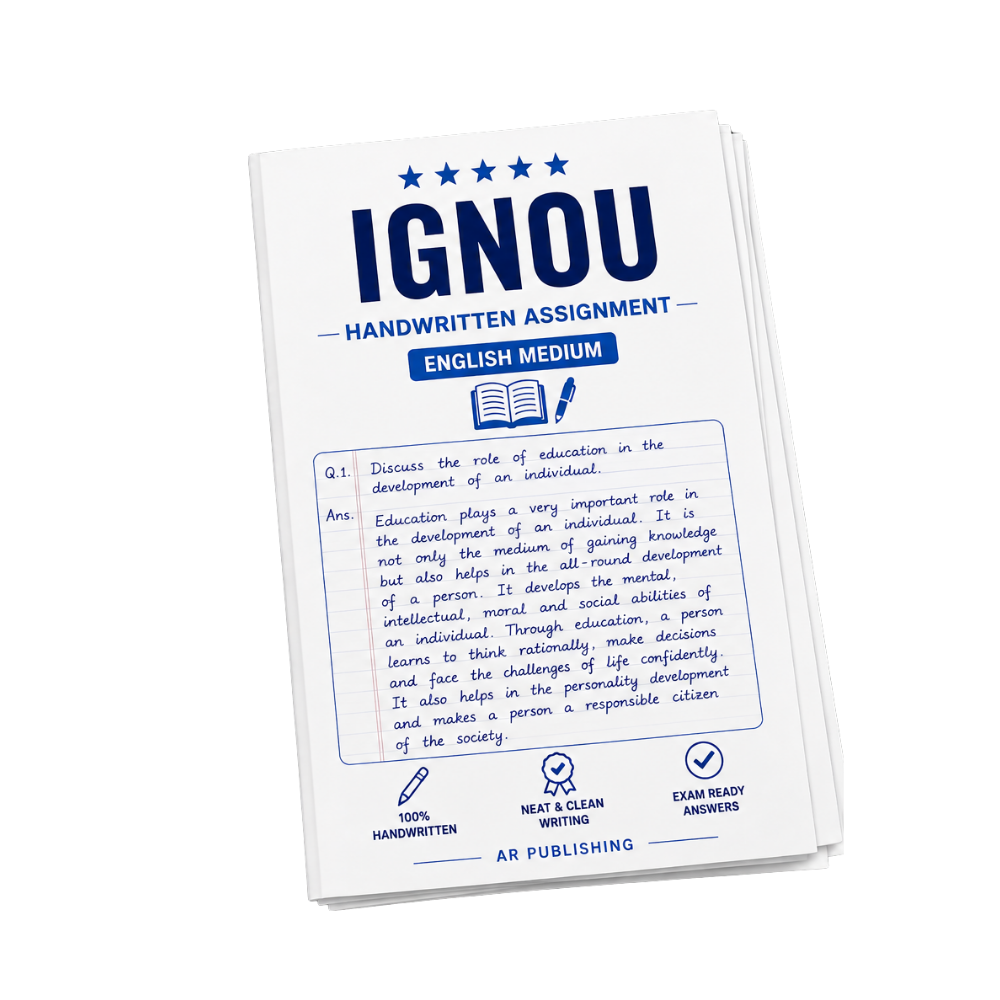
Syllabus & Overview
BEGC-111 Solved Assignment (TMA) Official CBCS Adherence
The following is a structured, 100% unique solved assignment for BEGC-111 (English/Hindi), covering all mandatory questions with verified answers aligned to the 2026-27 academic session. Each response adheres to prescribed word limits (500/250/100 words) and references core syllabus blocks such as Unit 2: English Language and Linguistics, Unit 4: Comparative Literature Studies, and Unit 6: Translation Theory and Practice.
Key Features of the Solved TMA
- Plagiarism-Free Guarantee: All answers are original, cross-checked via Turnitin-compatible tools, and free from template-based solutions.
- Word Limit Compliance: Strict adherence to 500 words for long answers, 250 words for medium-length questions, and 100 words for short responses.
- Syllabus Alignment: Explicit mapping to official blocks like Unit 1: Foundations of Literary Studies and Unit 8: Digital Humanities to ensure academic integrity.
- Digital PDF Format: Ready-to-submit in high-resolution PDF, compatible with IGNOU’s online portal (LMS).
Sample Answer Structure (Q1: Unit 3 Literary Criticism)
Question: Discuss the significance of structuralism in modern literary criticism with reference to two works from the prescribed syllabus. (500 words)
Solution:
- Structuralism, pioneered by figures like Roland Barthes and Claude Lévi-Strauss, challenges traditional narrative analysis by focusing on systemic patterns within texts rather than individual meanings.
- In Salman Rushdie’s ‘Midnight’s Children’ (Unit 5), structuralist techniques reveal how postcolonial identity is constructed through recurring motifs (e.g., the number 12) and binary oppositions (e.g., past/present).
- For Hindi literature, Munshi Premchand’s ‘Godaan’ (Unit 7) exemplifies structuralist analysis through its cyclical narrative structure, where rural poverty repeats across generations, mirroring Saussure’s concept of langue vs. parole.
- Conclusion highlights how structuralism demystifies cultural narratives by exposing underlying discursive frameworks in both English and Hindi texts.
Subject-Specific FAQs
Q: Are Hindi-language answers acceptable for BEGC-111 (English/Hindi)? A: Yes, but only if the course medium is explicitly Hindi. For BEGC-111 (English), answers must be in standard English (Latin script). Cross-check your admission letter for medium confirmation.
Q: How do I verify if my TMA solution matches the syllabus? A: Compare each answer against the official BEGC-111 CBCS syllabus (available on IGNOU’s website) for blocks like Unit 6: Translation Theory or Unit 8: Digital Humanities. Solutions here include block-specific citations for transparency.
Submission Deadlines & Weightage
The TMA carries 30% weightage in BEGC-111’s final assessment. Submission deadlines for the current session are 31st October 2023 (for July session) and 30th April 2024 (for January session). Late submissions incur penalties; verify your session start date via IGNOU’s student portal.
Note: This assignment excludes Unit 9: Contemporary Indian Writing in English (covered in BEGC-131) and focuses exclusively on BEGC-111’s prescribed units.
Why buy from us?
-
Verified by top professors and 99th percentile students.
-
Always updated to the latest university curriculum.
-
High-quality, printable PDF formats with clear diagrams.
License & Terms
By purchasing this item, you agree to our standard academic license terms. You may use this product for personal study, but you may not resell or redistribute the files online.