

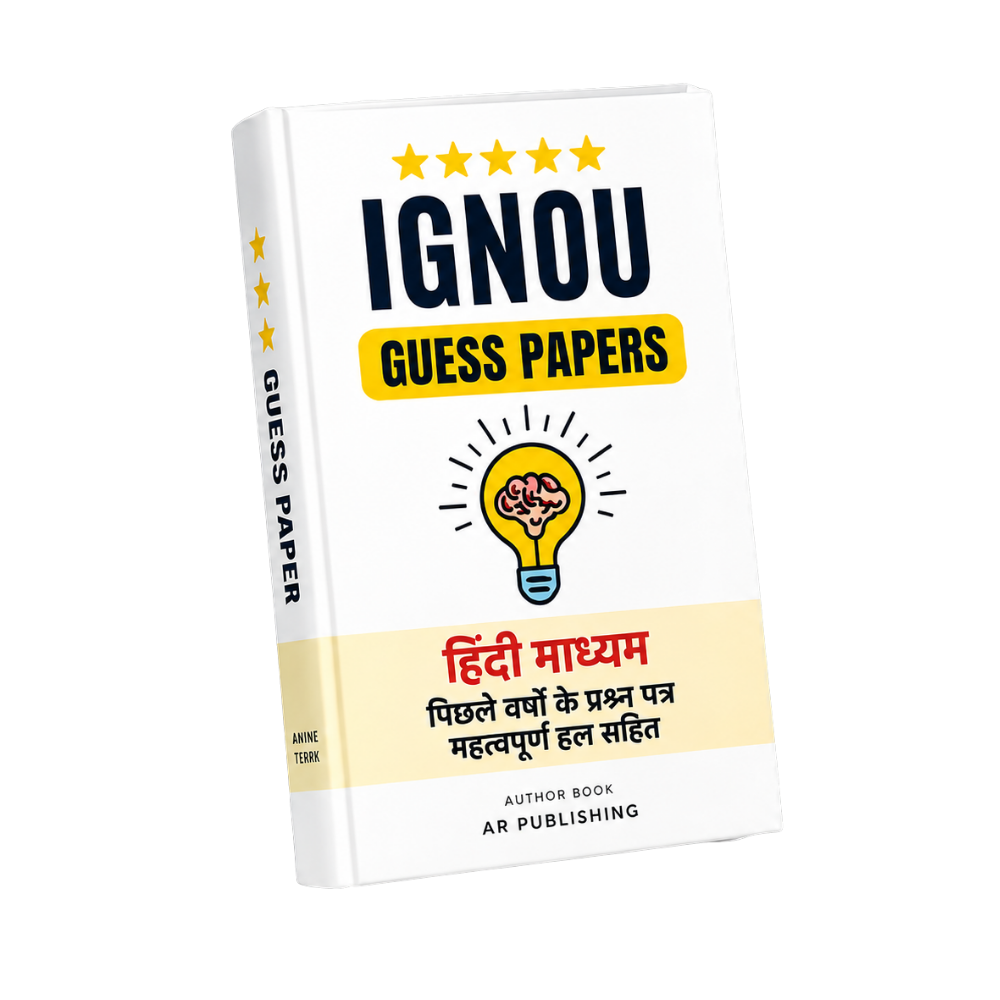
BEGG-172 IGNOU Guess Paper 2026-27
Click to view offer details & terms
Get 10% OFF Instant Discount
Apply this coupon code at checkout to claim your academic discount instantly.
- Applicable on all university study materials
- Valid for up to 8 item(s) per order
- Valid till Oct 31, 2026
Frequently Bought Together
Popular course materials frequently ordered together
Syllabus & Overview
BEGG-172 Guess Paper: Language and Linguistics (Term-End Exam Focus)
This structured guess paper aligns with IGNOU’s official BEGG-172 syllabus, emphasizing high-scoring units from previous TEE sessions (2018–2023). Prioritize these blocks for maximum marks:
Key Syllabus Blocks & Question Weightage
- Block-1: The Nature of Language
- Focus on definitions, characteristics (arbitrariness, productivity), and language vs. speech distinctions. Expect 1–2 short-answer questions (SAQs) and 1 descriptive question (20 marks).
- Common past topics: Saussure’s signifier-signified model, language universals, and acquisition vs. learning.
- Block-2: Sounds of English
- Phonetics (IPA symbols) and phonology (phonemes vs. allophones) dominate. Allocate 30% of time to practice transcribing words (e.g., /θ/ vs. /ð/).
- Past exam trends: Minimal pairs, stress/tone patterns, and articulatory phonetics (e.g., bilabial vs. alveolar sounds).
- Block-3: Word Formation Strategies
- Derivation (prefixes/suffixes), compounding, and blending are high-yield. Memorize affix lists (e.g., un-, -ness) and practice forming new words.
- Descriptive questions often ask to analyze a sentence for word formation processes (e.g., ‘bookish’ derivation + suffixation).
- Block-4: Sentence Type: Form and Function
- Divide time equally between declarative/interrogative/imperative/exclamatory forms and grammatical vs. rhetorical functions (e.g., requests vs. commands).
- Past papers favor sentence transformation exercises (e.g., converting declarative to interrogative) and function analysis (e.g., ‘Close the door!’ imperative with directive function).
3-Hour Exam Time Management
- First 30 mins: Skim all questions. Answer 2 SAQs (10 marks each) from Blocks 1 or 3 first—they’re quicker to score.
- Next 60 mins: Tackle Block-2 phonetics (transcription) and Block-4 sentence analysis. Use IPA charts for reference if needed.
- Final 90 mins: Dedicate to the 20-mark descriptive question (Block-1 or 4). Structure answers with theory examples analysis.
Subject-Specific FAQs
- Q: Are phonetic diagrams (e.g., IPA) allowed in the exam?
A: Yes, but only for transcription tasks. Avoid excessive diagrams; focus on accuracy and clarity.
- Q: How to handle ambiguous word formation questions?
A: Cite multiple possible strategies (e.g., ‘blackboard’ could be compounding or blending) and justify with examples.
Past Paper Patterns (June/Dec 2026-27)
- Objective questions (20 marks): 8–10 MCQs on Blocks 1–2 (phrases, definitions).
- Short answers (30 marks): 3 questions (10 marks each) from Blocks 3–4 (word formation, sentence analysis).
- Long answer (50 marks): 1 question from Block-1 or 4 (theory + application).
Why buy from us?
-
Verified by top professors and 99th percentile students.
-
Always updated to the latest university curriculum.
-
High-quality, printable PDF formats with clear diagrams.
License & Terms
By purchasing this item, you agree to our standard academic license terms. You may use this product for personal study, but you may not resell or redistribute the files online.