

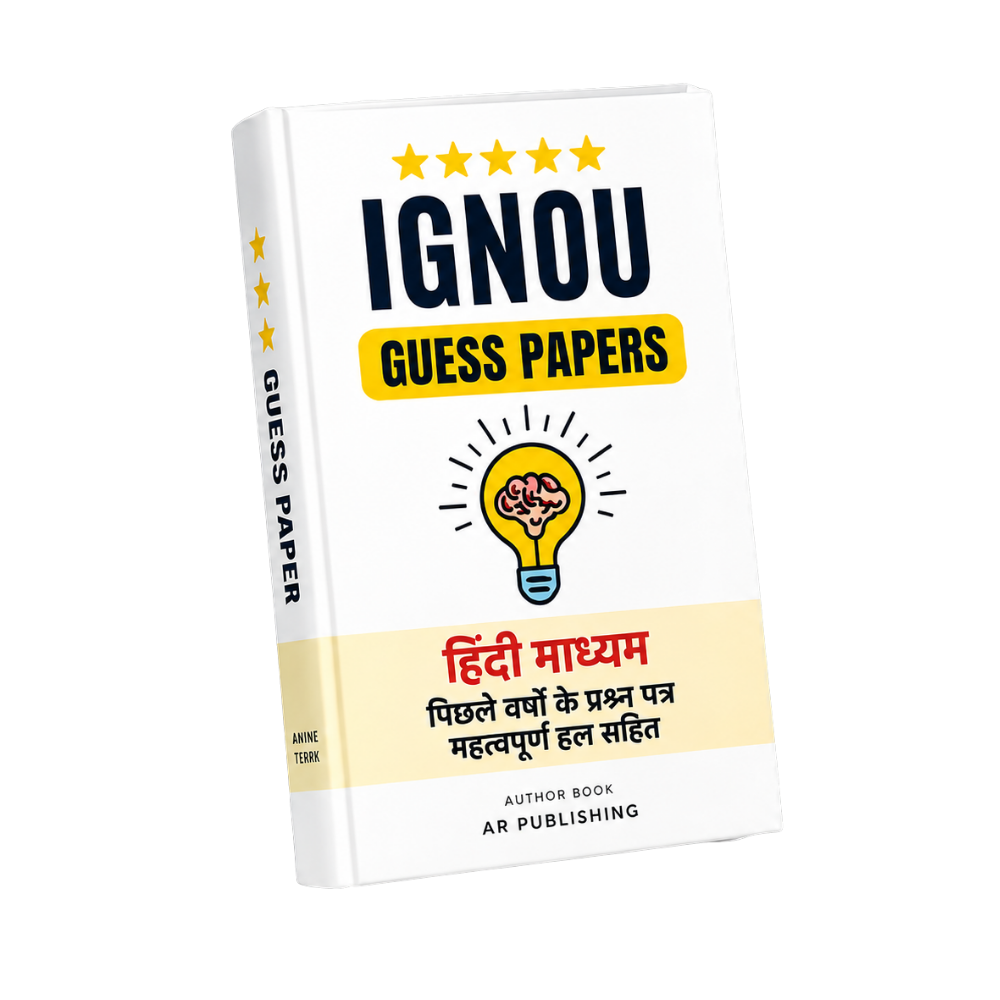
BEV-003 IGNOU Guess Paper 2026-27
Click to view offer details & terms
Get 10% OFF Instant Discount
Apply this coupon code at checkout to claim your academic discount instantly.
- Applicable on all university study materials
- Valid for up to 8 item(s) per order
- Valid till Oct 31, 2026
Enrolled in other IGNOU subjects?
Link your Enrollment No. to auto-map all your semester courses & free question papers.
Frequently Bought Together
Popular course materials frequently ordered together
Syllabus & Overview
BEV-003 Guess Paper: Term-End Exam (TEE) Preparation Guide
This digital PDF-style guess paper is designed for BEV-003 (, ), covering 3-hour exam strategies and previous year question trends. Focus areas are derived from IGNOU’s official curriculum blocks, with a 1:1 mapping of syllabus units to high-probability questions.
Key Syllabus Units & Question Weightage
- -1:
- Expected questions: 20–25% (3–4 questions)
- Plastic waste segregation codes (IS 14594:2019) and recycling processes for PET/PVC.
- Case studies on microplastic pollution in water bodies (Ganga/ Yamuna basins).
- Role of Extended Producer Responsibility (EPR) under the Plastic Waste Management Rules, 2022.
- Expected questions: 20–25% (3–4 questions)
- -2:
- Expected questions: 15–20% (2–3 questions)
- E-waste dismantling techniques for CRT monitors vs. LCD screens (comparative analysis).
- Regulatory frameworks: E-Waste (Management) Rules, 2016 vs. Basel Convention compliance.
- Toxic metals (lead, mercury) extraction from printed circuit boards (PCBs).
- Expected questions: 15–20% (2–3 questions)
- -3:
- Expected questions: 20–25% (3–4 questions)
- Autoclave vs. incineration for biomedical waste sterilization (cost-benefit analysis).
- Sharps waste handling protocols in hospitals (IS 15000:2020).
- Biomedical waste segregation at source: color-coding standards.
- Expected questions: 20–25% (3–4 questions)
- -4:
- Expected questions: 15–20% (2–3 questions)
- Construction waste recycling: crushed concrete aggregates for road construction.
- Demolition waste characterization (metallic vs. non-metallic fractions).
- Swachh Bharat Mission 2.0 integration for urban construction site waste.
- Expected questions: 15–20% (2–3 questions)
- Cross-Cutting Topics (10–15%)
- Life Cycle Assessment (LCA) for plastic/packaging waste.
- International treaties: Stockholm Convention on persistent organic pollutants (POPs).
Exam Time Management Tips
- Allocate 45 minutes for -1 and -3 (high-weightage units).
- Spend 30 minutes on numerical/calculation-based questions (e.g., waste volume reduction formulas).
- Prioritize case studies and regulatory compliance questions (2–3 marks each).
- Leave 5 minutes for reviewing answers in -4 (construction waste).
Subject-Specific FAQs
- Q: Are practical-based questions included in TEE for BEV-003?
Theory-heavy (80–85%), but 1–2 short-answer questions may test lab-based concepts (e.g., autoclave temperature settings for biomedical waste).
- Q: How to differentiate between hazardous and non-hazardous e-waste?
Refer to Annexure III of E-Waste Rules, 2016, which classifies devices by toxic metal content (e.g., CRT TVs as hazardous due to lead).
Why buy from us?
-
Verified by top professors and 99th percentile students.
-
Always updated to the latest university curriculum.
-
High-quality, printable PDF formats with clear diagrams.
License & Terms
By purchasing this item, you agree to our standard academic license terms. You may use this product for personal study, but you may not resell or redistribute the files online.