

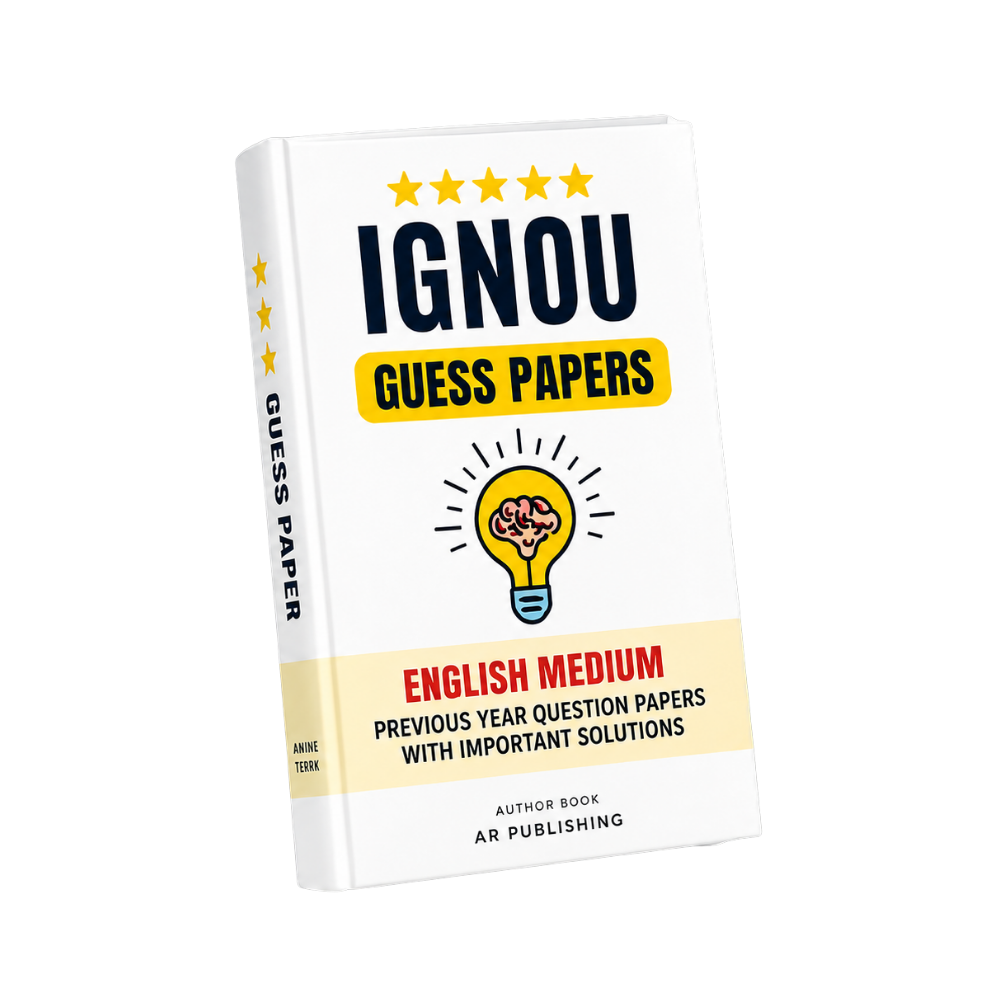
BGS-011 IGNOU Guess Paper 2026-27
Click to view offer details & terms
Get 10% OFF Instant Discount
Apply this coupon code at checkout to claim your academic discount instantly.
- Applicable on all university study materials
- Valid for up to 8 item(s) per order
- Valid till Oct 31, 2026
Frequently Bought Together
Popular course materials frequently ordered together
Syllabus & Overview
BGS-011 Guess Paper: Understanding Gender and Law Term-End Exam (TEE) Preparation
This structured guess paper aligns with the official IGNOU curriculum for BGS-011 (Understanding Gender and Law), focusing on key blocks and high-weightage topics from past term-end exams (June & December sessions). It includes chapter-wise question distribution, time management strategies, and solved question patterns.
Key Blocks & Focus Areas (Official IGNOU Syllabus)
- Block 1: Understanding Gender
- Critical analysis of gender as a social construct (Patriarchy, essentialism, intersectionality).
- Key theories: Feminist perspectives (Liberal, Radical, Marxist, Postcolonial).
- Case studies: Gender roles in Indian society (Rural/Urban contexts).
- Block 2: Understanding Law
- Legal frameworks: Constitutional provisions (Article 14, 15, 19, 21) and gender justice.
- Judicial precedents: Visakha Guidelines, Section 377, Mithu vs. State of Punjab.
- International conventions: CEDAW, Beijing Platform for Action.
- Block 3: Power and Subordination
- Power structures: Hegemonic masculinity, caste-gender intersections.
- Legal subordination: Dowry Prohibition Act, Protection of Women from Domestic Violence Act.
- Critical analysis: Gender and criminal justice (Trafficking, sexual harassment).
Exam Pattern & Question Weightage (Past 5-10 Years)
The Term-End Exam (TEE) for BGS-011 follows a 100-mark distribution:
- Block 1 (Understanding Gender): 30 marks
- Short-answer questions (10 marks): Gender theories, case studies.
- Long-answer questions (20 marks): Comparative analysis of feminist perspectives.
- Block 2 (Understanding Law): 40 marks
- Case-based questions (15 marks): Constitutional and judicial analysis.
- Essay-type questions (25 marks): Legal reforms and gender justice.
- Block 3 (Power and Subordination): 30 marks
- Critical commentary (15 marks): Power dynamics in legal systems.
- Application-based questions (15 marks): Policy analysis (e.g., Domestic Violence Act).
3-Hour Exam Time Management Tips
- First 30 minutes: Skim the entire question paper to identify high-weightage sections (e.g., Block 2 for law).
- Allocate time:
- Short answers (10 marks): 15-20 minutes per question.
- Long answers (20-25 marks): 30-40 minutes per question.
- Case studies (15-20 marks): 25-30 minutes with structured analysis.
- Avoid: Overwriting on short-answer questions; prioritize clarity and precision.
Subject-Specific FAQs
- Q: Which case study carries the highest weightage in past exams?
The Visakha Guidelines (1997) and Section 377 decriminalization (2018) frequently appear as high-weightage case studies in Block 2.
- Q: Are there recurring themes in Block 3 (Power and Subordination)?
Yes. Exams often test intersectionality (caste-gender) and legal subordination in domestic violence cases. Focus on the Protection of Women from Domestic Violence Act, 2005.
Previous Year Question Trends
Commonly asked topics from past exams include:
- Gender and constitutional rights (Article 15(1) vs. 15(3)).
- Critique of liberal feminism vs. radical feminism.
- Analysis of the Dowry Prohibition Act, 1961 and its loopholes.
- Role of NGOs in gender justice (e.g., Beti Bachao Beti Padhao).
Why buy from us?
-
Verified by top professors and 99th percentile students.
-
Always updated to the latest university curriculum.
-
High-quality, printable PDF formats with clear diagrams.
License & Terms
By purchasing this item, you agree to our standard academic license terms. You may use this product for personal study, but you may not resell or redistribute the files online.