

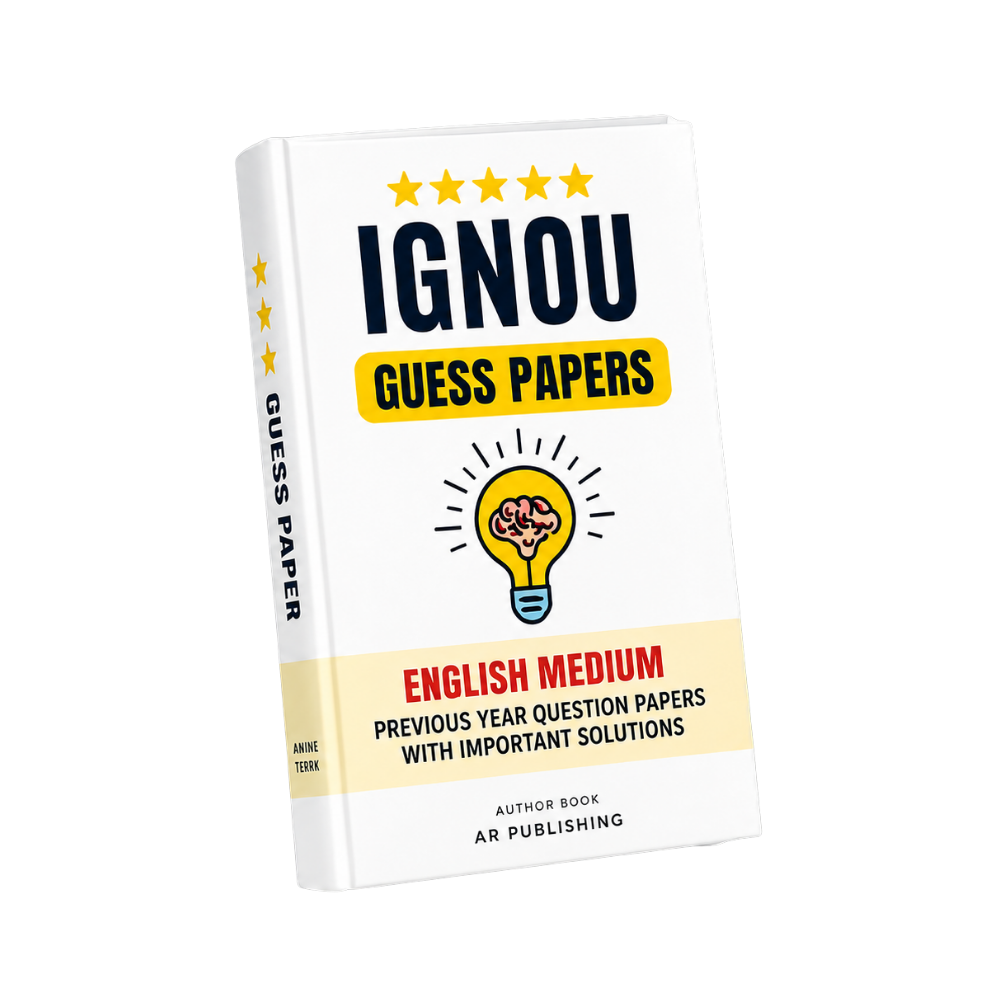
BGYCT-133 IGNOU Guess Paper 2026-27
Click to view offer details & terms
Get 10% OFF Instant Discount
Apply this coupon code at checkout to claim your academic discount instantly.
- Applicable on all university study materials
- Valid for up to 8 item(s) per order
- Valid till Oct 31, 2026
Enrolled in other IGNOU subjects?
Link your Enrollment No. to auto-map all your semester courses & free question papers.
Frequently Bought Together
Popular course materials frequently ordered together

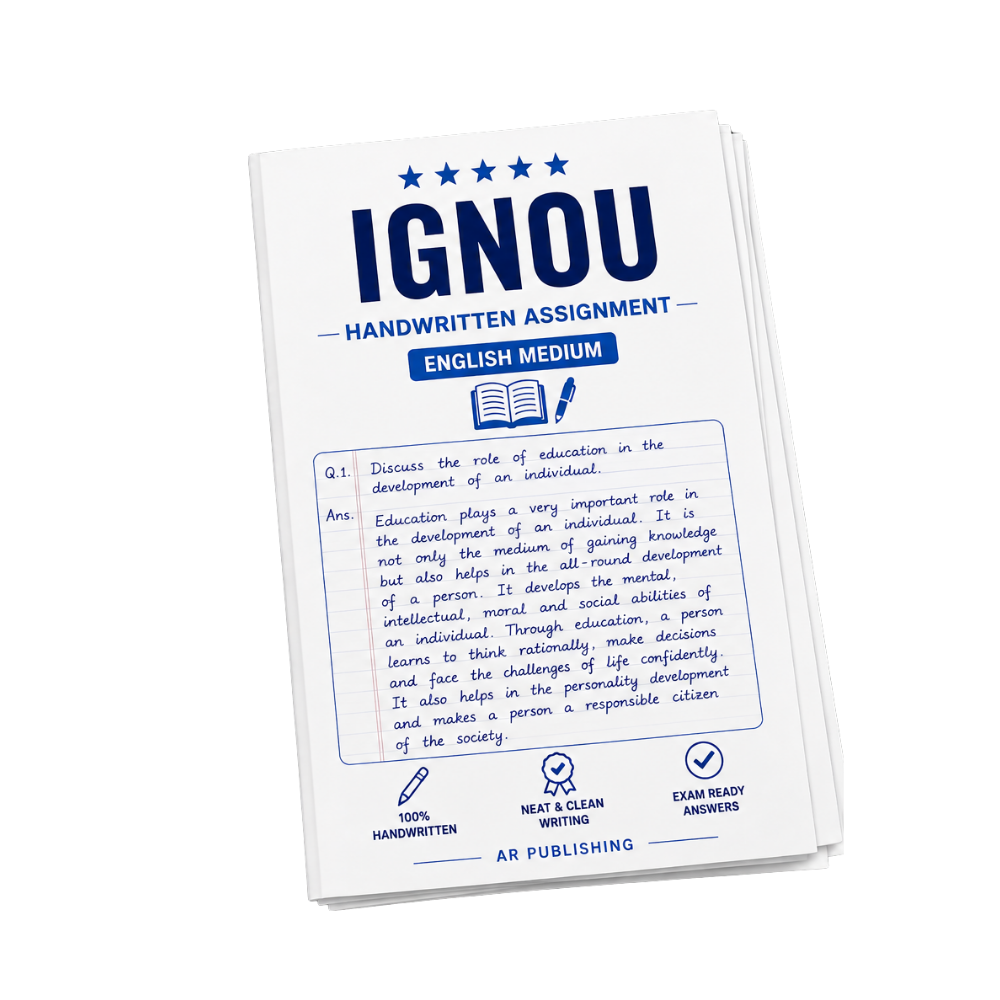
Syllabus & Overview
BGYCT-133 Guess Paper: Crystallography, Mineralogy and Economic Geology
This structured guide targets high-weightage topics from the official IGNOU curriculum for BGYCT-133, covering Blocks 1–4 with a focus on exam-relevant questions and patterns from the last 5–10 years.
Key Blocks & Focus Areas
- Block 1: Crystallography and Mineralogy
- Lattice systems and crystal symmetry (Bravais lattices, point groups).
- X-ray diffraction principles and Bragg’s Law (common exam question).
- Silicate mineral classification (orthosilicates, phyllosilicates).
- Block 2: Mineralogy
- Non-silicate minerals (carbonates, sulfides, oxides) with emphasis on diagnostic properties.
- Mineral identification techniques (hardness, cleavage, streak tests).
- Common ore minerals (e.g., hematite, galena, bauxite) and their economic significance.
- Block 3: Optical Mineralogy
- Polarizing microscopy basics (isotropic vs. anisotropic minerals).
- Optic axial angle and birefringence calculations (frequently tested).
- Identification of plagioclase vs. alkali feldspars under crossed polars.
- Block 4: Economic Geology
- Magmatic, sedimentary, and metamorphic ore deposits (case studies: copper, gold, iron).
- Geological mapping and prospecting techniques (remote sensing, geophysical methods).
- Environmental impact of mining (acid mine drainage, tailings management).
Exam Strategy & Previous Year Trends
Based on TEE patterns, 50–60% of questions originate from Blocks 1 and 3, while Block 4 often includes 2–3 descriptive questions on economic minerals. Short-answer questions (20 marks) prioritize crystallography principles and mineral identification, while long answers (30 marks) focus on optical properties or economic geology case studies.
Time Management Tips
- Allocate 45 minutes for crystallography/mineralogy (20 marks), 60 minutes for optical mineralogy (30 marks), and 60 minutes for economic geology (30 marks).
- Sketch crystal habit diagrams or optical diagrams for partial credit.
- Memorize diagnostic tables (e.g., hardness scale, cleavage angles) for quick reference.
Subject-Specific FAQs
- Q: How do I differentiate between twinning and zoning in feldspars?
A: Twinning appears as symmetric repetition of crystal faces (e.g., Carlsbad twinning in orthoclase), while zoning shows compositional bands (e.g., antiperthitic texture). Use polarizing microscopy to observe extinction angles.
- Q: Are there common mistakes in X-ray diffraction questions?
A: Students often confuse d-spacing with interplanar spacing (d = nλ/2sinθ). Always verify Bragg’s Law calculations with given λ (e.g., Cu-Kα = 1.54 Å).
Why buy from us?
-
Verified by top professors and 99th percentile students.
-
Always updated to the latest university curriculum.
-
High-quality, printable PDF formats with clear diagrams.
License & Terms
By purchasing this item, you agree to our standard academic license terms. You may use this product for personal study, but you may not resell or redistribute the files online.