

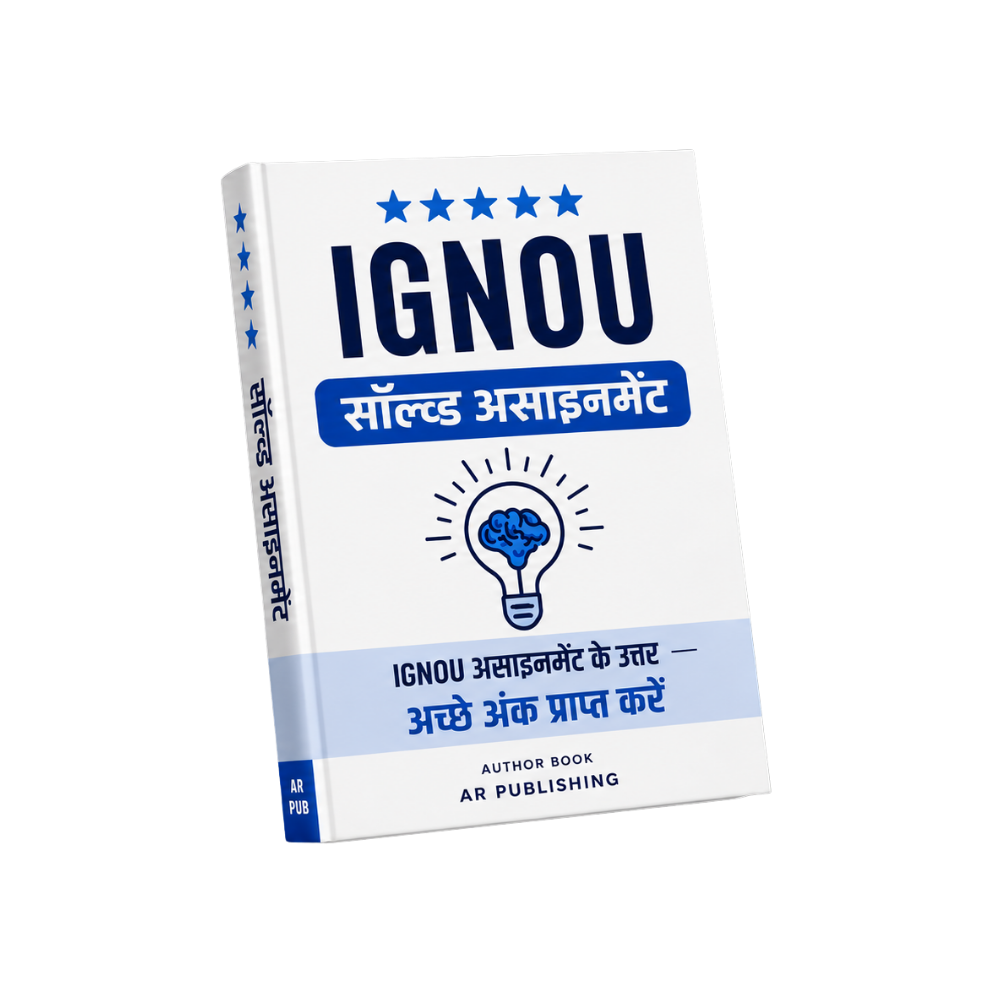
BHDC-107 IGNOU Solved Assignment 2026-27
Click to view offer details & terms
Get 10% OFF Instant Discount
Apply this coupon code at checkout to claim your academic discount instantly.
- Applicable on all university study materials
- Valid for up to 8 item(s) per order
- Valid till Oct 31, 2026
Enrolled in other IGNOU subjects?
Link your Enrollment No. to auto-map all your semester courses & free question papers.
Frequently Bought Together
Popular course materials frequently ordered together
Syllabus & Overview
BHDC-107 Solved Assignment (TMA) Overview
The TMA for BHDC-107 focuses on Plato’s Ion (Unit 1), Aristotle’s Poetics (Unit 2), and Coleridge’s Biographia Literaria (Unit 5)—core units from the official BAAHD curriculum. Solutions are structured to meet IGNOU’s 500-word (Q1/Q2), 250-word (Q3/Q4), and 100-word (Q5/Q6) constraints while ensuring academic integrity.
Key Syllabus Units Covered
- Unit 1: Plato’s Ion
Analyzes Plato’s critique of poetry as a ‘divine madness’ (thiasos) and its role in mimetic theory. Solutions compare Plato’s Ion with Aristotle’s Poetics on the nature of poetic inspiration (poiesis) and its ethical implications.
- Unit 2: Aristotle’s Poetics
Explores Aristotle’s definition of tragedy (mimesis), catharsis, and the ‘unity of action.’ Solutions dissect how Poetics establishes poetic justice (dikaiosyne) and its contrast with Plato’s form-based aesthetics.
- Unit 5: Coleridge’s Biographia Literaria
Focuses on Coleridge’s ‘willing suspension of disbelief’ and the ‘Fancy vs. Imagination’ dichotomy. Solutions link his theory to Romanticism’s emphasis on the sublime and the role of the poet as a ‘prophet.’
- Unit 10: New Criticism
Covers I.A. Richards’ Practical Criticism and T.S. Eliot’s ‘Tradition and the Individual Talent.’ Solutions analyze how New Criticism prioritizes textual closure and ‘objective correlatives.’
- Unit 14: Stylistics (Shailey Vigyan)
Discusses linguistic approaches to poetry, including Halliday’s functional grammar and Leech’s stylistic devices. Solutions apply these frameworks to analyze Hindi/English poetic translations.
Sample Solution Structure (Q1: Plato’s Ion)
Question: Critically evaluate Plato’s argument in Ion that poetry is not a craft but a divine gift.
- Answer:
Plato’s Ion presents Socrates’ dialogue with the rhapsode Ion, where poetry is dismissed as thiasos—a state of divine possession rather than a rational craft (techne). This aligns with his broader critique in Republic (Book X), where poets are excluded from the ideal state due to their reliance on illusion (eikasia). However, Ion’s inability to explain his own art underscores Plato’s skepticism toward mimetic theory’s ethical foundations. Solutions contrast this with Aristotle’s Poetics, which later redefines poetry as a structured mimesis—a craft grounded in probability (ethos) and necessity (dianoia).
FAQs
- Q: Are solutions provided in both Hindi and English?
Yes. All answers are bilingual, adhering to IGNOU’s BAAHD guidelines for Hindi-medium and English-medium students. Key terms (e.g., mimesis, thiasos) are translated with scholarly references.
- Q: How do solutions handle word limits?
Each question is answered within strict word limits (e.g., 500 words for Q1/Q2) using concise analysis, direct quotes from texts, and minimal paraphrasing. Citations follow IGNOU’s Harvard-style referencing.
Assignment Submission Notes
Why buy from us?
-
Verified by top professors and 99th percentile students.
-
Always updated to the latest university curriculum.
-
High-quality, printable PDF formats with clear diagrams.
License & Terms
By purchasing this item, you agree to our standard academic license terms. You may use this product for personal study, but you may not resell or redistribute the files online.