

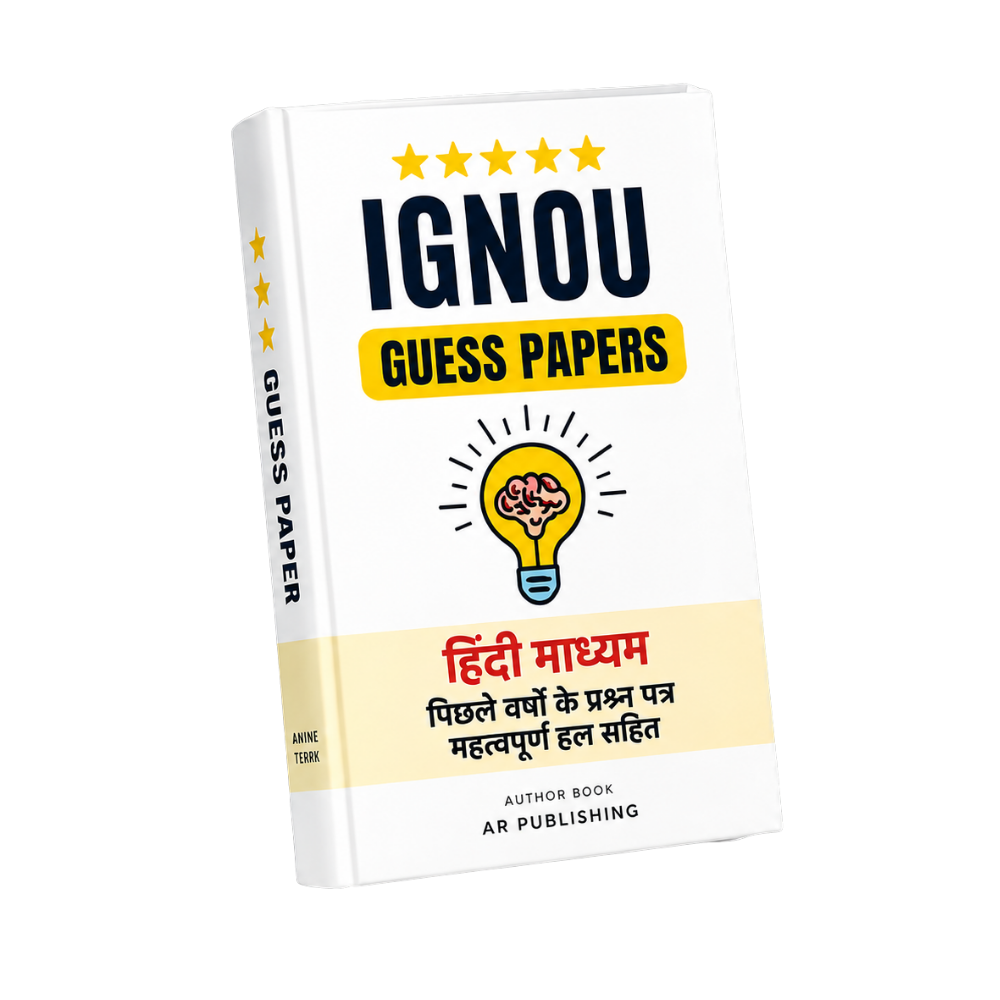
BHIC-104 IGNOU Guess Paper 2026-27
Click to view offer details & terms
Get 10% OFF Instant Discount
Apply this coupon code at checkout to claim your academic discount instantly.
- Applicable on all university study materials
- Valid for up to 8 item(s) per order
- Valid till Oct 31, 2026
Enrolled in other IGNOU subjects?
Link your Enrollment No. to auto-map all your semester courses & free question papers.
Frequently Bought Together
Popular course materials frequently ordered together


Syllabus & Overview
Course Scope and Syllabus Overview
BHIC-104: Social Formations and Cultural Patterns of the Medieval World is a core component of the Bachelor of Arts (Honours) History (BAHIH) curriculum under IGNOU’s School of Social Sciences. This course critically examines the socio-political structures, economic systems, and cultural dynamics that defined the medieval period (c. 500–1800 CE) across South Asia, Europe, and beyond. Rooted in archaeological evidence, textual sources, and anthropological methodologies, the syllabus explores how feudalism, religious syncretism, and trade networks shaped societal hierarchies, artistic expressions, and governance models. Students engage with primary sources, comparative case studies, and theoretical frameworks to analyze continuity and change in medieval societies, preparing them for rigorous term-end assessments that emphasize analytical depth over rote memorization.Key Syllabus Units and Topics
- Unit 1: Feudalism and Political Structures: Investigates the evolution of feudal hierarchies in Europe and South Asia, including the roles of kings, vassals, and local elites, with emphasis on legal codes (e.g., Mansabdari system) and military organization.
- Unit 2: Religious Syncretism and Cultural Exchange: Analyzes the interplay between Hinduism, Islam, Buddhism, and local traditions during the medieval period, focusing on synagogues, Sufi orders, and temple architecture as sites of cultural negotiation.
- Unit 3: Economic Systems and Trade Networks: Examines agrarian economies, guilds, and transregional trade routes (e.g., Silk Road, Indian Ocean networks), linking material culture (e.g., pottery, textiles) to broader economic power structures.
- Unit 4: Gender and Social Hierarchies: Critiques medieval gender roles through textual and material evidence, including women’s agency in religious institutions, royal courts, and domestic spheres, with comparisons to European and Islamic contexts.
- Unit 5: Archaeological and Textual Sources: Evaluates methodologies for interpreting medieval history, from epigraphic records (Aihole inscriptions) to archaeological excavations (e.g., Gwalior’s medieval fortifications), emphasizing source criticism and contextual analysis.
Frequently Asked Questions
Q: How are marks distributed in BHIC-104’s Term-End Examination (TEE), and what weightage does each question type carry?
A: The TEE for BHIC-104 follows a 100-mark pattern: 70 marks for essay-type questions (300–400 words) and 30 marks for short-answer questions (50–100 words). Essay questions typically cover 2–3 units, while short answers test specific topics or theoretical concepts; prioritize revising high-weightage units (e.g., Feudalism and Religious Syncretism) based on past papers.
Q: Are assignments mandatory for BHIC-104, and how do they impact the final grade?
A: Assignments contribute 30% to the total grade (70% from TEE), and they are submitted via the IGNOU portal before the deadline. Focus on assignments that align with TEE themes (e.g., case studies on medieval trade or gender roles) to reinforce conceptual understanding and improve analytical writing skills for exams.
Why buy from us?
-
Verified by top professors and 99th percentile students.
-
Always updated to the latest university curriculum.
-
High-quality, printable PDF formats with clear diagrams.
License & Terms
By purchasing this item, you agree to our standard academic license terms. You may use this product for personal study, but you may not resell or redistribute the files online.