

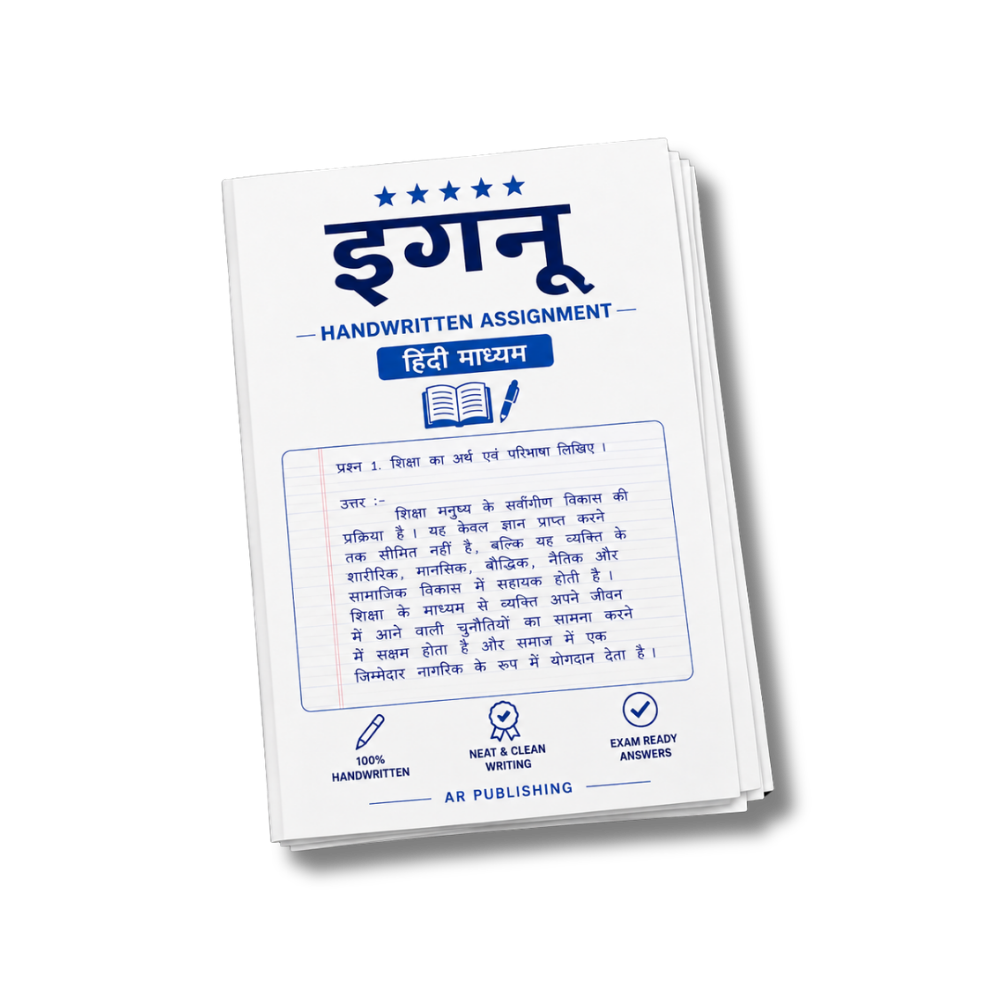
BHIE-141 IGNOU Handwritten Assignment 2026-27
Click to view offer details & terms
Get 10% OFF Instant Discount
Apply this coupon code at checkout to claim your academic discount instantly.
- Applicable on all university study materials
- Valid for up to 8 item(s) per order
- Valid till Oct 31, 2026
Frequently Bought Together
Popular course materials frequently ordered together
Syllabus & Overview
Course Scope & Syllabus Overview for BHIE-141: History of China (C. 1840–1978)
BHIE-141: History of China C. 1840–1978 is a core course under IGNOU’s Bachelor of Arts (BAG) programme, designed to critically examine China’s transformative 20th-century trajectory from colonial confrontation to revolutionary governance. This syllabus bridges historical analysis with political and social theory, exploring pivotal moments like the Opium Wars, nationalist uprisings, and the rise of Maoist communism. Students engage with primary sources, ideological shifts, and regional dynamics, fostering a nuanced understanding of China’s modern identity formation. The curriculum aligns with the CBCS framework, emphasizing interdisciplinary connections between imperial decline, revolutionary ideologies, and Cold War geopolitics.Key Syllabus Units & Topics
- Unit-10: Foreign Investment and Rise of New Class: Analyzes the economic and social repercussions of Western capitalism in late Qing China, including the emergence of merchant elites, industrialization efforts, and the formation of proto-bourgeois classes under colonial pressures.
- Unit-13: Struggle for Control: The Communist Party and the Guomindang: Examines the ideological and military rivalry between the CCP and GMD post-1927, focusing on the Long March, United Front strategies, and the fracturing of revolutionary alliances during Japan’s invasion.
- Unit-15: The Chinese Revolution: Traces the CCP’s consolidation of power from the Yan’an period to the 1949 victory, emphasizing land reform, peasant mobilization, and the ideological underpinnings of Maoist governance.
- Unit-6: Self-Strengthening Movement and the Hundred Days’ Reforms: Evaluates Qing dynasty reforms (1860s–1898) to modernize military and administrative structures, contrasting top-down imperial initiatives with grassroots nationalist dissent.
- Unit-4: Taiping Uprising: Explores the socio-religious rebellion (1850–1864) as a catalyst for Qing collapse, analyzing its gender dynamics, regional impact, and the state’s violent suppression tactics.
Frequently Asked Questions
Q: What is the marking scheme for BHIE-141 assignments, and how many questions are typically assigned per unit?
A: Assignments for BHIE-141 follow a 20-mark weightage (20% of total course grade), with 2–3 questions per unit. Each question carries equal marks, and answers must adhere to 2–3 pages per question (handwritten).
Q: Are there prescribed textbooks for BHIE-141, or can students rely solely on study materials?
A: While IGNOU’s History of China study materials (Block Notes) are mandatory, supplementary references like The Cambridge History of China (Vol. 12–13) and Red Star Over China by Edgar Snow are recommended for deeper analysis. Always cross-verify with the official syllabus.
Why buy from us?
-
Verified by top professors and 99th percentile students.
-
Always updated to the latest university curriculum.
-
High-quality, printable PDF formats with clear diagrams.
License & Terms
By purchasing this item, you agree to our standard academic license terms. You may use this product for personal study, but you may not resell or redistribute the files online.