


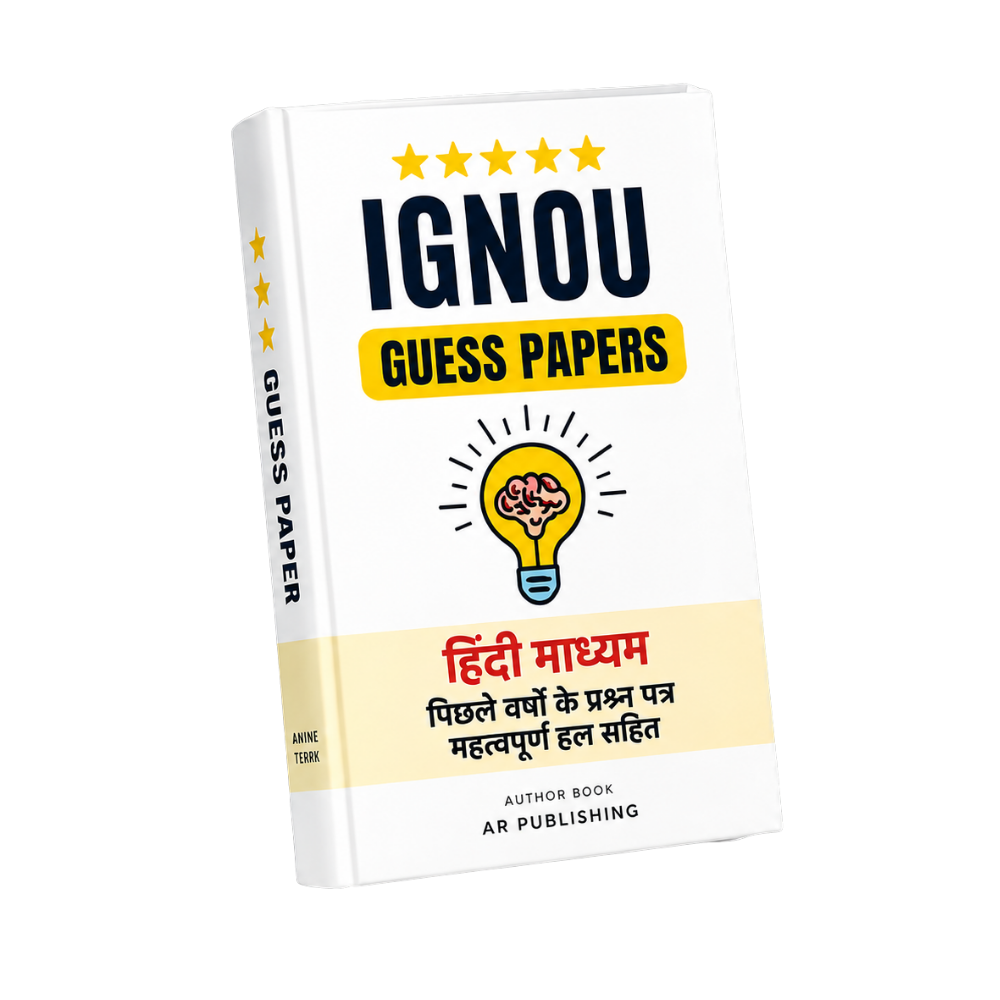
BHIE-143 IGNOU Guess Paper 2026-27
Click to view offer details & terms
Get 10% OFF Instant Discount
Apply this coupon code at checkout to claim your academic discount instantly.
- Applicable on all university study materials
- Valid for up to 8 item(s) per order
- Valid till Oct 31, 2026
Frequently Bought Together
Popular course materials frequently ordered together
Syllabus & Overview
Course Scope & Syllabus Overview: BHIE-143 History of Environment (IGNOU BAG Programme)
BHIE-143: History of Environment is a core course under the Bachelor of Arts (BAG) programme within IGNOU’s School of Social Sciences, designed to critically examine the interplay between human societies and environmental dynamics across historical epochs. This course spans pre-historic, ancient, medieval, and modern periods, analyzing how environmental concerns evolved from indigenous resource management to global policy frameworks. Through thematic units, students explore ecological degradation, conservation strategies, and the socio-political dimensions of environmentalism—from colonial-era exploitation to contemporary sustainability debates. The syllabus integrates primary sources, archaeological evidence, and theoretical frameworks to contextualize environmental history within broader historical narratives, ensuring students develop analytical skills to assess human-environmental interactions critically.
Key Syllabus Units & Topics
- Unit-1: Studying Environmental Concerns in History A Perspective: Introduces methodological approaches to environmental history, emphasizing interdisciplinary tools like archaeology, anthropology, and climate science to reconstruct past ecological systems and human adaptations.
- Unit-3: Environment and Early Societies II River Valley Civilizations: Investigates the ecological foundations of civilizations such as the Indus Valley, Mesopotamia, and ancient Egypt, analyzing water management, deforestation, and agricultural expansion as drivers of societal evolution.
- Unit-8: Colonialism and Environment Green Imperialism: Examines how colonial powers exploited natural resources (e.g., timber, minerals) while suppressing indigenous knowledge, framing environmental degradation as a byproduct of imperial economic policies.
- Unit-11: Gender and Environment: Deciphers the gendered dimensions of environmental labor, resource access, and conservation movements, highlighting how women’s roles in traditional ecological knowledge systems were often marginalized in historical narratives.
- Unit-12: Role of UN, NGOs, and International Agreements: Evaluates the formation of global environmental governance post-WWII, including the UN’s role in shaping treaties like the Montreal Protocol and the influence of NGOs in mobilizing public awareness.
Frequently Asked Questions
Q: How are marks distributed in BHIE-143’s Term-End Examination (TEE), and what weightage does each question type carry?
A: The TEE for BHIE-143 typically allocates 50% for theory-based long answers (20 marks), 30% for short-answer questions (12 marks), and 20% for case studies or map-based questions (8 marks). Prioritize revisiting solved papers to identify recurring themes in long answers, such as colonial resource exploitation or gender dynamics in conservation.
Q: Are assignments mandatory for BHIE-143, and how do they impact the final grade?
A: Yes, assignments contribute 30% to the total marks (15% each for Assignment-1 and Assignment-2). Focus on submitting well-researched responses aligned with unit-specific case studies, as they often mirror TEE question patterns—e.g., analyzing post-colonial environmental policies or traditional ecological knowledge systems.
Why buy from us?
-
Verified by top professors and 99th percentile students.
-
Always updated to the latest university curriculum.
-
High-quality, printable PDF formats with clear diagrams.
License & Terms
By purchasing this item, you agree to our standard academic license terms. You may use this product for personal study, but you may not resell or redistribute the files online.