

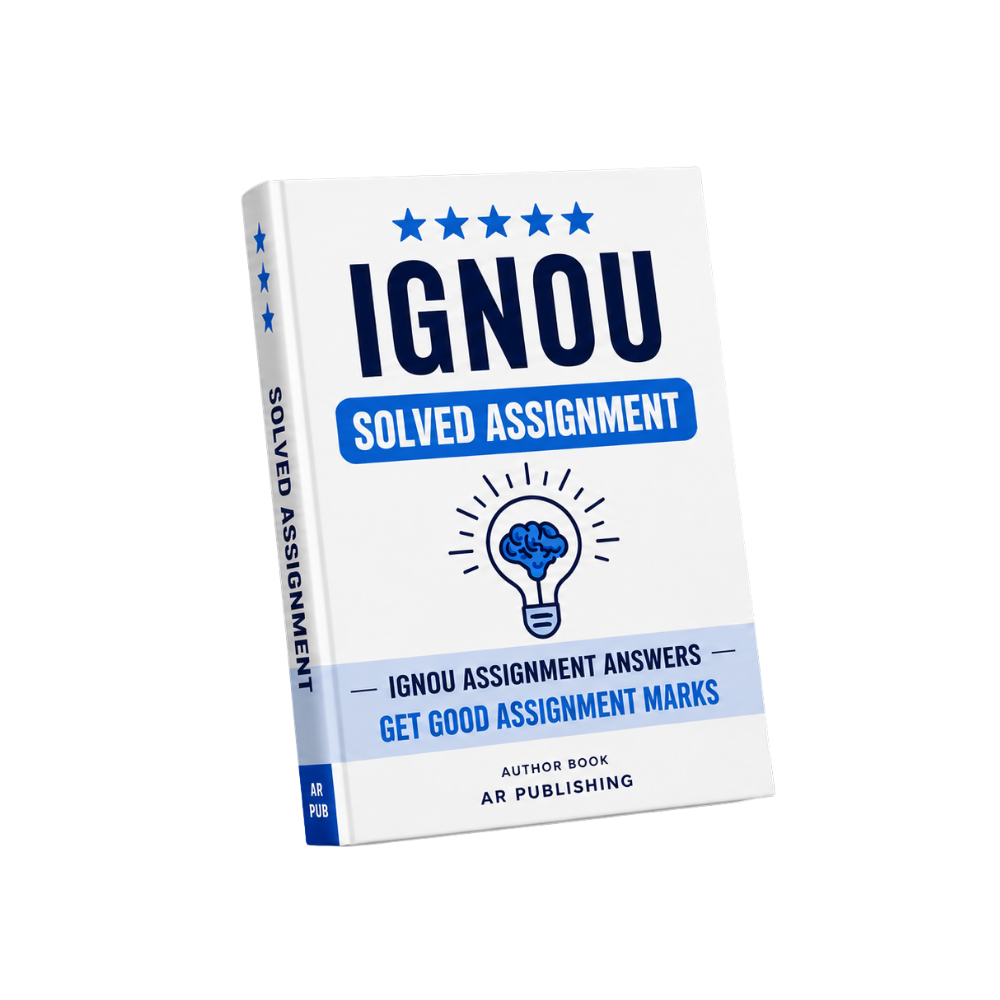
BLIS-224 IGNOU Solved Assignment 2026-27
Click to view offer details & terms
Get 10% OFF Instant Discount
Apply this coupon code at checkout to claim your academic discount instantly.
- Applicable on all university study materials
- Valid for up to 8 item(s) per order
- Valid till Oct 31, 2026
Enrolled in other IGNOU subjects?
Link your Enrollment No. to auto-map all your semester courses & free question papers.
Frequently Bought Together
Popular course materials frequently ordered together
Syllabus & Overview
Course Scope and Academic Rigor in BLIS-224: Library and Information Science
BLIS-224: Library and Information Science is a core component of IGNOU’s Bachelor’s Programme in Library and Information Science (BLIS), meticulously designed to equip students with foundational expertise in cataloguing, classification systems, and modern information management. This course bridges traditional library practices with contemporary digital frameworks, emphasizing the Dewey Decimal Classification (DDC) and Library of Congress Classification (LCC), alongside automated cataloguing standards like AACR2. Students explore information retrieval theories, digital library architectures, and ethical dimensions of information dissemination—preparing them for both academic and professional roles in libraries, archives, and knowledge-based organizations. The syllabus aligns with IGNOU’s CBCS curriculum, ensuring relevance to current industry standards and research trends.Key Syllabus Units and Topics
- Unit 1: Principles of Library and Information Science: Covers the historical evolution of libraries, information science paradigms, and the philosophical underpinnings of knowledge organization systems, including the role of libraries in societal development.
- Unit 2: Cataloguing Theory and Practice: Focuses on AACR2 rules for bibliographic description, authority control, and the creation of machine-readable catalog records, with practical applications in integrated library systems (ILS).
- Unit 3: Library Classification Systems: In-depth analysis of DDC and LCC, including their structure, notation systems, and adaptation for specialized subject fields, alongside emerging hybrid classification models.
- Unit 4: Digital Libraries and Information Storage: Examines metadata standards (MARC, Dublin Core), digital preservation techniques, and the design of user-friendly digital repositories using open-source tools.
- Unit 5: Information Retrieval and User Services: Analyzes search algorithms, Boolean logic, and the design of intuitive information interfaces, with a focus on inclusive access for diverse user communities.
Frequently Asked Questions
Q: What is the exact word count requirement for Section A (theory-based questions) in BLIS-224’s TMA, and how does IGNOU verify adherence to this guideline?
A: Section A of the TMA for BLIS-224 strictly mandates 500 words per question, with a ±10% tolerance. IGNOU’s evaluation system checks word counts via automated tools during submission, and deviations may result in deductions or rejection.
Q: Are there specific marking criteria for the practical component of BLIS-224 assignments, such as cataloguing records or classification schemes, and how are they weighted?
A: Practical components (e.g., cataloguing entries or classification exercises) are scored based on accuracy (60%), adherence to AACR2/DDC standards (25%), and clarity of presentation (15%). These carry 40% of the total TMA marks, with strict emphasis on consistency with IGNOU’s prescribed formats.
Why buy from us?
-
Verified by top professors and 99th percentile students.
-
Always updated to the latest university curriculum.
-
High-quality, printable PDF formats with clear diagrams.
License & Terms
By purchasing this item, you agree to our standard academic license terms. You may use this product for personal study, but you may not resell or redistribute the files online.