

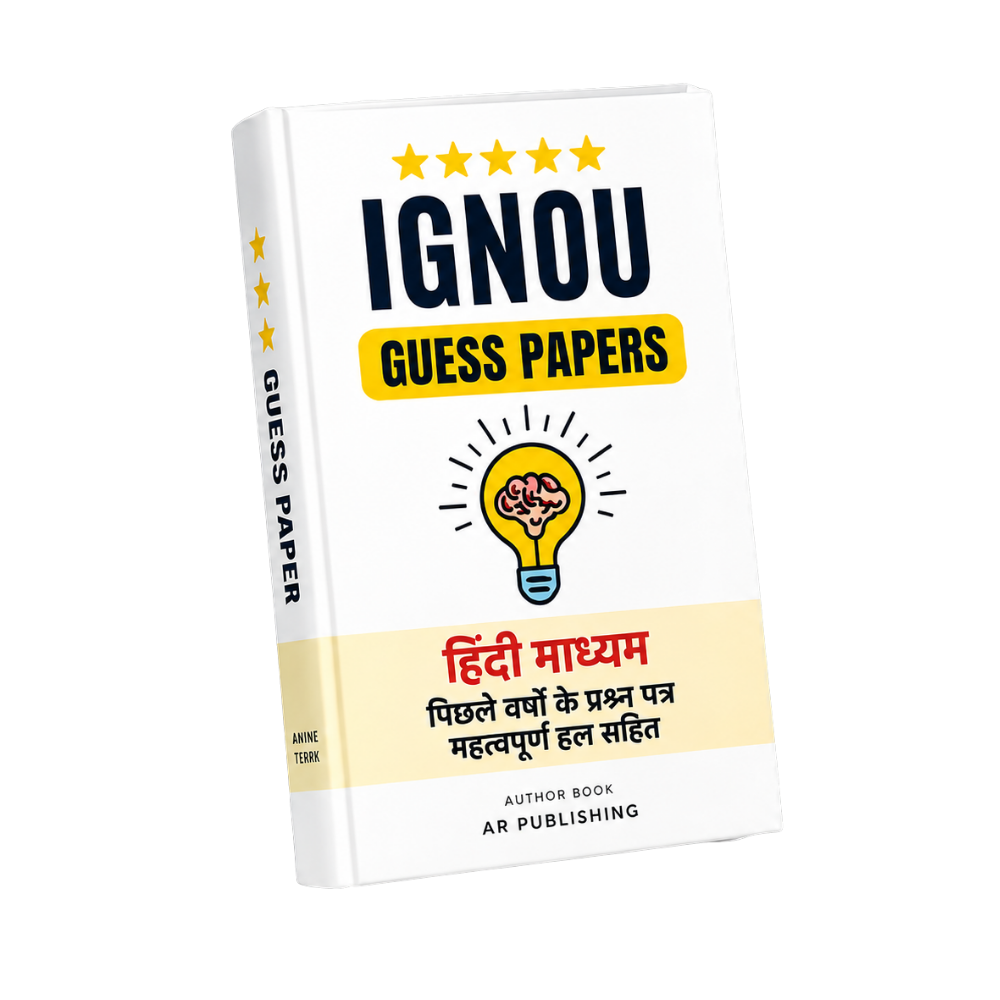
BNRI-104 IGNOU Guess Paper 2026-27
Click to view offer details & terms
Get 10% OFF Instant Discount
Apply this coupon code at checkout to claim your academic discount instantly.
- Applicable on all university study materials
- Valid for up to 8 item(s) per order
- Valid till Oct 31, 2026
Enrolled in other IGNOU subjects?
Link your Enrollment No. to auto-map all your semester courses & free question papers.
Frequently Bought Together
Popular course materials frequently ordered together


Syllabus & Overview
Course Scope & Syllabus Overview
BNRI-104: Rain Fed Farming is a specialized module under the Diploma in Watershed Management (DWM) curriculum, designed to equip students with foundational knowledge of sustainable agricultural practices in arid and semi-arid regions. This course explores the ecological, socio-economic, and technical dimensions of rain-fed farming, emphasizing water conservation strategies, soil management, and crop adaptation techniques. Through rigorous academic analysis, students gain insights into the challenges of low-rainfall zones while learning evidence-based solutions to enhance productivity and resilience. The syllabus aligns with IGNOU’s CBCS framework, ensuring structured learning progression from theoretical principles to practical applications, thereby preparing students for effective implementation in real-world watershed management scenarios.Key Syllabus Units & Topics
- Block-1: Introduction to Rain Fed Farming: This block covers the fundamental concepts of rain-fed agriculture, including its global significance, climatic constraints, and the role of watershed management in optimizing water availability. Students analyze the ecological balance of rain-fed ecosystems and the impact of land degradation on agricultural sustainability.
- Block-2: Practices of Water Conservation: Focuses on innovative techniques such as contour bunding, percolation tanks, and mulching to retain soil moisture. The unit also examines traditional and modern irrigation methods tailored for rain-fed conditions, emphasizing cost-effective and eco-friendly solutions.
- Soil-Water-Crop Interactions: Explores the dynamics between soil health, water retention, and crop yield under rain-fed conditions. Topics include soil moisture monitoring, crop selection for drought resilience, and agronomic interventions to mitigate yield variability.
- Economic Viability of Rain Fed Farming: Evaluates the socio-economic feasibility of rain-fed practices, including input costs, market linkages, and government support schemes. Case studies highlight successful models of rain-fed farming in India’s diverse agro-climatic zones.
- Climate Resilient Farming Strategies: Integrates climate change adaptation techniques such as drought-tolerant crop varieties, agroforestry, and precision farming tools. The unit emphasizes sustainable livelihood enhancement through climate-smart interventions.
Frequently Asked Questions
Q: What is the marking scheme for the Term-End Examination (TEE) in BNRI-104, and how are internal assessments weighted?
A: The TEE for BNRI-104 carries 100 marks, with questions distributed across objective and descriptive formats. Internal assessments, including assignments and tutorials, contribute 30% to the final grade, while the TEE accounts for the remaining 70%. Ensure submission of assignments on time to maximize your internal assessment score.
Q: Are there specific chapters or topics in BNRI-104 that frequently repeat in TEE question papers, and how can I prioritize my revision?
A: Blocks-1 and -2, particularly units on water conservation practices and soil-water-crop interactions, consistently appear in TEE papers. Prioritize these topics while cross-referencing past question papers to identify recurring themes, such as contour bunding techniques and drought-resistant crop selection.
Why buy from us?
-
Verified by top professors and 99th percentile students.
-
Always updated to the latest university curriculum.
-
High-quality, printable PDF formats with clear diagrams.
License & Terms
By purchasing this item, you agree to our standard academic license terms. You may use this product for personal study, but you may not resell or redistribute the files online.