

BPAC-103 IGNOU Solved Assignment 2026-27
Click to view offer details & terms
Get 10% OFF Instant Discount
Apply this coupon code at checkout to claim your academic discount instantly.
- Applicable on all university study materials
- Valid for up to 8 item(s) per order
- Valid till Oct 31, 2026
Enrolled in other IGNOU subjects?
Link your Enrollment No. to auto-map all your semester courses & free question papers.
Frequently Bought Together
Popular course materials frequently ordered together

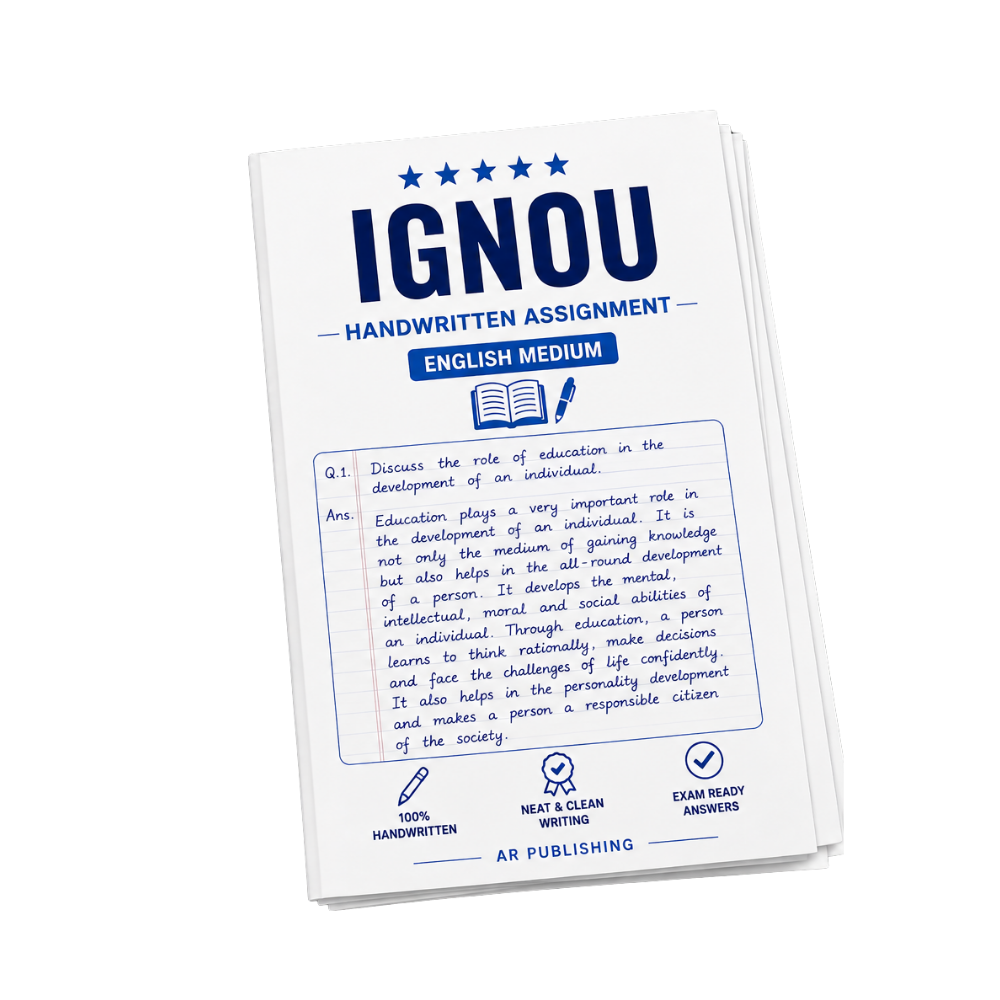
Syllabus & Overview
BPAC-103 Public Administration in India A Comprehensive Assignment Support Guide
BPAC-103, titled Public Administration in IndiaTheory and Practice, is a core course under IGNOU’s Bachelor’s Programme in Public Administration (BPAC) that examines the institutional, theoretical, and administrative frameworks governing governance in India. The syllabus integrates classical administrative theories with contemporary challenges such as decentralization, digital governance, and public policy implementation. This study material is designed to align with IGNOU’s CBCS curriculum, ensuring students grasp the interplay between constitutional provisions, administrative reforms, and grassroots administration. It emphasizes critical analysis of case studies, policy documents, and administrative ethics, preparing students for both theoretical assessments and practical applications in public service roles.Key Syllabus Units & Topics
- Unit 1: Evolution of Public Administration in India: Covers the historical progression from colonial administrative structures to post-independence reforms, including the role of the Indian Administrative Service (IAS) and the impact of the Planning Commission on bureaucratic development.
- Unit 3: Administrative Reforms and Public Policy: Analyzes key commissions (e.g., Administrative Reforms Commission) and their recommendations on decentralization, e-governance, and citizen-centric administration, with a focus on the National e-Governance Plan (NeGP) and Digital India initiatives.
- Unit 5: Local Self-Government and Panchayati Raj: Explores the constitutional framework of the 73rd and 74th Amendments, decentralized planning, and the challenges of implementing Swachh Bharat Abhiyan and MGNREGA at the grassroots level.
- Unit 7: Administrative Ethics and Accountability: Discusses the CVC Act, Lokpal Mechanism, and ethical dilemmas in public service, including case studies on corruption scandals and the role of whistleblowers.
- Unit 9: Comparative Public Administration: Compares Indian administrative models with those of the UK, USA, and Australia, highlighting universal principles like New Public Management and Good Governance Indicators.
Frequently Asked Questions
QHow are numerical questions (e.g., calculating administrative efficiency ratios) evaluated in BPAC-103’s TMA?
A Numerical questions typically require students to derive ratios (e.g., output per employee or cost-effectiveness of schemes) using data from government reports like the Public Expenditure Statistics or NITI Aayog’s India Innovation Index. Solutions must include clear formulas and references to the IGNOU Study Material (Chapter 4) for validation.
QWhat is the minimum passing mark for BPAC-103’s TMA, and how does it differ from the final exam?
A The TMA carries 30% weightage in the final grade, with a passing threshold of 50% aggregate marks (15/50 for Section A and 10/20 for Section B). Unlike the final exam (which tests conceptual understanding), the TMA focuses on applied analysis—e.g., critiquing a policy document or comparing two administrative models—using prescribed word limits strictly.
Why buy from us?
-
Verified by top professors and 99th percentile students.
-
Always updated to the latest university curriculum.
-
High-quality, printable PDF formats with clear diagrams.
License & Terms
By purchasing this item, you agree to our standard academic license terms. You may use this product for personal study, but you may not resell or redistribute the files online.