

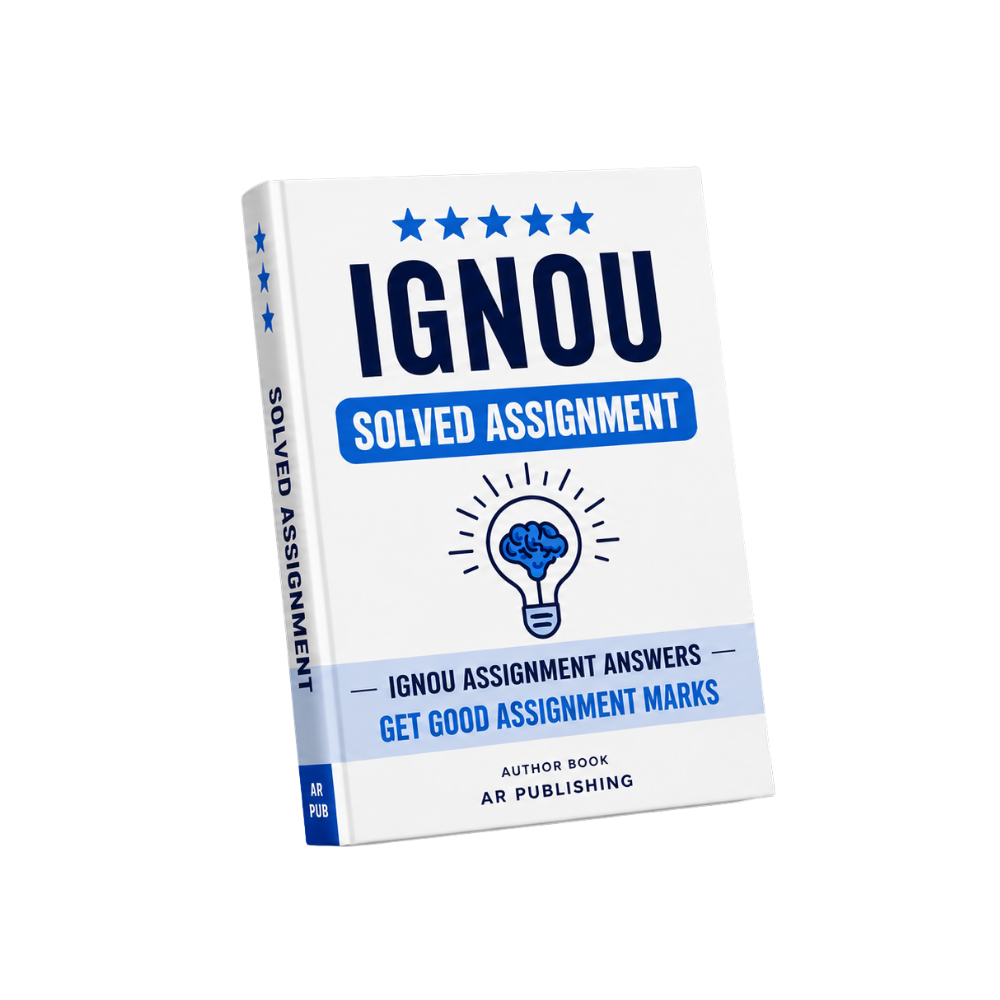
BPAC-132 IGNOU Solved Assignment 2026-27
Click to view offer details & terms
Get 10% OFF Instant Discount
Apply this coupon code at checkout to claim your academic discount instantly.
- Applicable on all university study materials
- Valid for up to 8 item(s) per order
- Valid till Oct 31, 2026
Enrolled in other IGNOU subjects?
Link your Enrollment No. to auto-map all your semester courses & free question papers.
Frequently Bought Together
Popular course materials frequently ordered together
Syllabus & Overview
Course Scope & Syllabus Overview for BPAC-132: Administrative Thinkers
Administrative Thinkers (BPAC-132)
IGNOU’s BPAC-132: Administrative Thinkers offers a rigorous exploration of foundational theories and intellectual contributions shaping modern public administration and organizational governance. As part of the Bachelor of Arts (BAG) curriculum under the School of Social Sciences, this course critically examines the evolution of administrative thought from indigenous Indian perspectives to contemporary behavioral and systems-based frameworks. Students analyze the works of eminent thinkers—spanning Weber’s bureaucratic models, Taylor’s scientific management, and modern behavioral theorists—while contextualizing their relevance to public policy, organizational efficiency, and socio-political structures. The syllabus integrates historical depth with practical applications, ensuring graduates develop analytical skills to evaluate administrative systems in dynamic environments.Key Syllabus Units & Topics
- Block-1: Indian Thinkers: Examines indigenous administrative philosophies, including contributions from ancient texts like the Arthashastra and medieval governance principles, emphasizing ethical leadership and bureaucratic ethics in traditional Indian administrative thought.
- Block-2: Classical Thinkers: Focuses on the works of Max Weber (bureaucracy), Henri Fayol (administrative functions), and Frederick Winslow Taylor (scientific management), dissecting their impact on modern organizational hierarchies and efficiency paradigms.
- Block-3: Behavioral and Systems Thinkers: Analyzes Mary Parker Follett’s participative management, Chester Barnard’s organizational communication theories, and systems thinkers like Ludwig von Bertalanffy, bridging behavioral science with systemic administrative models.
- Block-4: Socio-Psychological Thinkers: Explores Abraham Maslow’s hierarchy of needs in organizational contexts, Douglas McGregor’s Theory X/Y, and Kurt Lewin’s change management models, linking psychological theories to administrative decision-making.
- Block-5: Management and Public Policy Thinkers: Investigates contemporary thinkers like Peter Drucker (management by objectives) and James Q. Wilson’s policy analysis frameworks, critiquing their applications in public sector reforms and governance.
Frequently Asked Questions
Q: What is the word limit for Section A (Long Answer Type) in BPAC-132’s Tutor-Marked Assignment for the 2026-27 session?
A: Section A requires answers strictly within 500 words per question, adhering to IGNOU’s guidelines for the July 2026 and January 2027 submission cycles.
Q: How are marks distributed in BPAC-132’s internal assessment, and what is the passing criterion for the TMA?
A: The TMA carries 30% weightage, with a minimum passing score of 40% required in the assignment to qualify for the final examination; partial credit is awarded based on depth of analysis and adherence to academic standards.
Why buy from us?
-
Verified by top professors and 99th percentile students.
-
Always updated to the latest university curriculum.
-
High-quality, printable PDF formats with clear diagrams.
License & Terms
By purchasing this item, you agree to our standard academic license terms. You may use this product for personal study, but you may not resell or redistribute the files online.