

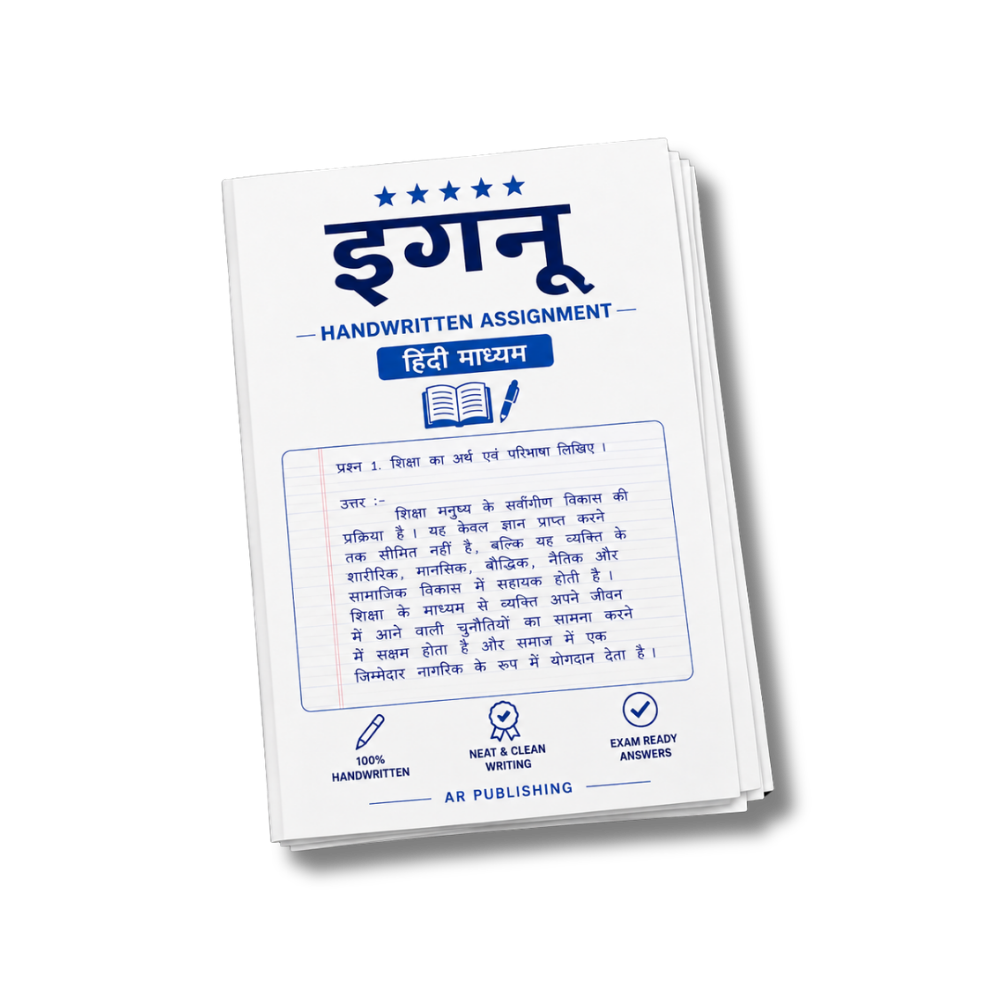
BPCC-104 IGNOU Handwritten Assignment 2026-27
Click to view offer details & terms
Get 10% OFF Instant Discount
Apply this coupon code at checkout to claim your academic discount instantly.
- Applicable on all university study materials
- Valid for up to 8 item(s) per order
- Valid till Oct 31, 2026
Enrolled in other IGNOU subjects?
Link your Enrollment No. to auto-map all your semester courses & free question papers.
Frequently Bought Together
Popular course materials frequently ordered together
Syllabus & Overview
Course Scope and Syllabus Overview for BPCC-104: Statistical Methods for Psychological Research-I
BPCC-104: Statistical Methods for Psychological Research-I is a core component of the Bachelor of Arts (BAM) curriculum under IGNOU’s School of Social Sciences. This course equips students with foundational statistical tools essential for analyzing psychological data, emphasizing both theoretical understanding and practical application. The curriculum integrates key concepts from descriptive and inferential statistics, enabling students to interpret research findings, evaluate psychological theories, and design evidence-based studies. Through structured assignments and case studies, learners develop proficiency in applying statistical techniques to real-world behavioral and psychological research scenarios.Key Syllabus Units and Topics
- Block-1 Introduction: This block introduces the fundamental principles of statistics in psychological research, covering the role of statistics in hypothesis testing, data interpretation, and research methodology. Students explore the distinction between descriptive and inferential statistics while learning about statistical notation and basic data organization.
- Block-2 Measures of Central Tendency and Variability: Focuses on calculating and interpreting measures such as mean, median, mode, and standard deviation to summarize and analyze psychological data. Emphasis is placed on understanding dispersion, skewness, and kurtosis, along with their implications for research validity.
- Block-3 Correlation: Examines the relationship between variables using correlation coefficients, including Pearson’s r, Spearman’s rank correlation, and partial correlation. The block emphasizes interpreting correlation strength, directionality, and the limitations of correlational analysis in psychological studies.
- Block-4 Normal Probability Distribution: Delves into the properties of the normal distribution, z-scores, and probability concepts, along with their applications in psychological measurement and error analysis. Students learn to identify deviations from normality and their impact on statistical inference.
Frequently Asked Questions
Q: What is the passing mark for BPCC-104 assignments, and how are they evaluated?
A: The passing mark for BPCC-104 assignments is typically 40%, with evaluation based on clarity, accuracy, and adherence to statistical principles. Assignments are graded on a scale of 20 marks, contributing 30% to the final course grade.
Q: Does BPCC-104 require students to memorize formulas, or is conceptual understanding prioritized?
A: While familiarity with key formulas is expected, the course prioritizes conceptual understanding and application. Students are assessed on their ability to interpret statistical outputs, choose appropriate methods, and justify their reasoning in research contexts.
Why buy from us?
-
Verified by top professors and 99th percentile students.
-
Always updated to the latest university curriculum.
-
High-quality, printable PDF formats with clear diagrams.
License & Terms
By purchasing this item, you agree to our standard academic license terms. You may use this product for personal study, but you may not resell or redistribute the files online.