

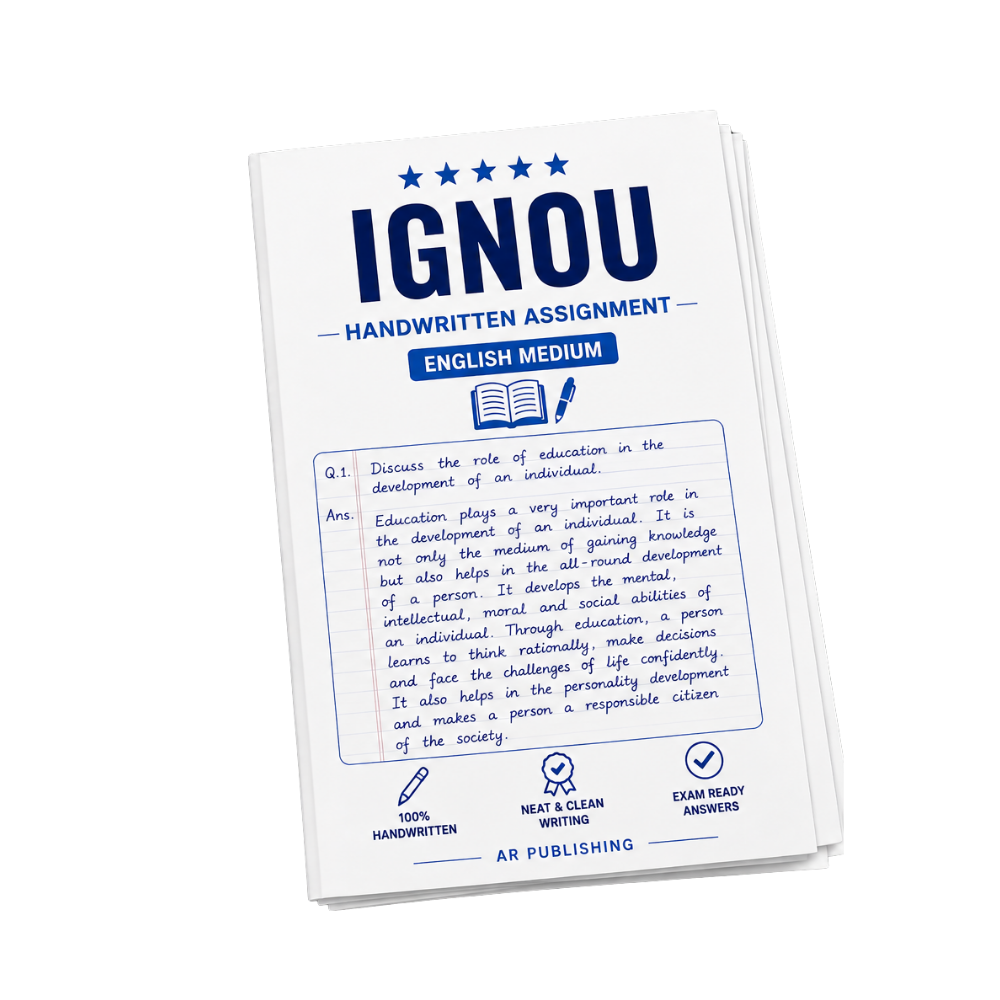
BPHE-101/PHE-01 IGNOU Handwritten Assignment 2026-27
Click to view offer details & terms
Get 10% OFF Instant Discount
Apply this coupon code at checkout to claim your academic discount instantly.
- Applicable on all university study materials
- Valid for up to 8 item(s) per order
- Valid till Oct 31, 2026
Frequently Bought Together
Popular course materials frequently ordered together

Syllabus & Overview
Course Scope & Syllabus Overview for BPHE-101: Foundations of Public Health Education
BPHE-101: Course Code BPHE-101 is a core component of IGNOU’s Bachelor’s Programme in Public Health Education, designed to equip students with foundational knowledge in public health principles, community engagement, and health promotion strategies. This course bridges theoretical frameworks with practical applications, emphasizing evidence-based interventions, health policy analysis, and the role of behavioral science in improving population health outcomes. Through structured academic modules, students explore critical areas such as epidemiological methods, health communication, and the socio-cultural determinants of health, ensuring a holistic understanding of public health challenges in diverse settings.Key Syllabus Units & Topics
- Unit 1: Introduction to Public Health and Its Principles: This unit introduces students to the core concepts of public health, including its historical evolution, key functions (prevention, health surveillance, health policy), and the distinction between public health and clinical medicine. It also covers ethical dilemmas and the global burden of diseases.
- Unit 2: Epidemiology and Biostatistics: Focuses on the principles of epidemiology, such as disease occurrence, patterns, and risk factors, alongside biostatistical tools for data analysis. Students learn to interpret epidemiological studies, calculate basic statistics, and apply this knowledge to public health decision-making.
- Unit 3: Health Promotion and Behavioral Change: Examines theories of health behavior change (e.g., Health Belief Model, Transtheoretical Model) and strategies for designing effective health promotion programs. Emphasis is placed on community participation, cultural sensitivity, and sustainable interventions.
- Unit 4: Health Communication and Media: Explores the role of communication in health education, including mass media, interpersonal communication, and digital health literacy. This unit also analyzes case studies of successful health campaigns and their impact on public health policies.
- Unit 5: Environmental Health and Occupational Safety: Covers environmental hazards, occupational health risks, and regulatory frameworks for ensuring workplace and community safety. Topics include air/water pollution, food safety, and the intersection of environmental health with economic development.
Frequently Asked Questions
Q: What is the marking scheme for BPHE-101 assignments, and how are they evaluated?
A: Assignments in BPHE-101 are typically graded on clarity of reasoning, application of theoretical concepts, adherence to academic standards, and originality. Each assignment carries 20 marks, with deductions for plagiarism or incomplete answers. Ensure your responses align with IGNOU’s prescribed question papers and demonstrate critical analysis.
Q: What are the minimum pass marks required for BPHE-101, and how is the final grade calculated?
A: The minimum pass marks for BPHE-101 (and all IGNOU courses) are 40%. The final grade is computed as a weighted average of assignments (30%), term-end examination (70%), and internal assessment (if applicable). Consistency in both assignments and exams is crucial to achieving a passing grade.
Why buy from us?
-
Verified by top professors and 99th percentile students.
-
Always updated to the latest university curriculum.
-
High-quality, printable PDF formats with clear diagrams.
License & Terms
By purchasing this item, you agree to our standard academic license terms. You may use this product for personal study, but you may not resell or redistribute the files online.