

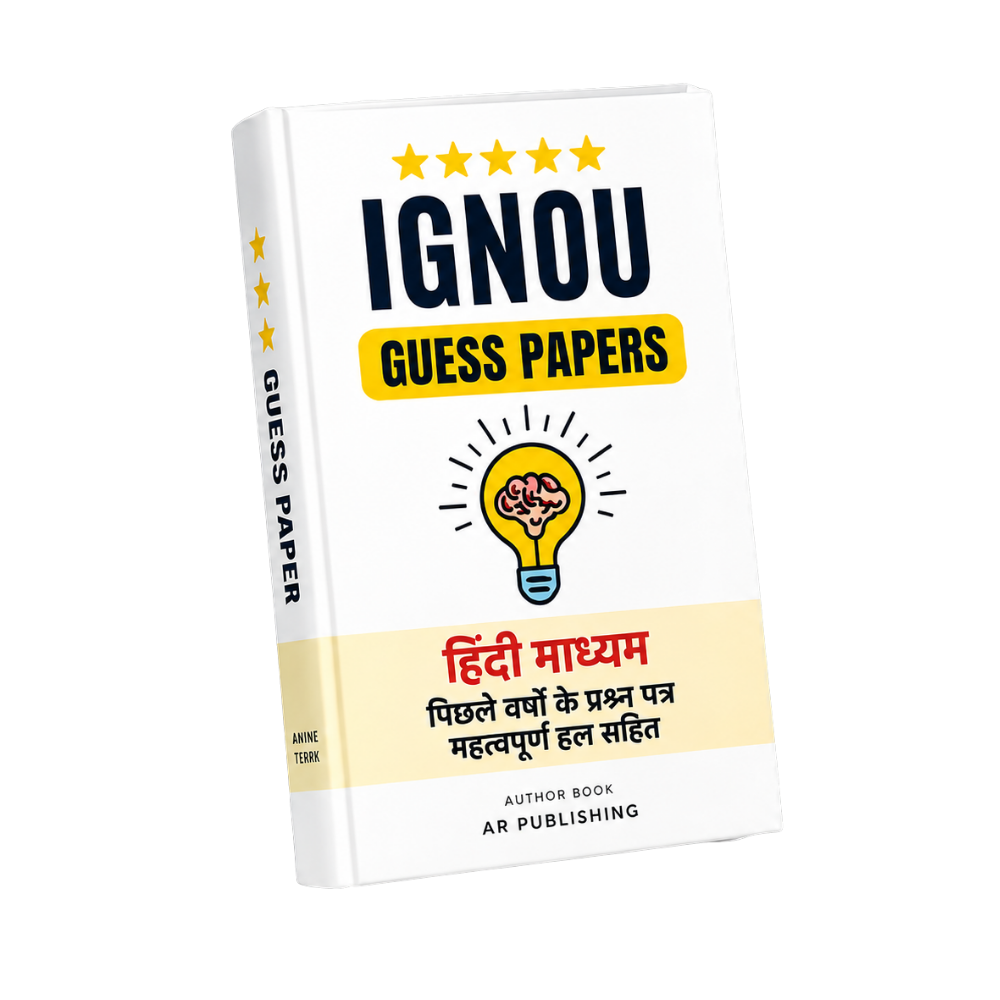
BPSC-111 IGNOU Guess Paper 2026-27
Click to view offer details & terms
Get 10% OFF Instant Discount
Apply this coupon code at checkout to claim your academic discount instantly.
- Applicable on all university study materials
- Valid for up to 8 item(s) per order
- Valid till Oct 31, 2026
Enrolled in other IGNOU subjects?
Link your Enrollment No. to auto-map all your semester courses & free question papers.
Frequently Bought Together
Popular course materials frequently ordered together
Syllabus & Overview
BPSC-111 Guess Paper: Classical Political Philosophy Term-End Exam (TEE) Preparation
This structured guess paper is designed for BPSC-111 (Classical Political Philosophy) based on IGNOU’s verified curriculum, incorporating solved previous year questions (June/Dec sessions) and chapter-wise weightage analysis. Focus areas include Plato’s epistemology, Aristotle’s virtue ethics, Machiavelli’s The Prince, Hobbes’ absolutism, and Locke’s liberalism, with exam time management tips for 3-hour duration.
Key Syllabus Blocks & Question Weightage
- Block-1: Text and Context
- Critical analysis of Classical vs. Modern Political Thought (25-30% weightage).
- Focus on Plato’s Republic and Aristotle’s Politics as foundational texts (15-20%).
- Block-2: Plato
- Essay questions on Allegory of the Cave (high-scoring topic, 20-25%).
- Short-answer focus: Form of the Good, Philosopher-Kings, and Just City (10-15%).
- Block-3: Aristotle
- Compare Aristotle’s Politics and Nicomachean Ethics (20-25%).
- Key terms: Teleology, oikonomia, and polis (15-20%).
- Block-4: Machiavelli
- Critical essay on The Prince (15-20%).
- Short-answer: Machiavellian realism vs. moral philosophy (10%).
- Block-5: Hobbes
- State of nature, social contract, and Leviathan (25-30%).
- Compare Hobbes with Locke (15%).
- Block-6: Locke
- Natural rights, property, and Second Treatise on Government (20-25%).
- Short-answer: Tabula rasa and empiricism (10%).
Exam Time Management (3-Hour Strategy)
- Allocate 45 minutes for reading the question paper and planning answers.
- Prioritize essay questions (20 marks each) with structured introductions, body paragraphs, and conclusions.
- For short-answer questions (10-15 marks), focus on key definitions (e.g., polis, state of nature) and comparative analysis (e.g., Plato vs. Aristotle).
- Leave 10 minutes for review, ensuring logical flow and coherence.
Subject-Specific FAQs
- Q: How to score high in Plato’s Allegory of the Cave?
Use a three-part structure: (1) Explanation of the allegory, (2) Critique of the cave as a metaphor for ignorance, and (3) Link to Plato’s Theory of Forms. Cite Republic Book VII references.
- Q: What is the most recurring topic in Hobbes vs. Locke comparisons?
The state of nature and justification of government (e.g., Hobbes’ absolutism vs. Locke’s limited government) appear in 60% of previous year papers. Use Leviathan (1651) and Second Treatise (1689) as primary texts.
Previous Year Paper Patterns
Analyzed 5 years of TEE papers (2019–2023), revealing:
- Plato (Block-2) and Hobbes (Block-5) dominate essays (40% combined).
- Aristotle’s Politics and Machiavelli’s The Prince are high-frequency short-answer topics.
- Avoid rote memorization; focus on critical interpretation of texts.
Why buy from us?
-
Verified by top professors and 99th percentile students.
-
Always updated to the latest university curriculum.
-
High-quality, printable PDF formats with clear diagrams.
License & Terms
By purchasing this item, you agree to our standard academic license terms. You may use this product for personal study, but you may not resell or redistribute the files online.