

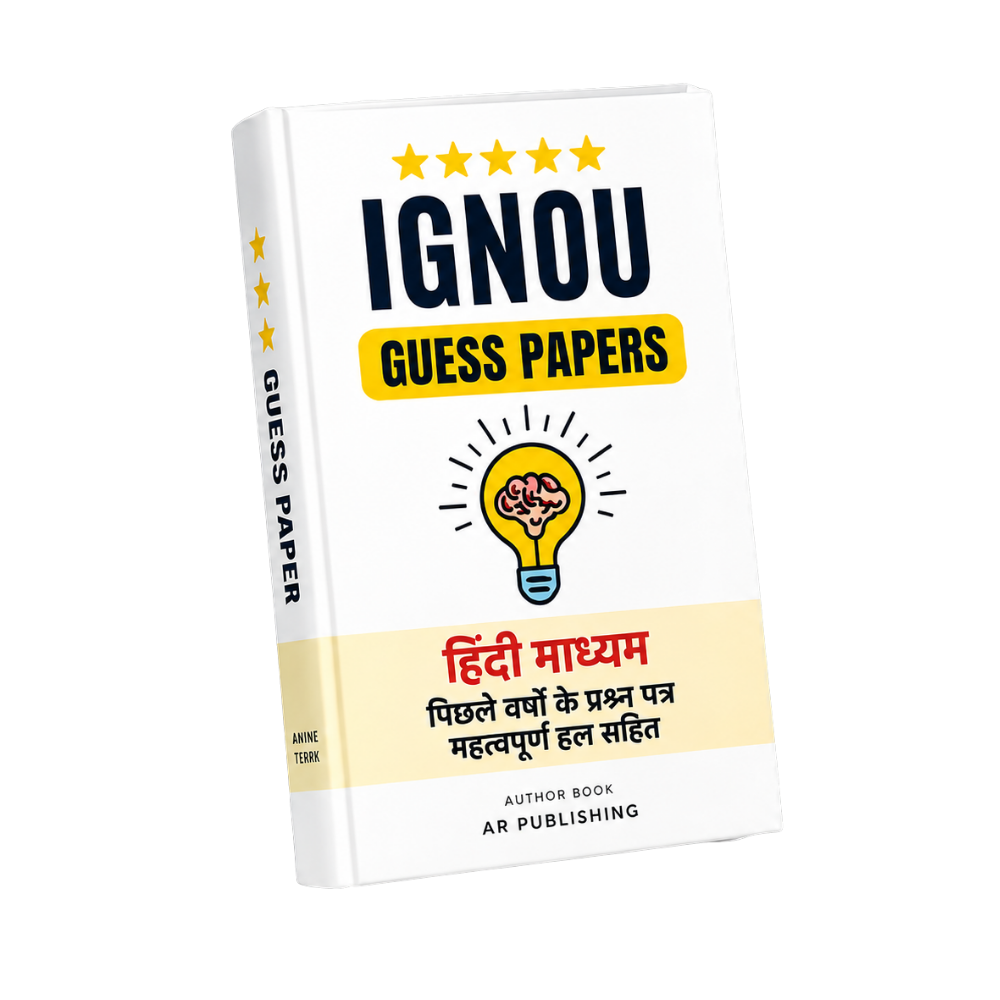
BPSE-143 IGNOU Guess Paper 2026-27
Click to view offer details & terms
Get 10% OFF Instant Discount
Apply this coupon code at checkout to claim your academic discount instantly.
- Applicable on all university study materials
- Valid for up to 8 item(s) per order
- Valid till Oct 31, 2026
Frequently Bought Together
Popular course materials frequently ordered together
Syllabus & Overview
Course Scope & Syllabus Overview for BPSE-143: State Politics in India
BPSE-143 under the IGNOU Bachelor of Arts (BAG) curriculum critically examines the dynamics of state-level governance in India, aligning with the School of Social Sciences’ focus on Political Science and International Relations. This course dissects the institutional, theoretical, and socio-political frameworks shaping state politics, from constitutional federalism to the evolving role of identity-based movements. Students analyze real-world case studies, policy implementations, and electoral patterns to understand how state-level politics intersects with national governance, economic development, and societal divisions. The study material emphasizes analytical rigor, ensuring learners can articulate informed perspectives on contemporary challenges such as resource allocation, regional disparities, and the balance between autonomy and centralization.Key Syllabus Units & Topics
- Block-1 Introduction: Explores the foundational concepts of state politics, including the historical evolution of Indian states, the role of the Constitution in defining state boundaries, and the theoretical underpinnings of state-level governance such as federalism and decentralization.
- Block-2 Federalism: Delves into the constitutional framework of Indian federalism, examining the power-sharing mechanisms between the Union and state governments, the role of inter-state councils, and contemporary disputes over state autonomy versus central dominance.
- Block-3 Development and State Politics: Investigates how state politics influences economic development, focusing on planning models, infrastructure projects, and the impact of state-level policies on rural and urban disparities, with case studies from regions like Kerala and Maharashtra.
- Block-4 Party System and Electoral Politics: Analyzes the dynamics of political parties at the state level, including coalition formations, electoral strategies, and the impact of national parties versus regional outfits, while addressing issues like vote-bank politics and electoral malpractices.
- Block-5 Identity Politics: Examines the role of linguistic, ethnic, and religious identities in shaping state politics, including movements for regional autonomy, the politics of representation, and the tension between national integration and local aspirations.
Frequently Asked Questions
Q: What is the marking scheme for BPSE-143’s Term-End Examination (TEE), and how are internal assessments weighted?
A: The TEE for BPSE-143 carries 100 marks, with questions designed to test understanding of theoretical concepts, case studies, and analytical reasoning. Internal assessments (assignments) contribute 20 marks, requiring students to submit well-researched responses based on the course material to meet the pass criteria of 40% overall.
Q: Are there recurring questions in past TEE papers for BPSE-143, and how can students prioritize their revision?
A: Yes, certain themes like federalism disputes, party system dynamics, and identity-based movements frequently appear. Students should focus on chapter-wise question weightage—typically, Blocks 2 and 4 carry higher marks—and practice answering questions within the 3-hour timeframe to build efficiency.
Why buy from us?
-
Verified by top professors and 99th percentile students.
-
Always updated to the latest university curriculum.
-
High-quality, printable PDF formats with clear diagrams.
License & Terms
By purchasing this item, you agree to our standard academic license terms. You may use this product for personal study, but you may not resell or redistribute the files online.