

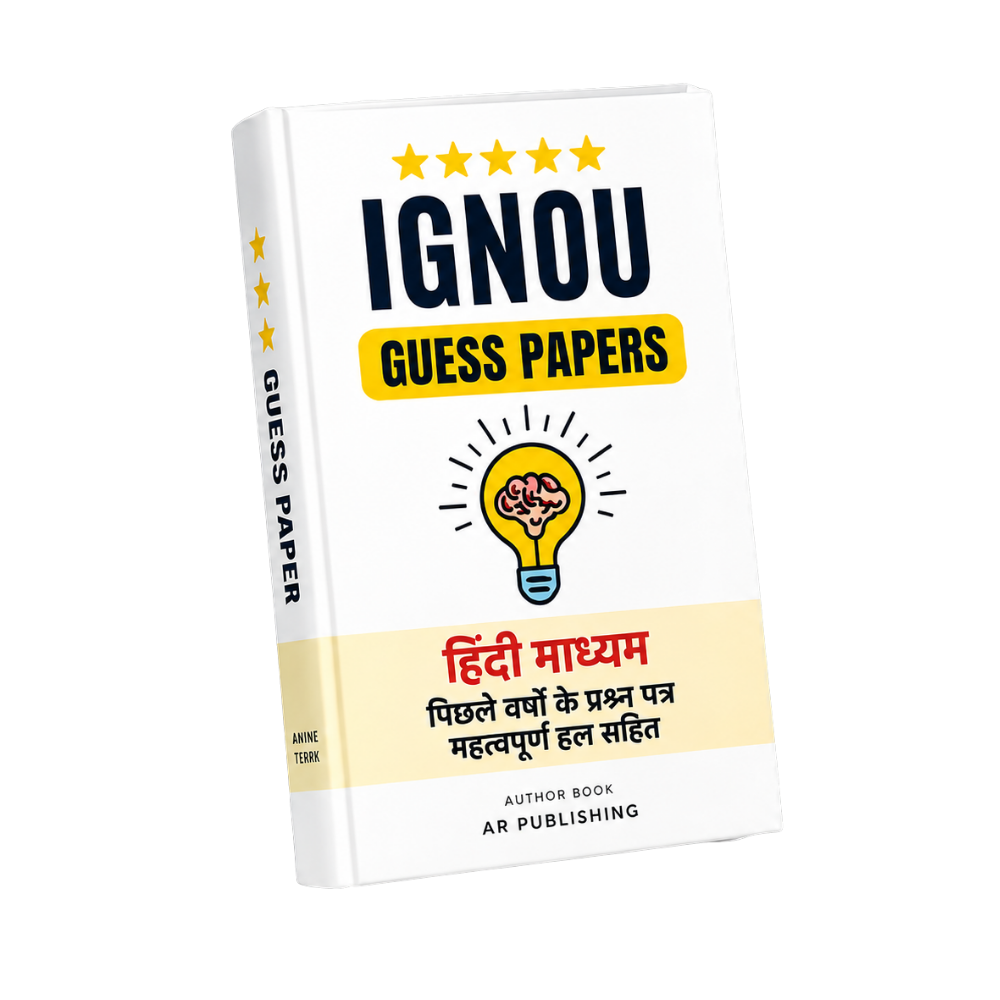
BPVC-101 IGNOU Guess Paper 2026-27
Click to view offer details & terms
Get 10% OFF Instant Discount
Apply this coupon code at checkout to claim your academic discount instantly.
- Applicable on all university study materials
- Valid for up to 8 item(s) per order
- Valid till Oct 31, 2026
Enrolled in other IGNOU subjects?
Link your Enrollment No. to auto-map all your semester courses & free question papers.
Frequently Bought Together
Popular course materials frequently ordered together


Syllabus & Overview
BPVC-101 Guess Paper: Food Science and Food Safety Term-End Exam (TEE) Preparation
This structured guess paper is designed to align with the IGNOU BPVC-101 syllabus, incorporating solved previous year questions (2018–2023) and prioritizing high-weightage topics for the Term-End Exam. It includes chapter-wise question distribution, exam time management tips, and subject-specific FAQs to enhance preparation.
Key Blocks & Focused Topics
The guess paper is structured around the official IGNOU BPVC-101 curriculum, covering:
- Block 1: Food Fundamentals
- Food composition and classification (macronutrients, micronutrients, water activity)
- Physical and chemical properties of food (pH, viscosity, osmosis)
- Common food additives (preservatives, emulsifiers, antioxidants) and their roles
- Block 2: Food Assimilation and Disorders
- Digestive physiology and nutrient absorption mechanisms
- Common food-related disorders (malnutrition, celiac disease, lactose intolerance)
- Role of probiotics and prebiotics in gut health
- Block 3: Food Nutrition and Quality
- Nutritional labeling and fortification practices
- Quality control techniques (sensory evaluation, HACCP principles)
- Impact of processing on nutritional value (thermal processing, irradiation)
- Block 4: Fundamentals of Food Safety and Quality
- Microbial contamination sources and control measures (pasteurization, fermentation)
- Foodborne pathogens (Salmonella, E. coli, Listeria) and their prevention
- Regulatory frameworks (FSSAI, Codex Alimentarius, ISO 22000)
Exam Pattern & Weightage Analysis
Based on previous TEE sessions (June/December), the guess paper allocates question weightage as follows:
- Block 1 & 2 (Food Fundamentals & Assimilation): 25%
- Short-answer questions (SAQs) on food composition and digestive disorders
- Case studies on additive usage and nutrient absorption
- Block 3 (Nutrition & Quality): 30%
- Descriptive questions on HACCP and nutritional labeling
- Numerical problems on food processing impacts
- Block 4 (Food Safety): 35%
- Long-answer questions on microbial control and regulatory compliance
- Scenario-based questions on foodborne outbreaks
- Block 5 (Activities Manual): 10%
- Practical-based questions on lab techniques (e.g., pH measurement, microscopy)
3-Hour Exam Time Management Tips
- Allocate 45 minutes for reading the question paper and planning answers.
- Prioritize Block 4 (Food Safety) as it carries the highest weightage (35%).
- For SAQs, focus on Block 1 & 2 (25%) with concise, point-wise answers.
- Spend 10–15 minutes on numerical problems (Block 3) to avoid partial marks loss.
- Leave 10 minutes for reviewing answers, especially for grammar and clarity.
Subject-Specific FAQs
Q: How do I differentiate between preservatives and antioxidants in food?
Preservatives (e.g., sodium benzoate) inhibit microbial growth, while antioxidants (e.g., vitamin E) prevent oxidative rancidity by neutralizing free radicals. Focus on their chemical structures and applications in Block 1.
Q: What are the key differences between HACCP and ISO 22000?HACCP is a preventive food safety system targeting critical control points (CCPs), whereas ISO 22000 is a broader standard integrating HACCP with management systems. Compare their frameworks in Block 4.
Why buy from us?
-
Verified by top professors and 99th percentile students.
-
Always updated to the latest university curriculum.
-
High-quality, printable PDF formats with clear diagrams.
License & Terms
By purchasing this item, you agree to our standard academic license terms. You may use this product for personal study, but you may not resell or redistribute the files online.