

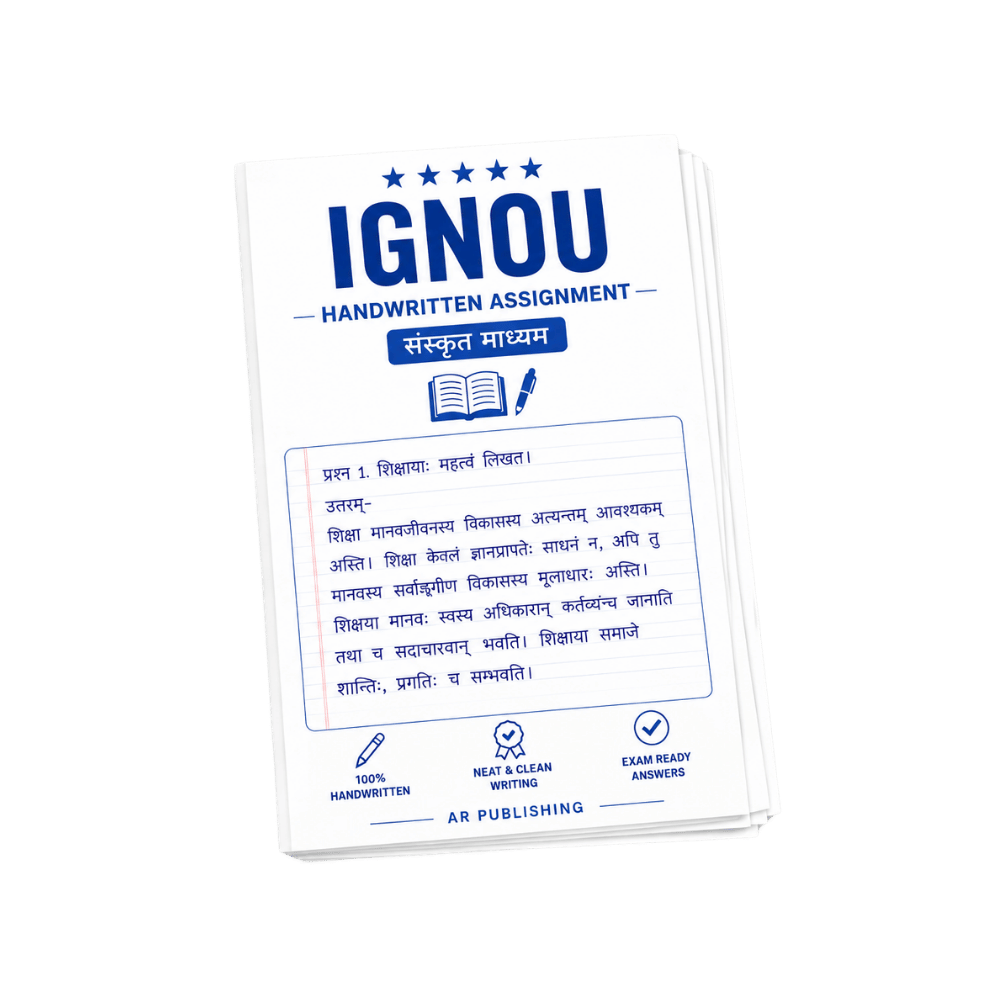
BSKE-141 IGNOU Handwritten Assignment 2026-27
Click to view offer details & terms
Get 10% OFF Instant Discount
Apply this coupon code at checkout to claim your academic discount instantly.
- Applicable on all university study materials
- Valid for up to 8 item(s) per order
- Valid till Oct 31, 2026
Enrolled in other IGNOU subjects?
Link your Enrollment No. to auto-map all your semester courses & free question papers.
Frequently Bought Together
Popular course materials frequently ordered together
Syllabus & Overview
Course Scope & Syllabus Overview for BSKE-141:
BSKE-141: is a foundational course under IGNOU’s Bachelor of Arts (Sanskrit) programme, designed to introduce students to the philosophical, textual, and conceptual foundations of Ayurveda as articulated in classical Sanskrit literature. This course bridges Sanskrit Studies and traditional Indian medicine by examining core Ayurvedic texts such as the Charaka Samhita and Upanishads, ensuring students grasp the historical, linguistic, and doctrinal underpinnings of Ayurveda’s theoretical framework. Through systematic analysis of Ayurvedic principles, students develop critical insights into the interplay between Sanskrit scriptures and medical philosophy, preparing them for advanced studies in Sanskrit literature and Ayurvedic hermeneutics.Key Syllabus Units & Topics
- -1 : This unit explores the origins, etymology, and philosophical definitions of Ayurveda in Sanskrit texts, including its classification as a Vedanga and its alignment with Vedic cosmology.
- -2 : A detailed study of the Charaka Samhita’s foundational Sutrasthana, covering the Tridosha theory, Panchamahabhutas, and the physiological and pathological frameworks of Ayurveda.
- -3 : Analysis of the Taittiriya Upanishad’s relevance to Ayurvedic thought, particularly its discussions on Prana, Atma, and the integration of spiritual and medical knowledge.
- -4 : Examination of Ayurvedic epistemology and its metaphysical assumptions, including the role of Rasa Shastra and the relationship between body, mind, and consciousness.
- -5 : A linguistic analysis of Ayurvedic terminology, focusing on Sanskrit roots, compound words, and the semantic evolution of medical terms in classical texts.
Frequently Asked Questions
Q: What is the marking scheme for BSKE-141 assignments, and how many marks are allocated to each unit?
A: The assignment for BSKE-141 carries 30 marks, distributed proportionally across all five units. Each unit typically contributes 6 marks, with questions designed to assess comprehension, textual analysis, and application of Ayurvedic concepts.
Q: Are there any specific pass marks or weightage criteria for BSKE-141 in the final examination?
A: The course follows IGNOU’s standard grading system, where 40% marks are required to pass the assignment component, and the theory examination carries 60% weightage. The final grade is determined by a combination of both components, with no unit-specific pass criteria beyond overall performance.
Why buy from us?
-
Verified by top professors and 99th percentile students.
-
Always updated to the latest university curriculum.
-
High-quality, printable PDF formats with clear diagrams.
License & Terms
By purchasing this item, you agree to our standard academic license terms. You may use this product for personal study, but you may not resell or redistribute the files online.