

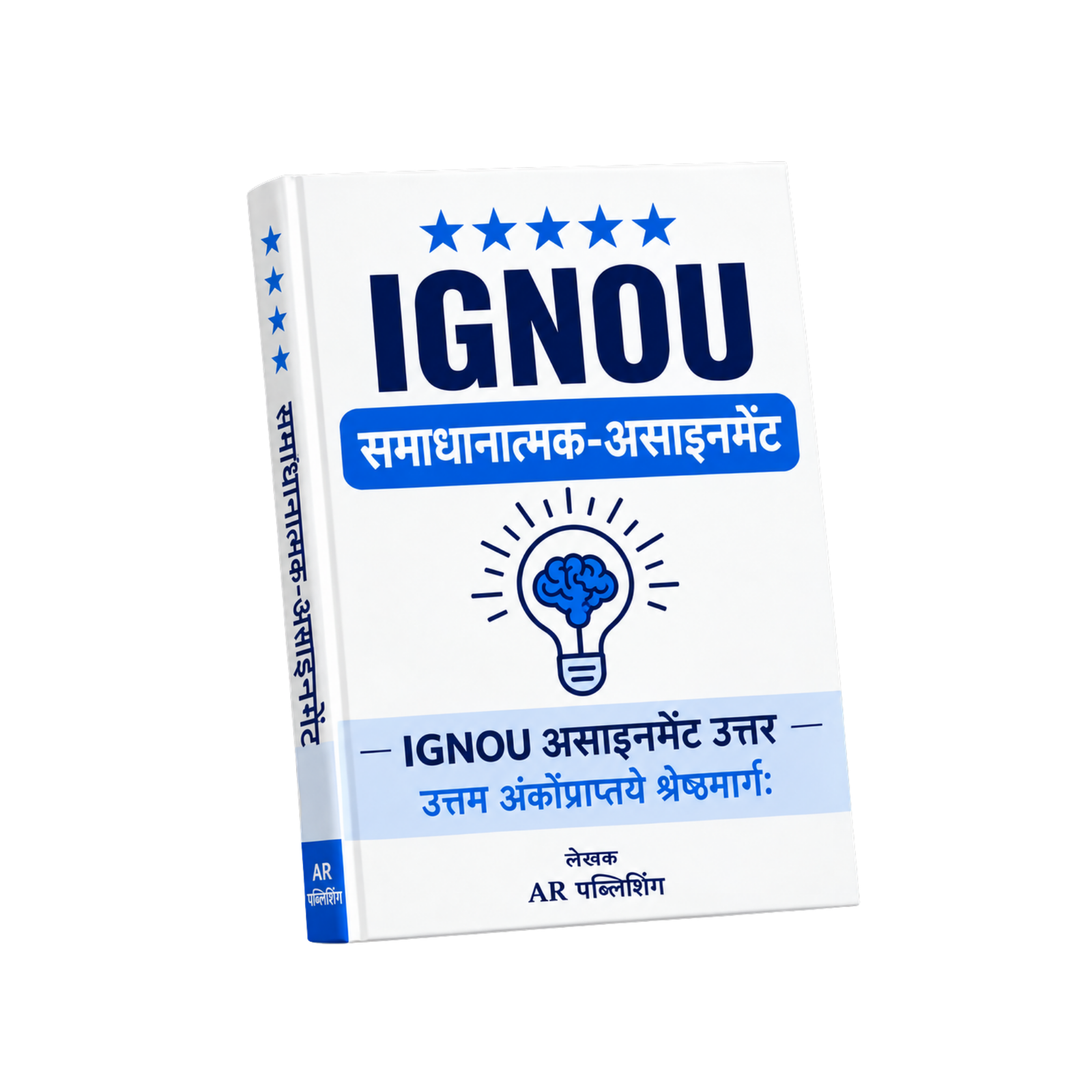
BSKG-178 IGNOU Solved Assignment 2026-27
Click to view offer details & terms
Get 10% OFF Instant Discount
Apply this coupon code at checkout to claim your academic discount instantly.
- Applicable on all university study materials
- Valid for up to 8 item(s) per order
- Valid till Oct 31, 2026
Enrolled in other IGNOU subjects?
Link your Enrollment No. to auto-map all your semester courses & free question papers.
Frequently Bought Together
Popular course materials frequently ordered together
Syllabus & Overview
Course Scope & Syllabus Overview for BSKG-178:
BSKG-178: is a foundational course under IGNOU’s Bachelor of Arts (BAG) program within the School of Humanities. This course meticulously explores the political structures, governance models, and socio-political dynamics of ancient India, drawing from Vedic, epical, and early state texts. It bridges historical and theoretical perspectives, enabling students to analyze the evolution of political thought—from the Manusmriti’s rajadharma principles to the administrative frameworks of the Mauryan and Gupta empires. Through this study, learners develop critical insights into the interplay between morality, governance, and statecraft, aligning with IGNOU’s CBCS curriculum’s emphasis on interdisciplinary textual analysis.Key Syllabus Units & Topics
- -1 : Examines the unique political geography of ancient India, including territorial divisions, urban-rural dynamics, and the role of sacred spaces like dharmaśāstra-endorsed capitals. Covers how political ideologies shaped administrative divisions and resource allocation.
- -2 : Analyzes theoretical classifications of states (rajya, gana, sangha) as articulated in the Arthashastra and Bhagavad Gita, contrasting centralized monarchies with decentralized republics. Includes case studies of early state formations like the Mahajanapadas.
- -3 : Investigates the composition and functions of royal councils (mantriparishad), legislative assemblies (sabha), and advisory bodies in ancient texts, emphasizing their role in policy formulation and judicial oversight.
- -4 : Explores the legal frameworks of ancient India, including danda (penal codes), vyavahara (civil law), and taxation systems (bhaga, hasta). Discusses interstate diplomacy, treaties (sanadhi), and the Chakravarti emperor’s role in maintaining regional harmony.
Frequently Asked Questions
Q: How are assignments in BSKG-178: graded, and what word limits apply?
A: Assignments carry 30% weightage and require strict adherence to IGNOU’s prescribed word limits: 500 words for Section A (theoretical questions) and 250 words for Section B (case studies or short answers). Marking prioritizes textual accuracy, logical flow, and adherence to dharma-based governance principles.
Q: Are there specific reference texts or scriptures recommended for answering questions in this course?
A: Primary reliance should be on the Arthashastra (Kautilya), Manusmriti, and Bhagavad Gita, alongside IGNOU’s prescribed study material. Cross-referencing these texts with secondary scholarly works (e.g., Ancient Indian Political Thought by Romila Thapar) enhances depth and authenticity in responses.
Why buy from us?
-
Verified by top professors and 99th percentile students.
-
Always updated to the latest university curriculum.
-
High-quality, printable PDF formats with clear diagrams.
License & Terms
By purchasing this item, you agree to our standard academic license terms. You may use this product for personal study, but you may not resell or redistribute the files online.