

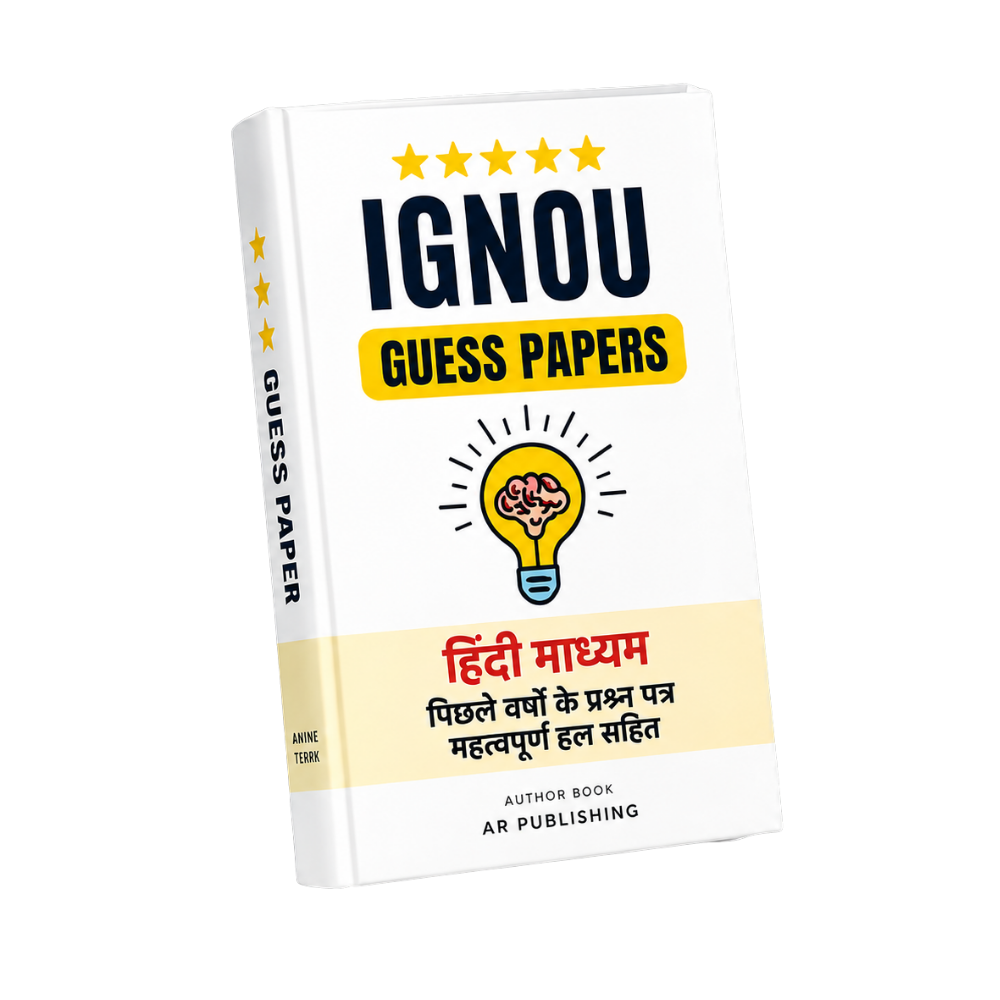
BSOC-102 IGNOU Guess Paper 2026-27
Click to view offer details & terms
Get 10% OFF Instant Discount
Apply this coupon code at checkout to claim your academic discount instantly.
- Applicable on all university study materials
- Valid for up to 8 item(s) per order
- Valid till Oct 31, 2026
Frequently Bought Together
Popular course materials frequently ordered together
Syllabus & Overview
BSOC-102 Guess Paper: Sociology of India-I TEE Exam Strategy
This structured guide aligns with the official IGNOU curriculum for BSOC-102, covering high-weightage topics from previous 5-10 years’ June & December sessions. Focus on 3-hour time management, chapter-wise question distribution, and key scoring areas.
Key Syllabus Blocks for TEE Preparation
- Block-1: Understanding India Major Discourses
- Colonial and post-colonial sociological perspectives (e.g., M.N. Srinivas’ Temple Towns, G.S. Ghurye’s caste studies).
- Critical analysis of Indian Society by S.C. Dube and Social Change in Modern India by Andre Béteille.
- Commonly tested: Comparative regional studies (e.g., North vs. South India’s social structures).
- Block-2: Interrogating Indian Society-I
- Urbanization and rural transformations (focus on Mumbai’s slums and Kerala’s development models).
- Caste dynamics: Dalit movements, Bahujan politics, and Ambedkar’s contributions.
- Previous year patterns: 20-25% weightage on case studies of marginalized groups (e.g., Adivasi communities).
- Block-3: Interrogating Indian Society-II
- Gender and family structures (e.g., Patriarchy in India by Kumari Jayawardena).
- Religion and secularism: Temple entry movements and Sri Aurobindo’s philosophy.
- Exam tip: Contrast rural vs. urban gender roles using data from NSSO reports.
3-Hour Exam Time Management Tips
- Allocate 45 minutes for Block-1 (Discourses) and 60 minutes for Blocks 2-3 combined.
- Prioritize short-answer questions (SAQs) (20 marks) over long answers (30 marks).
- Use past-year Q&A templates for essay-type questions (e.g., ‘Critically evaluate Srinivas’ concept of “Sanskritization”).
Subject-Specific FAQs
- Q: Are diagrams/maps allowed in BSOC-102?
Yes, for Block-2/3 case studies (e.g., caste hierarchy maps, urban migration flows), but label axes clearly.
- Q: How to score in ‘Marginalized Communities’?
Link theoretical frameworks (e.g., Marxist vs. Weberian perspectives) with real-world examples (e.g., Naxalite-affected regions).
Previous Year Paper Insights (June/Dec 2018–2023)
- Block-1: 30% questions on colonial sociology; focus on Dube’s ‘Indian Village’.
- Block-2: 25% on caste; expect questions on Ambedkar’s Annihilation of Caste.
- Block-3: 20% on gender; prioritize Dowry System and Women’s Reservation Act.
Why buy from us?
-
Verified by top professors and 99th percentile students.
-
Always updated to the latest university curriculum.
-
High-quality, printable PDF formats with clear diagrams.
License & Terms
By purchasing this item, you agree to our standard academic license terms. You may use this product for personal study, but you may not resell or redistribute the files online.