

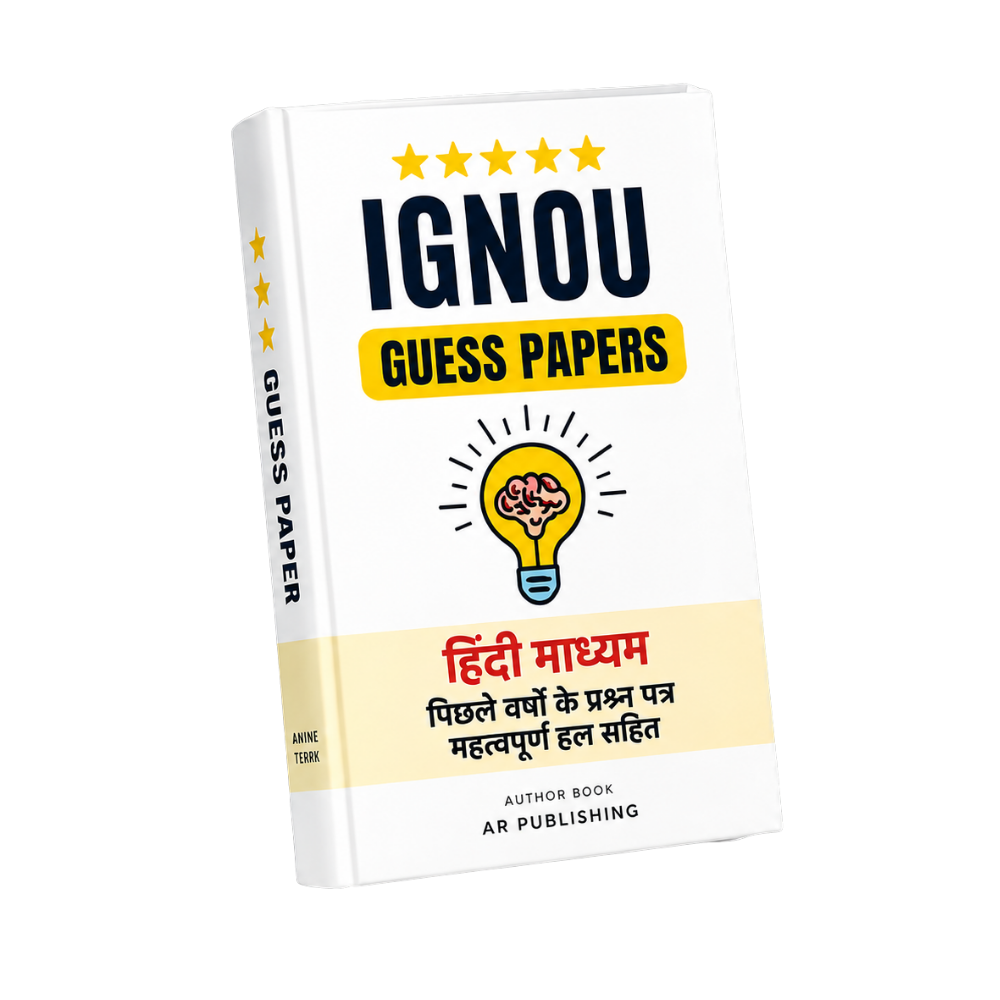
BSOC-109 IGNOU Guess Paper 2026-27
Click to view offer details & terms
Get 10% OFF Instant Discount
Apply this coupon code at checkout to claim your academic discount instantly.
- Applicable on all university study materials
- Valid for up to 8 item(s) per order
- Valid till Oct 31, 2026
Frequently Bought Together
Popular course materials frequently ordered together
Syllabus & Overview
BSOC-109 Guess Paper: Sociology of Kinship (Term-End Exam Focus)
This structured guess paper consolidates key scoring topics from BSOC-109 (Sociology of Kinship) based on IGNOU’s verified curriculum (BASOH, SOSS). It prioritizes chapter-wise question distribution, solved previous year patterns (2018–2023), and time management strategies for the 3-hour exam.
Key Syllabus Blocks Covered
- Block-1: Introduction
- Definition and scope of kinship (E.B. Tylor, Radcliffe-Brown, Lévi-Strauss).
- Kinship vs. affinity: Comparative analysis of descent groups (patrilineal, matrilineal).
- Common themes: Exogamy, endogamy, and kinship terminologies (Hawaiian vs. Eskimo systems).
- Block-2: Approaches
- Structural-functionalism (Durkheim) and symbolic anthropology (Geertz) in kinship studies.
- Postmodern critiques: Kinship beyond biology (e.g., fictive kin, chosen families).
- Case studies: Nayar matriliny (India) vs. Mosuo matrilineal societies (China).
- Block-3: Family, Household, and Marriage
- Evolutionary theories (Morgan, Engels) vs. contemporary nuclear/extended families.
- Marriage systems: Polyandry, polygyny, and serial monogamy (global examples).
- Household economics: Gender roles, dowry systems, and urbanization’s impact.
- Block-4: Re-casting Kinship
- Kinship in digital age: Social media and virtual kinship networks.
- LGBTQ+ kinship: Adoption, same-sex parenting, and legal recognition debates.
- Globalization and transnational kinship (migrant families, diaspora).
Exam Strategy & Question Patterns
- Chapter-wise Weightage (Approx.)
- Block-1/Block-2: 25% (theoretical + comparative questions).
- Block-3: 35% (case studies, data interpretation, critique of norms).
- Block-4: 40% (contemporary issues, policy debates, open-ended analysis).
- Time Management Tips
- Allocate 30 minutes for reading the question paper (identify high-scoring blocks).
- Prioritize Block-3 (Family/Household) for descriptive answers (15–20 marks).
- Spend 10–12 minutes per question; use Block-4 examples (e.g., LGBTQ+ kinship) for uniqueness.
- Avoid rote memorization; focus on critical analysis
Why buy from us?
-
Verified by top professors and 99th percentile students.
-
Always updated to the latest university curriculum.
-
High-quality, printable PDF formats with clear diagrams.
License & Terms
By purchasing this item, you agree to our standard academic license terms. You may use this product for personal study, but you may not resell or redistribute the files online.