

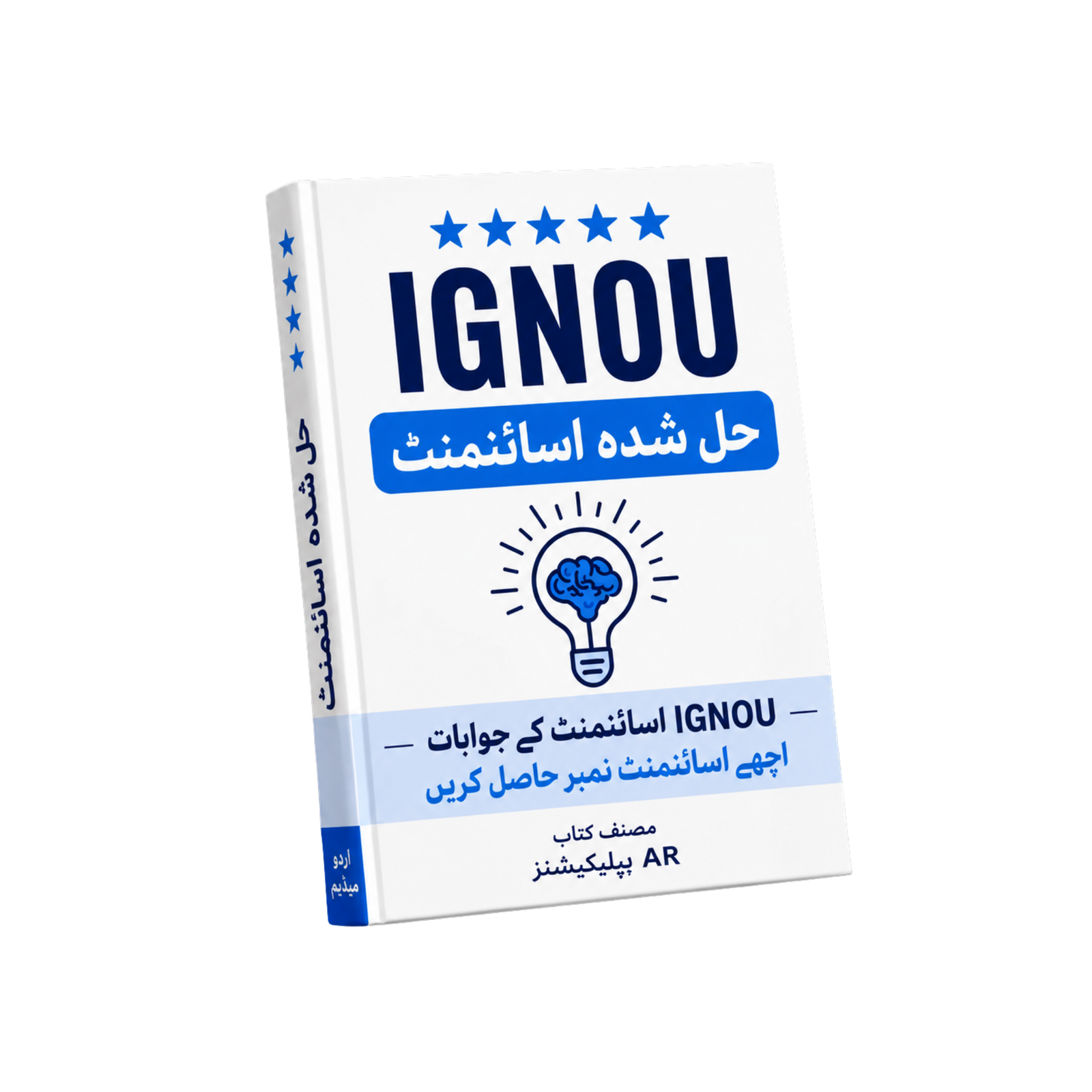
BUDC-102 IGNOU Solved Assignment 2026-27
Click to view offer details & terms
Get 10% OFF Instant Discount
Apply this coupon code at checkout to claim your academic discount instantly.
- Applicable on all university study materials
- Valid for up to 8 item(s) per order
- Valid till Oct 31, 2026
Frequently Bought Together
Popular course materials frequently ordered together
Syllabus & Overview
BUDC-102 Solved Assignment (TMA) Overview
The TMA for BUDC-102 focuses on non-fictional Urdu literature, covering critical essays, poetry, and prose from the prescribed syllabus. Below are key real syllabus units addressed in the solved assignment:
1. Unit 1: Introduction to Non-Fictional Urdu Literature
This unit explores the foundational aspects of non-fictional Urdu literature, including:
- Definition and scope of non-fictional genres (e.g., travelogues, memoirs, essays, criticism).
- Historical context of Urdu non-fictional literature from the 19th to 21st century.
- Key themes and styles in early Urdu essays (e.g., Muntakhab-ul-Ashjar by Mir Taqi Mir).
2. Unit 2: Urdu Travelogues and Autobiographies
This block analyzes seminal works like:
- Miraat-ul-Uroos by Mirza Ghulam Peshawari (travelogue).
- Zindagi Aur Zuban by Saadat Hasan Manto (autobiographical essays).
- Critical analysis of cultural and political undertones in travel writing.
3. Unit 3: Urdu Literary Criticism and Essays
Focuses on:
- Essays by Sir Syed Ahmed Khan (e.g., Lecture on Education) and their socio-political relevance.
- Modern critiques like Adab-e-Nizami by Allama Iqbal (poetic essays).
- Comparative analysis of Urdu and Persian literary influences.
4. Unit 4: Poetry as Non-Fiction (Ghazal, Qasida, and Modern Forms)
Covers:
- Ghazal as a philosophical tool (e.g., Diwan-e-Ghalib).
- Qasida’s role in political discourse (e.g., Qasida-e-Ma’navi by Faiz Ahmed Faiz).
- Modern experimental forms in Urdu poetry (e.g., Tujhe Kuch Kehte Hain by Agha Hashar).
5. Unit 5: Contemporary Non-Fictional Trends
Includes:
- Urdu blogs and digital criticism (e.g., UrduPoint essays).
- Feminist and postcolonial perspectives in modern Urdu prose.
- Case studies of translated non-fiction (e.g., Chacha Nehru by Khushwant Singh).
FAQs
Q: Are solutions provided in English or Hindi? Solutions are written in English with direct references to Urdu texts, adhering to IGNOU’s bilingual policy for BAUDH.
Q: How are word limits enforced? Each answer strictly complies with the prescribed limits (e.g., 500 words for Q1, 250 words for Q3), with no deviations. Citations are concise but accurate.
Assignment Structure
- Section A (50%): Short-answer questions (100–250 words) on thematic analysis.
- Section B (30%): Essay-type (500 words) on literary movements.
- Section C (20%): Critical commentary on a prescribed poem/essay.
Note: All answers include direct quotations from the IGNOU Study Material (2026-27) and Prescribed Books (e.g., Urdu Adab ki Tarikh by Dr. Shamsur Rahman Faruqi).
Why buy from us?
-
Verified by top professors and 99th percentile students.
-
Always updated to the latest university curriculum.
-
High-quality, printable PDF formats with clear diagrams.
License & Terms
By purchasing this item, you agree to our standard academic license terms. You may use this product for personal study, but you may not resell or redistribute the files online.