

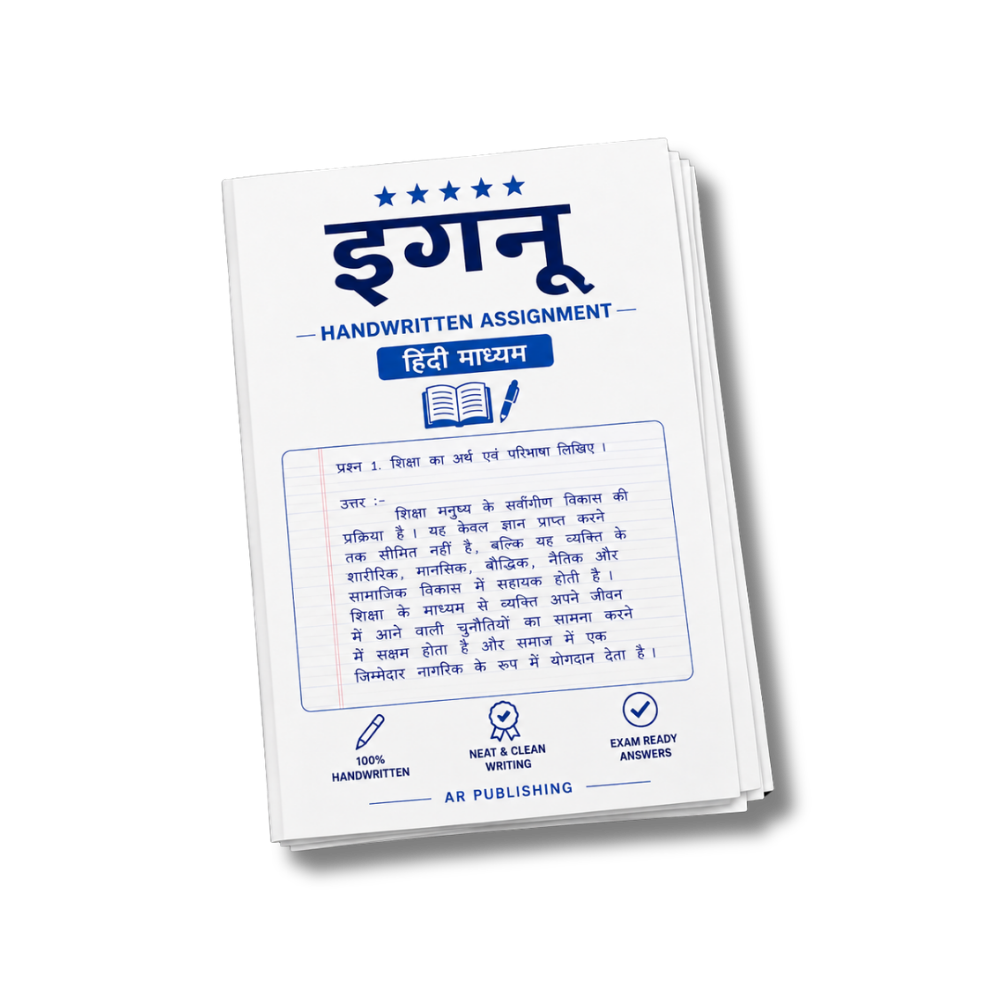
CBKG-001 IGNOU Handwritten Assignment 2026-27
Click to view offer details & terms
Get 10% OFF Instant Discount
Apply this coupon code at checkout to claim your academic discount instantly.
- Applicable on all university study materials
- Valid for up to 8 item(s) per order
- Valid till Oct 31, 2026
Enrolled in other IGNOU subjects?
Link your Enrollment No. to auto-map all your semester courses & free question papers.
Frequently Bought Together
Popular course materials frequently ordered together
Syllabus & Overview
Course Scope and Syllabus Overview for CBKG-001: -
CBKG-001: is a specialized course under IGNOU’s Certificate Programme in Indian Chronology (CBKG), designed to explore the philosophical and historical dimensions of time across Indian and global traditions. This course examines the conceptual frameworks of time in classical Indian thought, comparative temporal philosophies, and the intersection of ancient calendrical systems with modern chronology. It equips students with critical analytical tools to interpret textual, archaeological, and cultural evidence, bridging traditional knowledge with contemporary scholarly debates. The curriculum ensures a rigorous engagement with primary sources while maintaining relevance to contemporary academic discourse.Key Syllabus Units and Topics
- -1 : This unit delves into foundational concepts of time in Indian philosophy, including the distinction between (time) and (chronology), with references to Vedic, Puranic, and medieval texts. It explores how temporal frameworks in Indian thought differ from Western linear chronology, emphasizing cyclical and ritualistic time structures.
- -2 : Focuses on the epistemological and ontological nature of time, analyzing how Indian scholars (e.g., Adi Shankaracharya, Ramanujacharya) conceptualized time as a metaphysical entity. It contrasts these views with global philosophical traditions, such as Aristotelian or Buddhist temporal theories, to highlight cross-cultural nuances.
- -3 : Traces the evolution of Indian chronology from the to medieval astronomical texts like the and . It evaluates the methodological rigor of these systems and their influence on global calendrical practices.
- -4 : Examines how temporal structures shape cultural practices, rituals, and historical narratives in India, including the role of in royal chronicles, temple architecture, and literary traditions. Comparative studies with non-Indian cultural timekeeping systems are also included.
- -5 : Assesses contemporary applications of Indian temporal theories in archaeology, astrophysics, and digital humanities. It critiques modern adaptations of ancient chronologies while emphasizing their enduring relevance in interdisciplinary research.
Frequently Asked Questions
Q: What is the marking scheme for the CBKG-001 examination, and how are assignments weighted?
A: The CBKG-001 examination follows IGNOU’s standard pattern: 80% weightage for the theory paper and 20% for assignments. Assignments are typically worth 20 marks each, with a pass mark of 50% in both components combined. Submission deadlines are strictly enforced, and late assignments incur penalties.
Q: Are there any recommended reference texts beyond the course material for effective preparation?
A: While the prescribed study material (including textbooks and assignments) is sufficient, students may consult supplementary works like by Dr. R. S. Sharma or Indian Chronology by Dr. K. V. Ramesh for deeper insights. However, adherence to the syllabus ensures comprehensive coverage for examination purposes.
Why buy from us?
-
Verified by top professors and 99th percentile students.
-
Always updated to the latest university curriculum.
-
High-quality, printable PDF formats with clear diagrams.
License & Terms
By purchasing this item, you agree to our standard academic license terms. You may use this product for personal study, but you may not resell or redistribute the files online.