

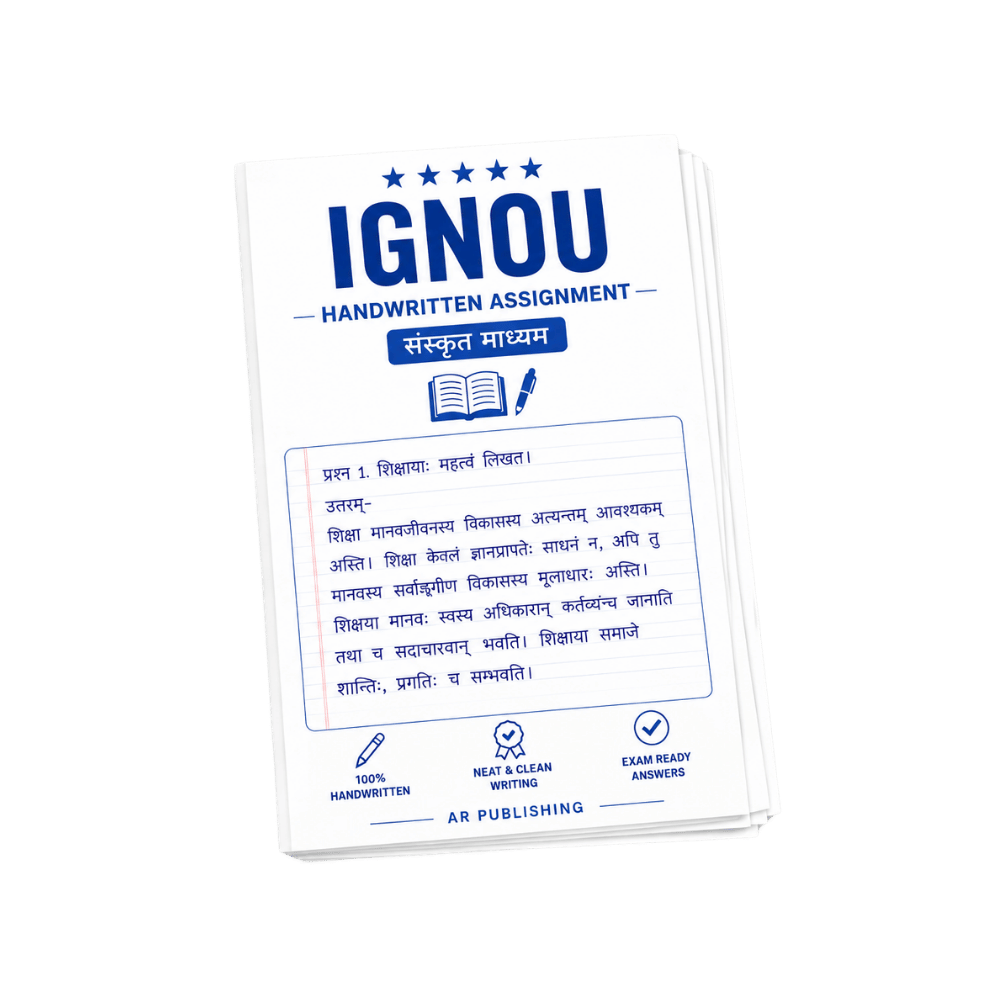
CBKG-002 IGNOU Handwritten Assignment 2026-27
Click to view offer details & terms
Get 10% OFF Instant Discount
Apply this coupon code at checkout to claim your academic discount instantly.
- Applicable on all university study materials
- Valid for up to 8 item(s) per order
- Valid till Oct 31, 2026
Enrolled in other IGNOU subjects?
Link your Enrollment No. to auto-map all your semester courses & free question papers.
Frequently Bought Together
Popular course materials frequently ordered together
Syllabus & Overview
Course Scope and Academic Rigour in CBKG-002:
CBKG-002: is a specialized course under the Bachelor of Arts in Applied Sanskrit (BAASK) curriculum, designed to equip students with foundational and advanced techniques of Indian chronology. This course bridges historical accuracy with linguistic precision, enabling learners to decode ancient and medieval temporal systems while applying them to textual analysis. The syllabus emphasizes both theoretical frameworks and practical applications, ensuring students can interpret calendar systems, astronomical correlations, and ritual timings as documented in Sanskrit literature. Through structured assignments, students develop critical analytical skills to reconstruct historical timelines and contextualize textual references within their chronological frameworks.Core Syllabus Units and Methodological Focus
- -1 -1: This unit explores the foundational principles of Indian chronology, including the origins of the Hindu calendar system, lunar and solar cycles, and the significance of and frameworks. Students analyze primary texts such as the , , and to understand temporal classifications and their cultural implications.
- -2 -2: The second block delves into advanced methodologies for calculating historical dates, focusing on the and traditions. It covers the correlation between astronomical observations and textual chronicles, enabling students to reconstruct event timelines with precision.
- : This segment examines ancient and medieval chronicles (, , ) to trace the evolution of Indian temporal systems. Students learn to cross-reference textual accounts with archaeological and epigraphic evidence.
- : The unit evaluates contemporary adaptations of traditional calendars, including the and , and their relevance in modern academic and ritual contexts. Practical exercises involve calculating dates for festivals and historical events.
- : This block addresses linguistic complexities in temporal terminology, such as , , and , and their semantic variations across regional dialects. Students engage in comparative analysis to resolve ambiguities in historical texts.
Frequently Asked Questions
Q: What is the passing mark requirement for CBKG-002 assignments, and how are they evaluated?
A: The minimum passing mark for CBKG-002 assignments is 40%, with evaluation based on accuracy, logical coherence, and adherence to prescribed methodologies. Assignments are graded on a scale of 20 marks, where clarity of chronology reconstruction and textual referencing are prioritized.
Q: Are there any specific guidelines for referencing historical texts in CBKG-002 assignments?
A: Yes, students must cite primary sources (e.g., , ) using standard IGNOU referencing formats, including author, text name, and relevant or chapter references. Unverified or speculative interpretations are penalized, as the course emphasizes empirical validation.
Why buy from us?
-
Verified by top professors and 99th percentile students.
-
Always updated to the latest university curriculum.
-
High-quality, printable PDF formats with clear diagrams.
License & Terms
By purchasing this item, you agree to our standard academic license terms. You may use this product for personal study, but you may not resell or redistribute the files online.