

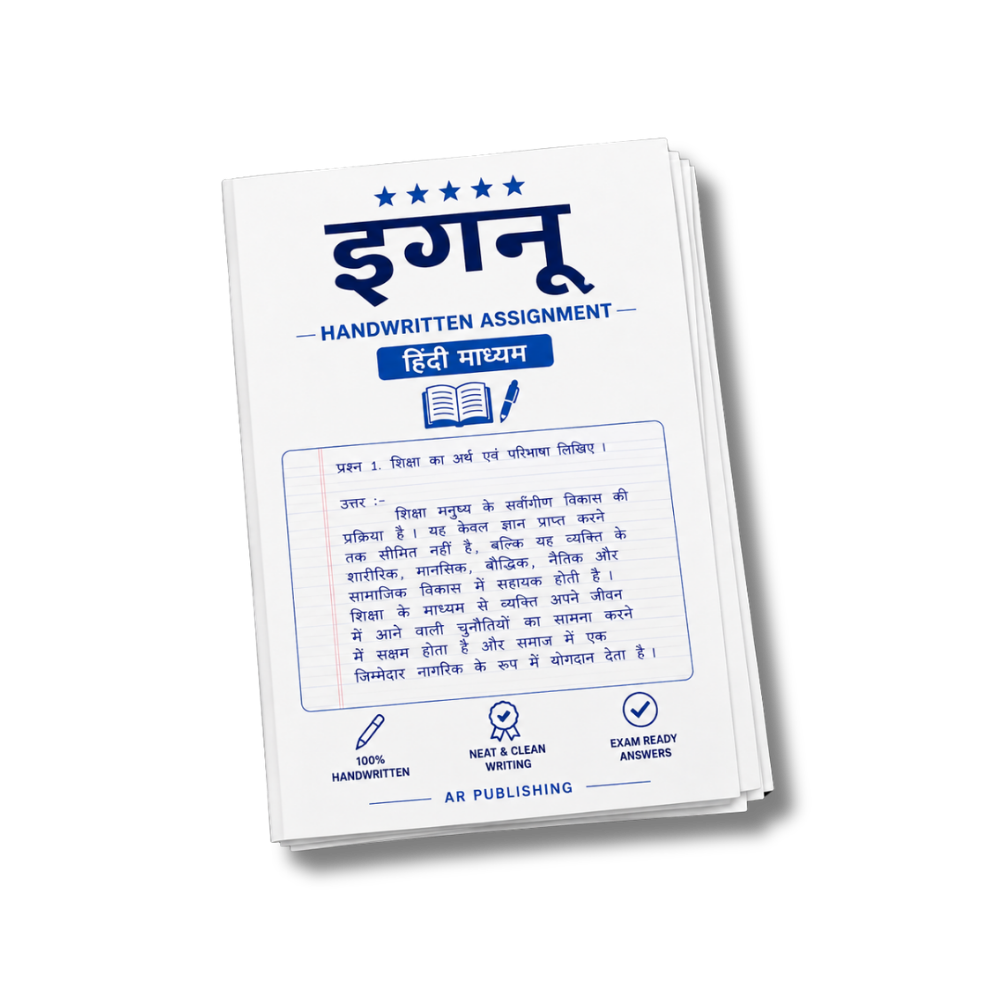
CBKG-003 IGNOU Handwritten Assignment 2026-27
Click to view offer details & terms
Get 10% OFF Instant Discount
Apply this coupon code at checkout to claim your academic discount instantly.
- Applicable on all university study materials
- Valid for up to 8 item(s) per order
- Valid till Oct 31, 2026
Enrolled in other IGNOU subjects?
Link your Enrollment No. to auto-map all your semester courses & free question papers.
Frequently Bought Together
Popular course materials frequently ordered together
Syllabus & Overview
Course Scope and Academic Objectives for CBKG-003:
CBKG-003: is a specialized course under IGNOU’s Certificate in Indian Calendar System (CBKG) program, designed to provide students with a comprehensive understanding of traditional and global calendrical systems. This course bridges historical, linguistic, and cultural dimensions by examining the intricacies of Indian calendars (e.g., Panchang, Vikram Samvat) alongside major world calendars (Gregorian, Islamic, Hebrew). Students explore the mathematical, astronomical, and societal foundations of these systems, enhancing their ability to interpret temporal frameworks across civilizations. The curriculum fosters critical analysis of how calendars shape rituals, governance, and daily life, preparing learners for scholarly or practical applications in cultural studies, history, or literature.Key Syllabus Units and Topics
- -1 : This unit delves into the structure and significance of the Indian Panchang, including its lunar-solar framework, Tithi (lunar day), Nakshatra (asterism), and Yogas. Students analyze its role in religious ceremonies, agricultural cycles, and traditional timekeeping methods.
- : A comparative study of regional Indian calendars such as the Malayalam, Tamil, and Bengali Panchang, highlighting their unique adaptations and shared astronomical principles.
- -2 : This segment examines the Gregorian, Islamic, Hebrew, and Chinese calendars, focusing on their historical evolution, leap-year mechanisms, and cultural impact. Case studies illustrate how these systems influence global events and religious observances.
- : An exploration of how international date formats (e.g., ISO 8601) are derived from these calendars, emphasizing their relevance in modern diplomacy, technology, and cross-cultural communication.
- : This unit investigates the linguistic nuances in calendar terminology across languages, including Sanskrit, Arabic, and Latin, and their reflection in literary and philosophical texts.
Frequently Asked Questions
Q: What is the marking scheme for CBKG-003’s assignments, and how many assignments are there in total?
A: The CBKG-003 course includes two mandatory assignments, each carrying 20 marks (total 40 marks). These assignments account for 20% of the final grade, while the theory examination contributes 60% and the practical/viva 20%. Clear adherence to the prescribed format and depth of analysis is critical for maximizing scores.
Q: Are there any specific pass marks or criteria for the CBKG-003 examination, and how is the theory paper structured?
A: The theory examination for CBKG-003 follows a 100-mark pattern, with a minimum pass percentage of 40% required. The paper typically includes objective and descriptive questions, covering all syllabus units (-1 and -2). Focus on conceptual clarity and application-based answers to meet the passing threshold effectively.
Why buy from us?
-
Verified by top professors and 99th percentile students.
-
Always updated to the latest university curriculum.
-
High-quality, printable PDF formats with clear diagrams.
License & Terms
By purchasing this item, you agree to our standard academic license terms. You may use this product for personal study, but you may not resell or redistribute the files online.