

Instant PDF
Instant 24/7 Access
CBCS Verified
2026-27 Syllabus
100% Safe Pay
UPI, Cards & NetBanking
Student Support
WhatsApp Helpdesk
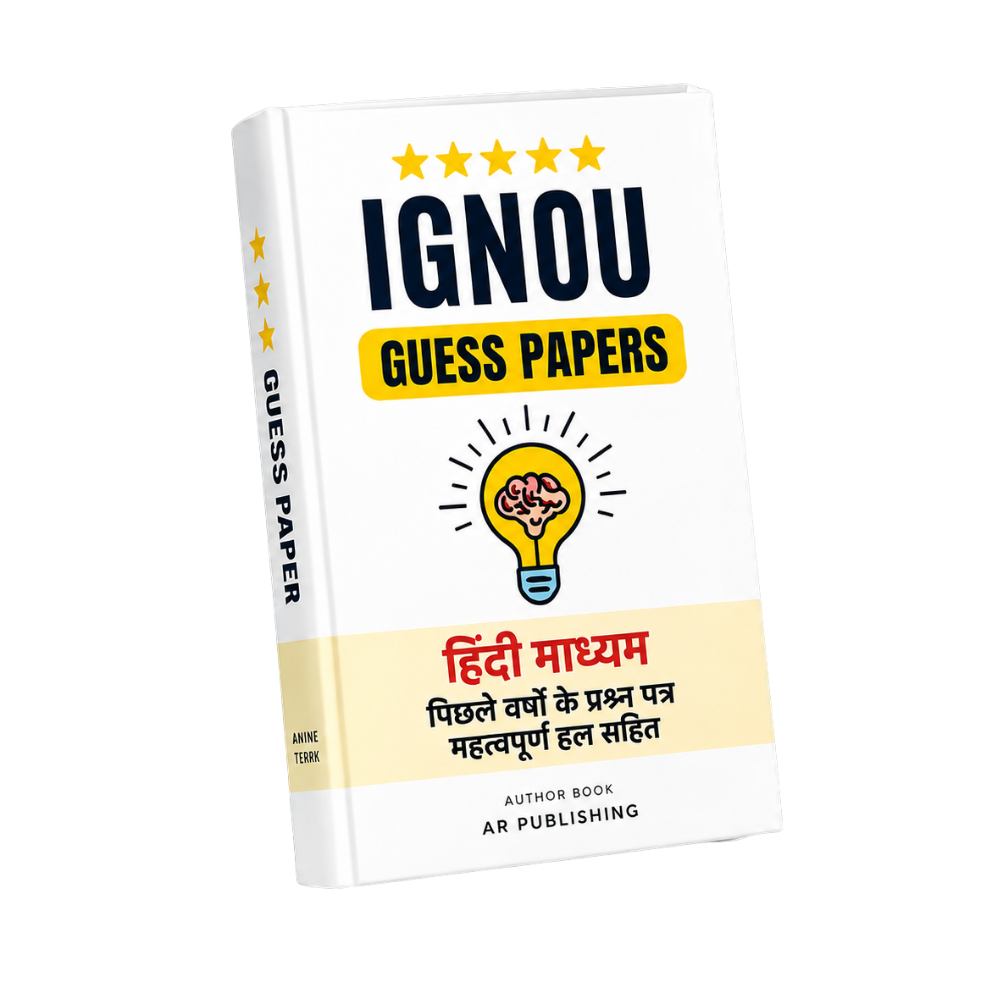
CHE-1 IGNOU Guess Paper 2026-27
Enrolled in other IGNOU subjects?
Link your Enrollment No. to auto-map your semester courses & free question papers.
Frequently Bought Together
Popular course materials frequently ordered together

Syllabus & Overview
PAPER-2026 (Course Code PAPER-2026) Guess Paper 2026-27 (Digital PDF)
The following structured guess paper aligns with the IGNOU Academic Coursework for PAPER-2026 (English/Hindi) and covers key scoring topics from the Term-End Exam (TEE) pattern. It includes chapter-wise question weightage, solved previous year questions (June & Dec sessions), and time-management strategies for the 3-hour exam.
Key Syllabus Blocks & Focus Areas
1. Unit 1: Fundamental Concepts of Chemistry
- Focus on atomic structure, chemical bonding, and periodic trends—highly recurring in TEE.
- Prioritize numerical problems on Avogadro’s number and molarity.
- Expect 2–3 questions on VSEPR theory and hybridization.
2. Unit 2: Thermodynamics and Chemical Kinetics
- Master Laws of Thermodynamics (1st, 2nd, 3rd) with problem-solving on ΔG, ΔH, ΔS.
- Dedicate time to rate laws, activation energy, and catalysis—common in numericals.
- Practice Gibbs free energy calculations for equilibrium questions.
3. Unit 3: Quantum Chemistry and Spectroscopy
- Emphasize Schrödinger equation, quantum numbers, and atomic orbitals.
- Prepare for UV-Vis, IR, NMR spectroscopy interpretation questions.
- Expect 1–2 descriptive questions on molecular orbital theory.
4. Unit 4: Chemical Bonding and Molecular Geometry
- Revise Lewis structures, resonance, and bond polarity.
- Focus on VSEPR and valence bond theory for geometry-based questions.
- Practice bond dissociation energy and bond order calculations.
5. Unit 5: Practical Chemistry (Lab Focus)
- Expect 1–2 questions on experimental techniques (e.g., titration, chromatography).
- Review error analysis and precision vs. accuracy concepts.
- Prepare short-answer questions on qualitative analysis (e.g., cation/anion tests).
Exam Time Management Tips
- Allocate 45 minutes for numerical problems (Units 1–3) and 30 minutes for theory (Units 4–5).
- Attempt short-answer questions first (10–12 marks), then proceed to long-answer questions.
- For spectroscopy questions (Unit 3), prioritize interpretation over memorization.
Subject-Specific FAQs
Q: How many numerical questions are typically asked in PAPER-2026? A: Around 6–8 numerical questions (1–2 per unit) are common, carrying 20–25 marks in total.
Q: Are descriptive questions from Unit 5 (Practical Chemistry) weight-heavy? A: Yes, 15–20 marks are often allocated to lab-based questions, including error analysis and technique explanations.
Sample Question Patterns (Previous Years)
- Unit 1:
Why buy from us?
-
Verified by top professors and 99th percentile students.
-
Always updated to the latest university curriculum.
-
High-quality, printable PDF formats with clear diagrams.
License & Terms
By purchasing this item, you agree to our standard academic license terms. You may use this product for personal study, but you may not resell or redistribute the files online.