

EHI-01 IGNOU Guess Paper 2026-27
Click to view offer details & terms
Get 10% OFF Instant Discount
Apply this coupon code at checkout to claim your academic discount instantly.
- Applicable on all university study materials
- Valid for up to 8 item(s) per order
- Valid till Oct 31, 2026
Enrolled in other IGNOU subjects?
Link your Enrollment No. to auto-map all your semester courses & free question papers.
Frequently Bought Together
Popular course materials frequently ordered together
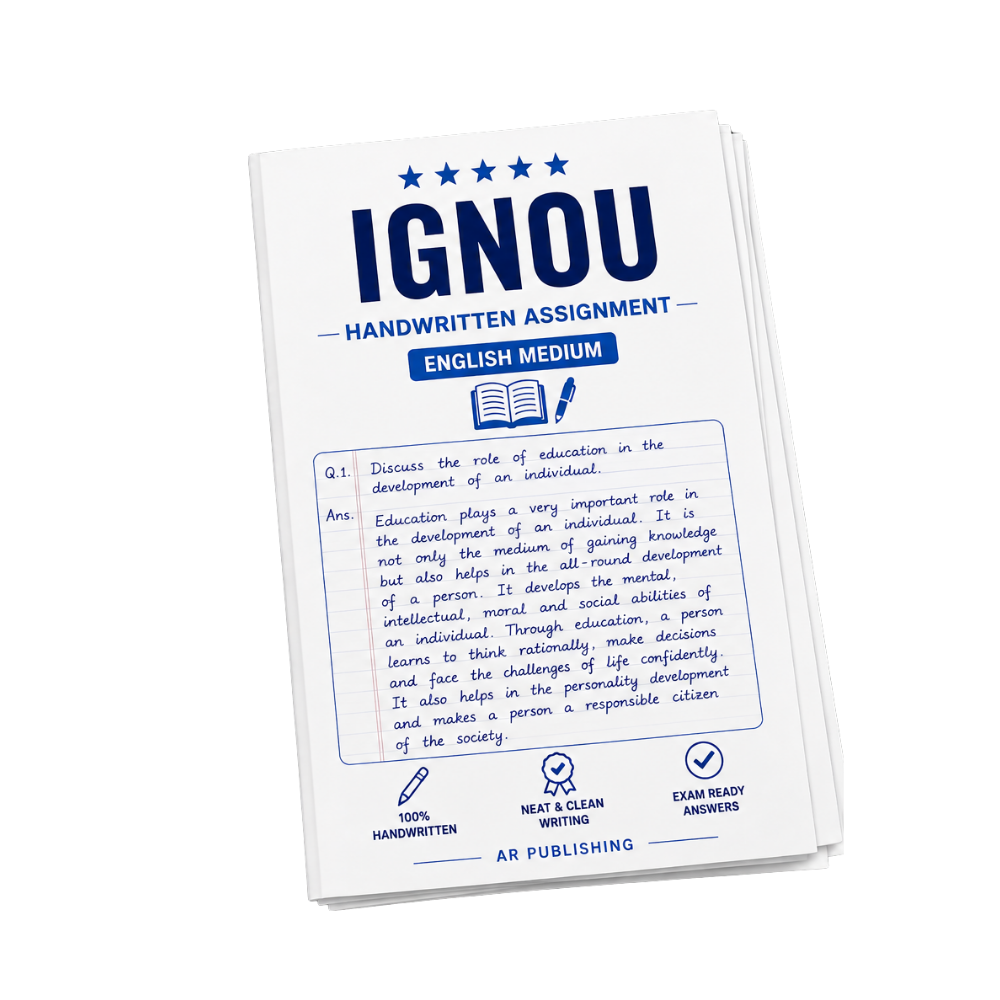
Syllabus & Overview
Course Scope & Syllabus Overview for EHI-01: Modern India 1857–1964
EHI-01, offered under the School of Humanities (SOH) as an elective course, examines the socio-political and cultural transformations of India from the 1857 Uprising to the mid-1960s. Rooted in the CBCS curriculum, this course critically analyses the interplay between imperialism, nationalism, and decolonisation, tracing the evolution of organised political movements, ideological shifts, and the eventual transition to an independent nation-state. It integrates primary sources, theoretical frameworks, and case studies to contextualise key events—such as the rise of Gandhian non-violence, the partition crisis, and the early challenges of post-independence governance—while emphasising analytical rigor and historical nuance. The structured syllabus ensures students develop a nuanced understanding of India’s modern identity, preparing them for rigorous term-end evaluations.Key Syllabus Units & Topics
- Block-1: Imperialism, Colonialism and Nationalism: Explores the economic and ideological foundations of British colonial rule, the 1857 Revolt as a precursor to nationalist consciousness, and the emergence of early reformist and separatist movements in the 19th century.
- Block-3: Radical Trends, Nationalism and Mahatma Gandhi: Analyses the ideological divergence between militant radicalism (e.g., revolutionary terrorists) and Gandhian pacifism, alongside the philosophical underpinnings of Swaraj and Satyagraha as strategic tools of resistance.
- Block-5: Nationalism: Inter-War Year-II: Focuses on the Quit India Movement (1942) and the escalating civil disobedience campaigns, evaluating their impact on British policy and the acceleration of decolonisation.
- Block-7: Towards a Sovereign State: Investigates the constitutional debates of the 1940s, the partition’s human and political consequences, and the drafting of the Indian Constitution, including the tensions between secularism and communalism.
- Block-8: Independent India: Towards Development 1947–1964: Examines Nehruvian socialism, the planning commission’s early priorities, and the ideological struggles between capitalism and state-led industrialisation in post-independence India.
Frequently Asked Questions
Q: How are marks distributed in the EHI-01 Term-End Examination (TEE), and what weightage does each section carry?
A: The TEE for EHI-01 typically allocates 80 marks to written answers (divided into objective and descriptive questions) and 20 marks to internal assignments. The question paper follows a 3:2 ratio for theory and practical/application-based questions, with Blocks 1–5 and 7–8 receiving equal emphasis in the exam pattern.
Q: Are there specific chapters or topics in EHI-01 that frequently repeat in past TEE question papers, and how can students prioritise revision?
A: Blocks 3 (Radical Trends, Nationalism and Mahatma Gandhi) and 5 (Nationalism: Inter-War Year-II) consistently feature in repeated questions due to their pivotal role in shaping India’s political trajectory. Students should prioritise these units while cross-referencing solved past papers to identify recurring themes like Gandhian strategies, the 1942 Movement, and constitutional debates.
Why buy from us?
-
Verified by top professors and 99th percentile students.
-
Always updated to the latest university curriculum.
-
High-quality, printable PDF formats with clear diagrams.
License & Terms
By purchasing this item, you agree to our standard academic license terms. You may use this product for personal study, but you may not resell or redistribute the files online.