

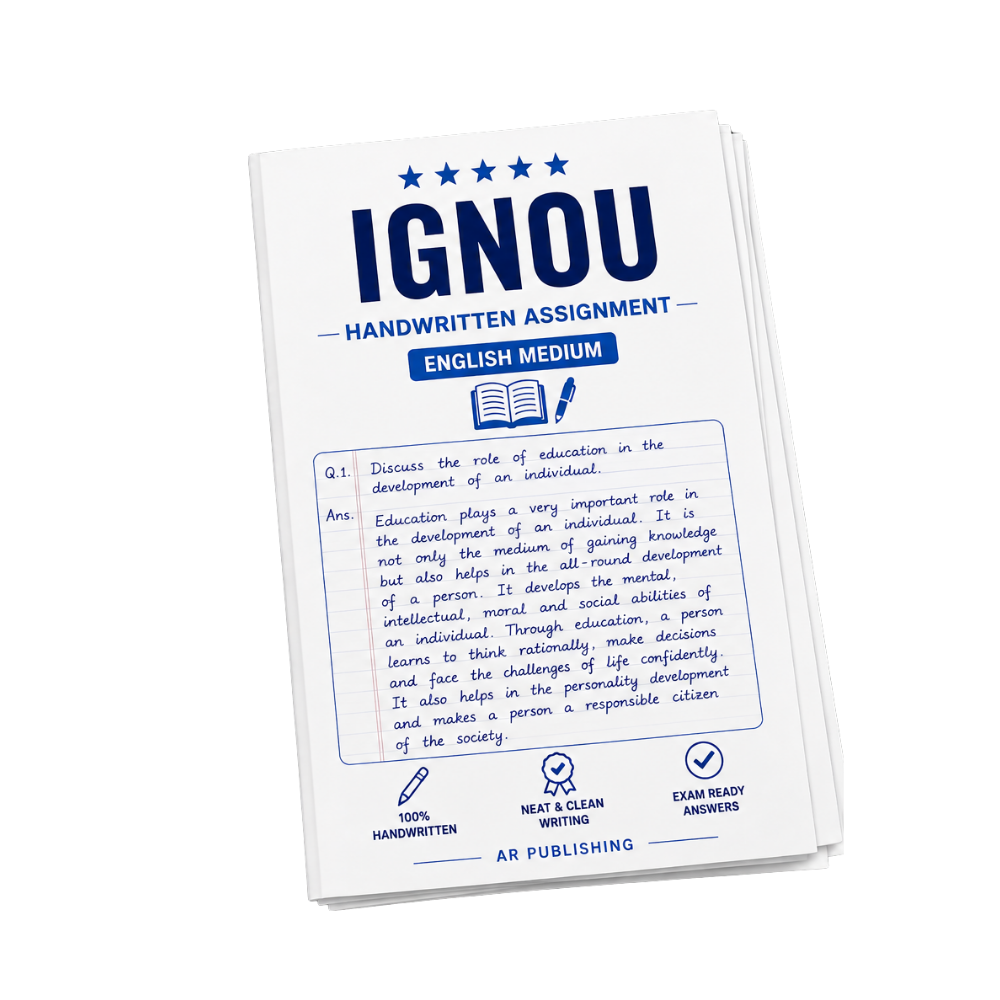
LSE-01 IGNOU Handwritten Assignment 2026-27
Click to view offer details & terms
Get 10% OFF Instant Discount
Apply this coupon code at checkout to claim your academic discount instantly.
- Applicable on all university study materials
- Valid for up to 8 item(s) per order
- Valid till Oct 31, 2026
Enrolled in other IGNOU subjects?
Link your Enrollment No. to auto-map all your semester courses & free question papers.
Frequently Bought Together
Popular course materials frequently ordered together

Syllabus & Overview
Course Scope & Syllabus Overview for LSE-01: Cell Biology (B.Sc.)
Cell Biology (LSE-01) is a core component of the Bachelor of Science curriculum under IGNOU’s School of Sciences, designed to provide foundational insights into the structure, function, and dynamics of cells—the fundamental units of life. This course bridges molecular biology, biochemistry, and cell physiology, equipping students with analytical tools to understand cellular processes such as metabolism, communication, and differentiation. Through a structured CBCS framework, the syllabus emphasizes both theoretical depth and practical relevance, ensuring students grasp how cellular mechanisms underpin broader biological phenomena, from disease pathways to evolutionary adaptations. The assignment solutions reflect this rigor, offering meticulously crafted responses aligned with IGNOU’s assessment criteria and academic standards.
Key Syllabus Units & Topics
- Block-1: Introduction to Cell Biology: Covers the historical evolution of cell theory, fundamental concepts of cell structure (prokaryotic vs. eukaryotic), and the role of light/electron microscopy in cellular visualization. Emphasizes the chemical composition of cells, including macromolecules like proteins, lipids, and nucleic acids, and their functional significance.
- Block-2: Cell Membranes and Enzymes: Explores the fluid mosaic model of cell membranes, transport mechanisms (passive/active), and the role of membrane proteins in signaling and recognition. Analyzes enzyme kinetics, regulation, and classification, with applications in metabolic pathways and biochemical engineering.
- Block-3: Metabolism and Communication in Cells: Details catabolic and anabolic pathways (e.g., glycolysis, Krebs cycle, oxidative phosphorylation), energy currency (ATP), and signal transduction pathways (e.g., G-protein-coupled receptors). Highlights intercellular communication via hormones, neurotransmitters, and gap junctions.
- Block-4: Cell Division, Cell Movement, and Differentiated Cell Types: Discusses the stages of mitosis/meiosis, cell cycle regulation, and genetic consequences of errors. Examines mechanisms of cell motility (e.g., cytoskeleton dynamics) and the specialization of cell types (e.g., neurons, muscle cells) through differentiation and stem cell biology.
Frequently Asked Questions
Q: What is the marking scheme for the LSE-01 assignment, and how many questions are typically assigned per unit?
A: The LSE-01 assignment carries 30% of the total course weight, with questions distributed across all four blocks. Each unit (Block) usually includes 2–3 questions, requiring detailed explanations or case-based applications, with internal marks allocated for accuracy, clarity, and adherence to biological principles.
Q: Are there specific pass marks for the LSE-01 assignment, and how does it impact the final grade?
A: The minimum pass mark for the LSE-01 assignment is 40% of the total assigned marks. While it contributes 30% to the final course grade, securing above 50% ensures a strong foundation for the term-end examination, which accounts for the remaining 70% of the evaluation.
Why buy from us?
-
Verified by top professors and 99th percentile students.
-
Always updated to the latest university curriculum.
-
High-quality, printable PDF formats with clear diagrams.
License & Terms
By purchasing this item, you agree to our standard academic license terms. You may use this product for personal study, but you may not resell or redistribute the files online.