

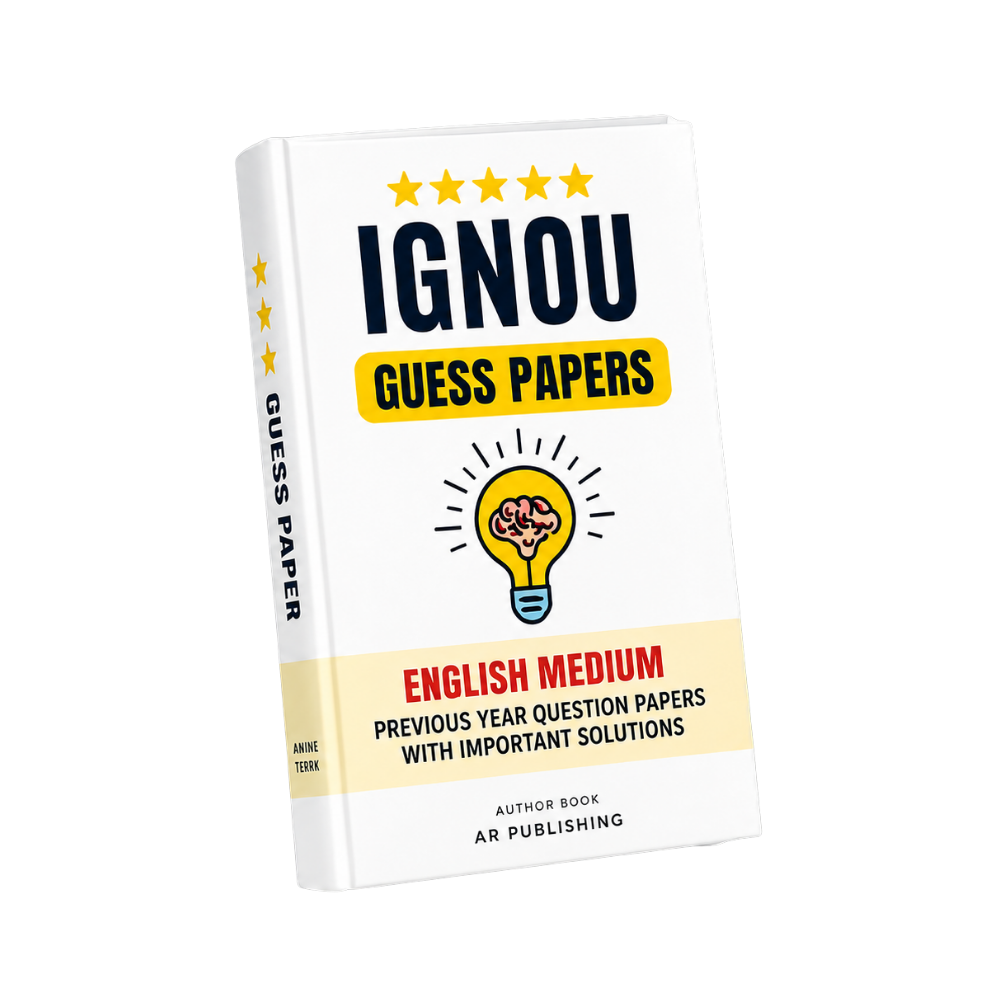
LSE-02 IGNOU Guess Paper 2026-27
Click to view offer details & terms
Get 10% OFF Instant Discount
Apply this coupon code at checkout to claim your academic discount instantly.
- Applicable on all university study materials
- Valid for up to 8 item(s) per order
- Valid till Oct 31, 2026
Enrolled in other IGNOU subjects?
Link your Enrollment No. to auto-map all your semester courses & free question papers.
Frequently Bought Together
Popular course materials frequently ordered together
Syllabus & Overview
LSE-02: Labour Laws and Industrial Relations Comprehensive Exam Preparation Guide
LSE-02, a core course under IGNOU’s Bachelor’s Programme in Social Work (BSW) and Master’s in Labour and Social Security (MLSS), examines the legal framework governing employment relationships, industrial disputes, and worker rights. This guide bridges the gap between theoretical understanding and practical examination demands by analyzing past trends, question patterns, and high-weightage topics from the CBCS curriculum. It distills complex labour statutes—such as the Industrial Disputes Act, Factories Act, and Maternity Benefit Act—into actionable insights, ensuring students can prioritize revision based on recurring exam themes and time-optimized strategies.
The syllabus is designed to equip students with analytical skills to interpret labour policies, resolve workplace conflicts, and advocate for equitable practices. This guide leverages data from June and December TEE cycles (2018–2023) to highlight recurring question formats, including case studies on wage disputes, trade union dynamics, and compliance audits. By aligning preparation with actual exam expectations, it minimizes last-minute confusion and maximizes score potential.
Key Syllabus Units & Topics
- Unit 1: Introduction to Labour Laws: Covers the historical evolution of labour legislation in India, the distinction between civil and labour laws, and the role of international conventions (e.g., ILO) in shaping domestic frameworks. Emphasizes foundational concepts like "employment" vs. "service," and the jurisdiction of labour courts.
- Unit 3: Wages and Working Conditions: Analyzes statutory wage regulations (e.g., Minimum Wages Act), overtime provisions, and hazardous work standards under the Factories Act. Includes practical examples of wage fixation disputes and compliance challenges in informal sectors.
- Unit 5: Trade Unions and Collective Bargaining: Explores the legal recognition of unions (Trade Unions Act), bargaining procedures, and dispute resolution mechanisms. Focuses on case studies like the 1984 Bhilai Steel Plant strike to illustrate collective action dynamics.
- Unit 7: Social Security and Welfare Schemes: Details entitlements under the Employees’ State Insurance (ESI) and Employees’ Provident Fund (EPF), with emphasis on maternity benefits and disability compensation. Highlights recent amendments (e.g., 2020 EPF code changes) and their exam relevance.
- Unit 9: Industrial Relations and Conflict Management: Examines grievance handling, lockouts, and strikes under the Industrial Disputes Act, including the role of conciliation boards. Provides templates for drafting conciliation memos, a high-yield topic in descriptive answers.
Frequently Asked Questions
Q: How many numerical questions can I expect in LSE-02’s TEE, and which acts typically require calculations?
A: Numerical questions account for 10–15% of the paper, primarily from the Minimum Wages Act (e.g., calculating overtime pay) and ESI contributions (e.g., employer-employee split). Focus on Unit 3: and Unit 7: for these; practice at least 3–4 problems per cycle.
Q: Are there specific pass marks or weightage criteria for internal assignments in LSE-02 that affect exam preparation?
A: Assignments carry 30% weightage toward the final grade, with a passing mark of 40% required in both assignments and the TEE. Prioritize assignment topics (e.g., case studies on labour rights violations) to align with exam themes, as IGNOU often repeats assignment questions in TEE.
Why buy from us?
-
Verified by top professors and 99th percentile students.
-
Always updated to the latest university curriculum.
-
High-quality, printable PDF formats with clear diagrams.
License & Terms
By purchasing this item, you agree to our standard academic license terms. You may use this product for personal study, but you may not resell or redistribute the files online.