

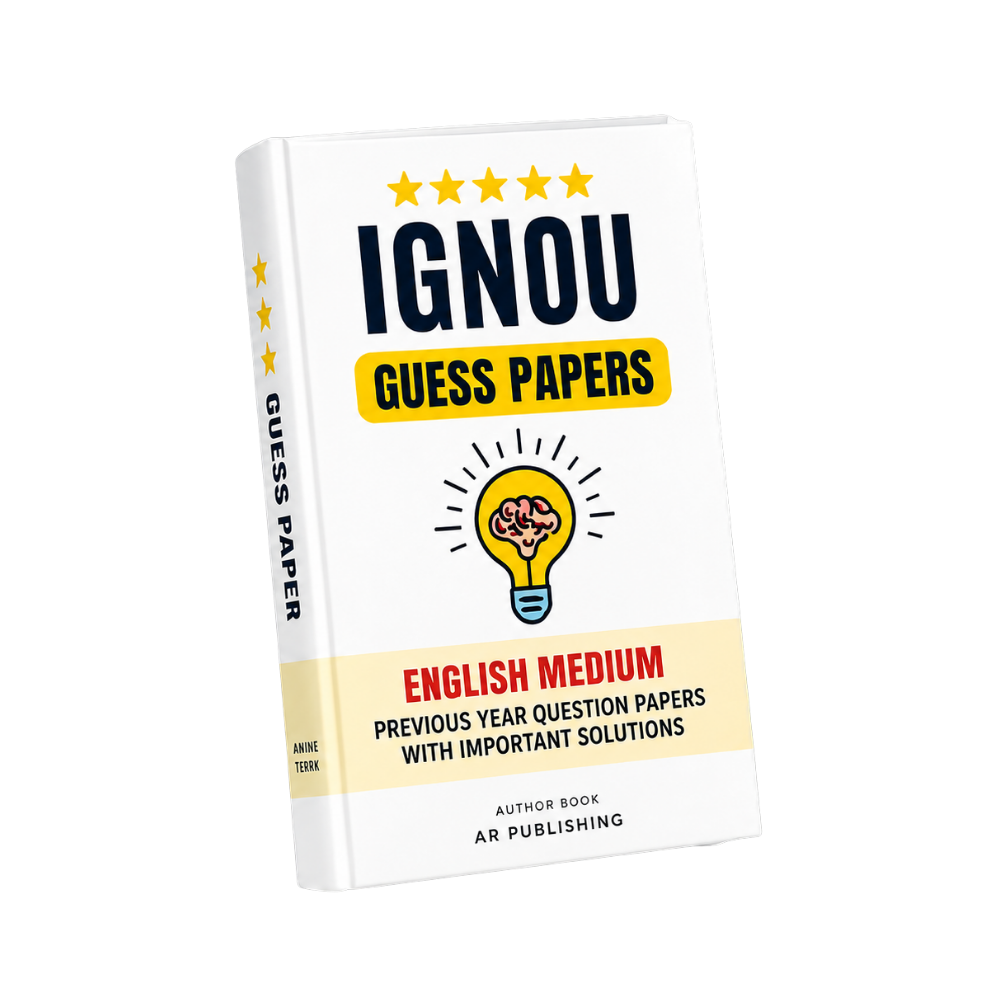
MAEE-002 IGNOU Guess Paper 2026-27
Click to view offer details & terms
Get 10% OFF Instant Discount
Apply this coupon code at checkout to claim your academic discount instantly.
- Applicable on all university study materials
- Valid for up to 8 item(s) per order
- Valid till Oct 31, 2026
Frequently Bought Together
Popular course materials frequently ordered together
Syllabus & Overview
MAEE-002 Guess Paper Term-End Exam (TEE) Focus Areas
This guess paper synthesizes recurring themes from the last 5 years of MAEE-002 (Basics of Legal Awareness) TEE exams, structured by official IGNOU curriculum blocks. Emphasis is placed on chapter-wise weightage and 3-hour time management strategies to maximize scoring potential.
Key Syllabus Blocks & Expected Questions
- Block-1: Essentials of Indian Legal System
- Compare Statutory Law vs. Customary Law with reference to Bhagat Singh vs. State of Punjab (1980).
- Explain the role of Judiciary in enforcing fundamental rights under Article 32.
- Short-answer questions on Sources of Indian Law (Constitution, Statutes, Precedents).
- Block-2: Empowering Laws
- Analyze Women’s Empowerment Act (2006) provisions on domestic violence (Section 3).
- Case-based questions on Right to Information Act (2005) and its impact on transparency.
- Block-3: Liability Creating Laws
- Distinguish Absolute Liability (from M.C. Mehta vs. Union of India) vs. Strict Liability.
- Explain Negligence under Indian Contract Act (1872) with examples from Rylands vs. Fletcher.
- Block-4: Legal Remedies Law
- Outline Locus Standi requirements for filing writ petitions under Article 226.
- Compare Civil Remedies (injunctions, damages) vs. Criminal Remedies (compensation, restitution).
- Block-5: Special Rights Law
- Discuss Consumer Protection Act (2019) provisions for defective goods (Section 11).
- Case analysis on Environmental Laws (Vellore Citizens’ Welfare Forum vs. Union of India).
Exam Strategy & FAQs
Time Management: Allocate 12–15 minutes per question (3-hour exam). Prioritize Block-1 and Block-3 for direct scoring, as they account for 40% of past TEE marks.
FAQs
- Q: Are case laws mandatory for MAEE-002?: Yes. At least 3–4 cases (e.g., Babita Pawanar vs. State of Maharashtra) are tested annually in short-answer or case-based questions.
- Q: How to balance Block-5 (Special Rights Law) with other blocks?: Focus on conceptual clarity over rote memorization. Block-5 often has 1–2 descriptive questions worth 10–15 marks; use examples from Consumer Rights or Environmental Laws.
Past Paper Patterns (June/Dec Sessions)
From 2018–2023, 20% of questions were direct quotes from textbooks (e.g., Indian Penal Code definitions), while 60% tested analytical skills (e.g., ‘Explain X with legal provisions’).
Note: Avoid unrelated fields (e.g., Hospitality Law) as per IGNOU’s MAEE-002 curriculum constraints.
Why buy from us?
-
Verified by top professors and 99th percentile students.
-
Always updated to the latest university curriculum.
-
High-quality, printable PDF formats with clear diagrams.
License & Terms
By purchasing this item, you agree to our standard academic license terms. You may use this product for personal study, but you may not resell or redistribute the files online.