

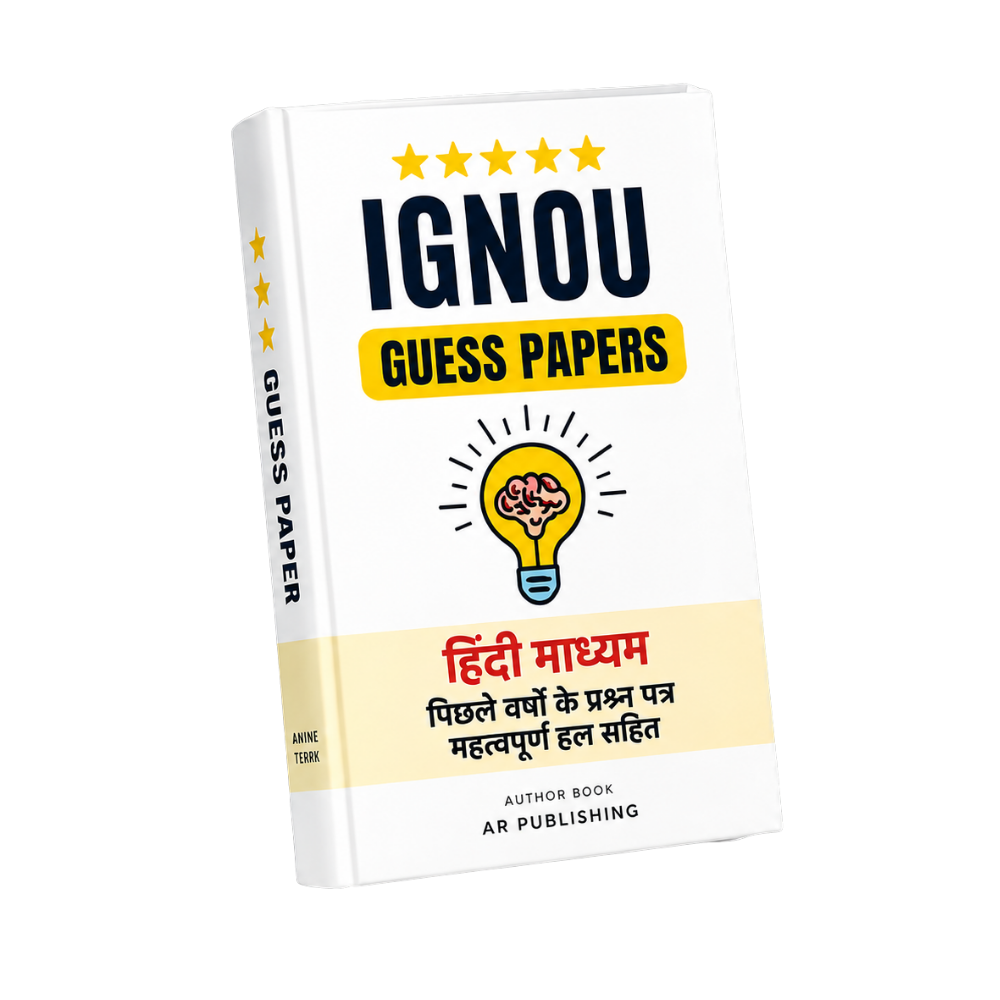
MAL-006 IGNOU Guess Paper 2026-27
Click to view offer details & terms
Get 10% OFF Instant Discount
Apply this coupon code at checkout to claim your academic discount instantly.
- Applicable on all university study materials
- Valid for up to 8 item(s) per order
- Valid till Oct 31, 2026
Enrolled in other IGNOU subjects?
Link your Enrollment No. to auto-map all your semester courses & free question papers.
Frequently Bought Together
Popular course materials frequently ordered together


Syllabus & Overview
MAL-006 Guess Paper: Term-End Exam (TEE) Preparation Guide
This structured guide aligns with the official IGNOU syllabus for MAL-006 (Course Code MAL-006) and includes a curated selection of high-probability questions based on past TEE patterns (June & Dec sessions). It emphasizes key scoring topics and time management strategies for the 3-hour exam.
Key Syllabus Blocks Covered
- Unit 1: Poetic Forms and Literary Devices
- Analyze sonnet structures (Petrarchan vs. Shakespearean) with reference to 2-3 poems from the prescribed text.
- Explain metaphor, simile, and personification in selected poems, linking them to thematic intent.
- Compare lyric and narrative poetry using examples from the course material.
- Unit 3: Critical Approaches in Literature
- Discuss Marxist criticism with a focus on class and power in a prescribed text (e.g., Godan or Mira Nair’s films).
- Apply feminist theory to analyze gender representation in a short story or poem.
- Evaluate postcolonial criticism in the context of Indian literature, referencing 1-2 case studies.
- Unit 5: Comparative Analysis of Texts
- Contrast traditional and modern narrative techniques using examples from prescribed prose/poetry.
- Compare themes of identity and alienation across two texts (e.g., Train to Pakistan and The Guide).
- Analyze cultural and linguistic influences in bilingual literary works (Hindi-English or regional languages).
- Unit 7: Translation Theory and Practice
- Explain equivalence vs. fidelity in translation, with examples from Hindi to English or vice versa.
- Discuss cultural and semantic challenges in translating poetic or philosophical texts.
- Practice short translation exercises (5-10 lines) from prescribed texts, focusing on tone and context.
Chapter-Wise Question Weightage (Past TEE Trends)
The following distribution is based on the last 5 years of TEE papers (June & Dec sessions):
- Poetic Forms (Unit 1 & 2): 25-30% (2-3 questions, 20 marks total). Focus on analysis of poems and literary devices.
- Critical Approaches (Unit 3 & 4): 20-25% (2 questions, 15-20 marks). Prioritize Marxist, feminist, or postcolonial criticism.
- Comparative Analysis (Unit 5 & 6): 25-30% (2-3 questions, 20 marks). Emphasize thematic or stylistic comparisons.
- Translation Theory (Unit 7 & 8): 15-20% (1-2 questions, 10-15 marks). Practice short translations and theoretical explanations.
3-Hour Exam Time Management Tips
- Allocate 10 minutes to quickly skim the question paper and prioritize sections with higher weightage (e.g., poetic analysis or critical approaches).
- Divide time equally among sections: 45 minutes per 20-mark question, 30 minutes per 10-mark question.
- For descriptive answers (e.g., critical analysis), structure responses with introduction, body (3-4 points), and conclusion to maximize clarity.
- Avoid lengthy quotations unless directly referenced in the question. Focus on interpretation and analysis.
- Leave 10 minutes for review: Check for spelling/grammar errors and ensure all parts of multi-part questions are answered.
Subject-Specific FAQs
- Q: Are previous year papers sufficient for MAL-006 preparation?
A: Yes, solving 3-5 past TEE papers (June & Dec sessions) is highly recommended. Focus on question patterns (e.g., poem analysis vs. critical theory) and weightage shifts across years. Supplement with unit-wise notes for weaker topics.
- Q: How should I approach translation questions in MAL-006?
A: For theoretical questions, explain concepts like literal vs. free translation with examples. For practical questions, translate 5-10 lines while preserving rhythm, tone, and cultural context. Use prescribed texts (e.g., Hindi poems) for practice.
Why buy from us?
-
Verified by top professors and 99th percentile students.
-
Always updated to the latest university curriculum.
-
High-quality, printable PDF formats with clear diagrams.
License & Terms
By purchasing this item, you agree to our standard academic license terms. You may use this product for personal study, but you may not resell or redistribute the files online.