

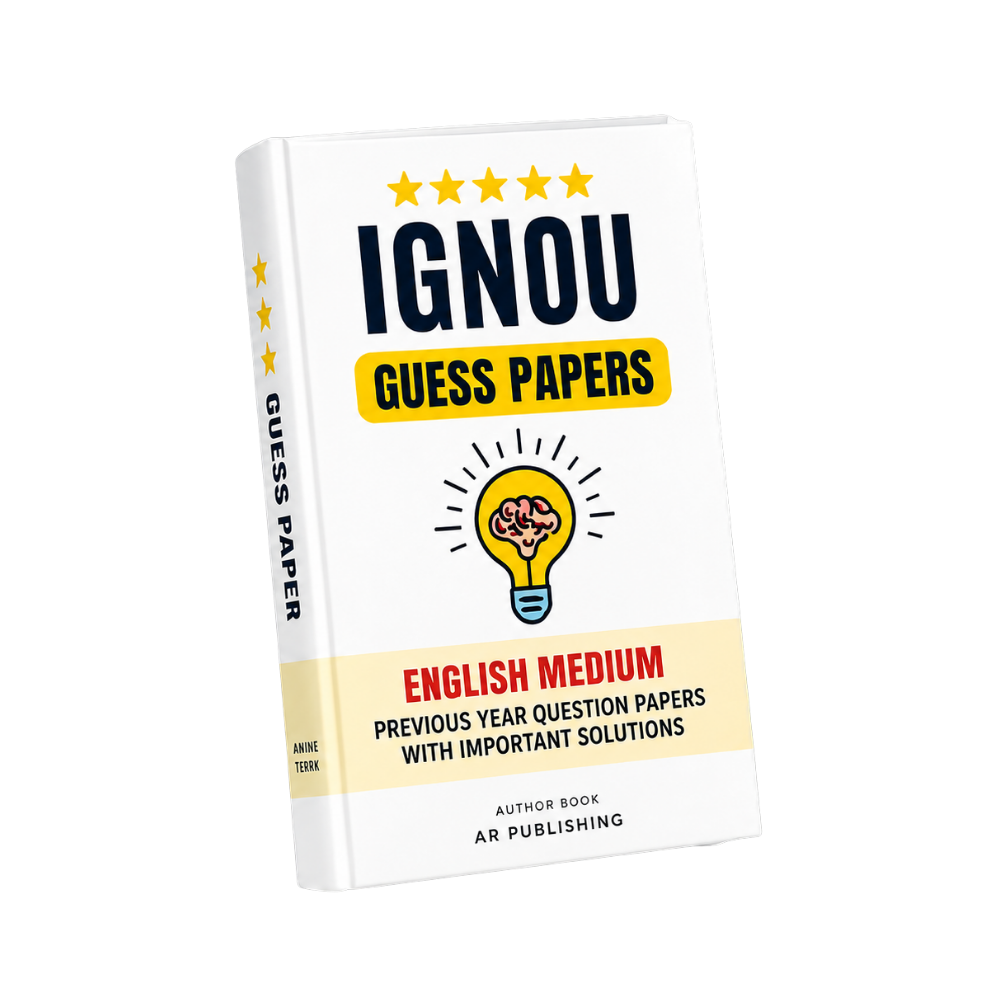
MAN-002 IGNOU Guess Paper 2026-27
Click to view offer details & terms
Get 10% OFF Instant Discount
Apply this coupon code at checkout to claim your academic discount instantly.
- Applicable on all university study materials
- Valid for up to 8 item(s) per order
- Valid till Oct 31, 2026
Enrolled in other IGNOU subjects?
Link your Enrollment No. to auto-map all your semester courses & free question papers.
Frequently Bought Together
Popular course materials frequently ordered together

Syllabus & Overview
Course Scope & Syllabus Overview: MAN-002 Archaeological Anthropology
MAN-002: Archaeological Anthropology is a core component of IGNOU’s Master’s in Anthropology (MAAN) under the School of Social Sciences, designed to bridge archaeological evidence with anthropological theory. This course explores the material culture, cultural evolution, and socio-environmental interactions of prehistoric societies, integrating stratigraphy, typology, and contextual analysis. Students gain critical insights into how archaeological records—from lithic tools to settlement patterns—reveal human adaptive strategies, technological advancements, and cultural transformations across Pleistocene and Holocene periods. The curriculum emphasizes evidence-based inquiry, preparing students to interpret archaeological data within broader anthropological frameworks, essential for research, heritage management, and policy analysis.Key Syllabus Units & Topics
- Block-1: Definition and Scope: Introduces foundational concepts of archaeological anthropology, distinguishing it from classical archaeology and historical anthropology. Covers the epistemological basis of archaeological inquiry, including the role of material culture in reconstructing past lifeways and societal structures.
- Block-2: Archaeological Units: Examines spatial and temporal units in archaeology, such as sites, features, and artifacts, with emphasis on their classification, documentation, and interpretive frameworks. Discusses excavation methodologies and the significance of stratigraphic sequences in contextualizing archaeological assemblages.
- Block-4: Dating Methods: Focuses on absolute and relative chronometric techniques, including radiocarbon dating, thermoluminescence, and stratigraphic correlation. Explores their applications, limitations, and integration in establishing chronological frameworks for prehistoric cultures.
- Block-5: Palaeolithic Cultures: Analyzes Lower, Middle, and Upper Palaeolithic technological traditions, toolkits (e.g., Oldowan, Acheulean, Mousterian), and their ecological contexts. Highlights hominin behavioral adaptations, hunting-gathering economies, and early symbolic expressions.
- Block-7: Neolithic and Chalcolithic Cultures: Investigates the transition from foraging to food production, including agricultural origins, domestication processes, and the emergence of settled communities. Evaluates socio-political changes, craft specialization, and the development of early states in South and Southeast Asia.
Frequently Asked Questions
Q: What is the marking scheme for MAN-002 Term-End Examination (TEE), and how are internal assessment marks allocated?
A: The TEE for MAN-002 carries 100 marks, divided into two sections: 60 marks for descriptive questions (including essay-type) and 40 marks for short-answer questions. Internal assessment (20 marks) includes assignments and tutorials, which must be submitted on time to qualify for the examination.
Q: Are there recurring themes or question patterns in MAN-002 exams that students should prioritize for revision?
A: Repeated examination focus areas include dating methods (Block-4), Palaeolithic tool typologies (Block-5), and the Neolithic transition (Block-7). Prioritize case studies from South Asian archaeology (e.g., Mehrgarh, Burzahom) and theoretical debates on cultural evolution, as these frequently appear in both short and long-answer questions.
Why buy from us?
-
Verified by top professors and 99th percentile students.
-
Always updated to the latest university curriculum.
-
High-quality, printable PDF formats with clear diagrams.
License & Terms
By purchasing this item, you agree to our standard academic license terms. You may use this product for personal study, but you may not resell or redistribute the files online.