

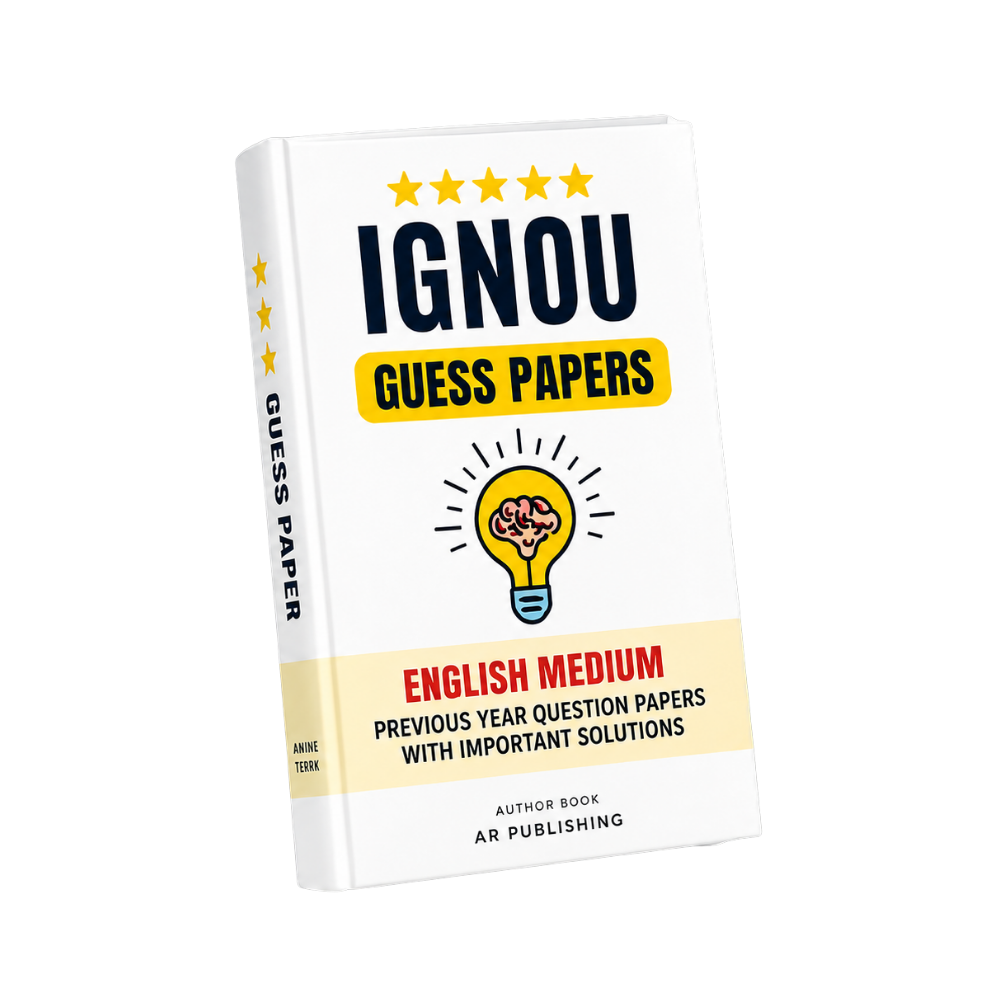
MANI-001 IGNOU Guess Paper 2026-27
Click to view offer details & terms
Get 10% OFF Instant Discount
Apply this coupon code at checkout to claim your academic discount instantly.
- Applicable on all university study materials
- Valid for up to 8 item(s) per order
- Valid till Oct 31, 2026
Enrolled in other IGNOU subjects?
Link your Enrollment No. to auto-map all your semester courses & free question papers.
Frequently Bought Together
Popular course materials frequently ordered together

Syllabus & Overview
Course Scope and Syllabus Overview for MANI-001: Anthropology and Method of Research
MANI-001, titled Anthropology and Method of Research, is a core component of IGNOU’s Master’s in Anthropology (MAAN) curriculum under the School of Social Sciences. This course bridges theoretical anthropology with empirical research methodologies, equipping students with critical analytical tools to study human societies, cultures, and behaviors. The syllabus emphasizes ethnographic fieldwork, qualitative and quantitative research designs, and the application of statistical techniques to anthropological data. It aligns with IGNOU’s CBCS framework by fostering interdisciplinary inquiry while adhering to rigorous academic standards, ensuring students can independently conduct research and interpret findings with methodological precision.Key Syllabus Units and Topics
- Block-1 Introducing Anthropology: Explores the foundational principles of anthropology, including its historical evolution, key anthropological perspectives (cultural, biological, linguistic, and archaeological), and the discipline’s role in addressing social and cultural diversity. This block also critiques anthropological theories from colonial and post-colonial lenses.
- Block-2 Field Work Tradition in Anthropology: Delves into ethnographic fieldwork techniques, emphasizing participant observation, interviews, and case studies. It examines the ethical considerations, challenges, and methodologies of long-term field research in diverse cultural contexts.
- Block-3 Research Design: Covers the formulation of research questions, hypothesis development, and the selection of appropriate research paradigms (deductive, inductive, or grounded theory). Students learn to design research frameworks tailored to anthropological inquiries.
- Block-4 Data Collection Techniques: Focuses on qualitative methods such as unstructured and semi-structured interviews, focus group discussions, and documentary analysis. It also introduces mixed-methods approaches, ensuring students can adapt data collection strategies to research objectives.
- Block-6 Project Work: Integrates all prior learning through a capstone project, where students apply research methodologies to a real-world anthropological study. This block emphasizes report writing, data analysis, and presenting findings with academic rigor.
Frequently Asked Questions
Q: What is the marking scheme for MANI-001’s Term-End Examination (TEE), and how are internal and external assessments weighted?
A: The TEE for MANI-001 carries 100 marks, with no specific internal assessment component. The examination typically includes a mix of short-answer, long-answer, and case-study questions, with weightage distributed across all syllabus blocks. Past papers reveal a focus on research methodologies, fieldwork techniques, and theoretical applications.
Q: Are there specific pass marks or grading criteria for MANI-001, and how can students maximize scores in the TEE?
A: IGNOU follows a grading system where a minimum of 40% marks are required to pass the TEE. To maximize scores, prioritize understanding research designs, fieldwork ethics, and statistical analysis—areas frequently tested. Practicing solved previous years’ question papers (June/December cycles) and focusing on high-weightage topics (e.g., Block-3 and Block-4) can significantly improve performance.
Why buy from us?
-
Verified by top professors and 99th percentile students.
-
Always updated to the latest university curriculum.
-
High-quality, printable PDF formats with clear diagrams.
License & Terms
By purchasing this item, you agree to our standard academic license terms. You may use this product for personal study, but you may not resell or redistribute the files online.