

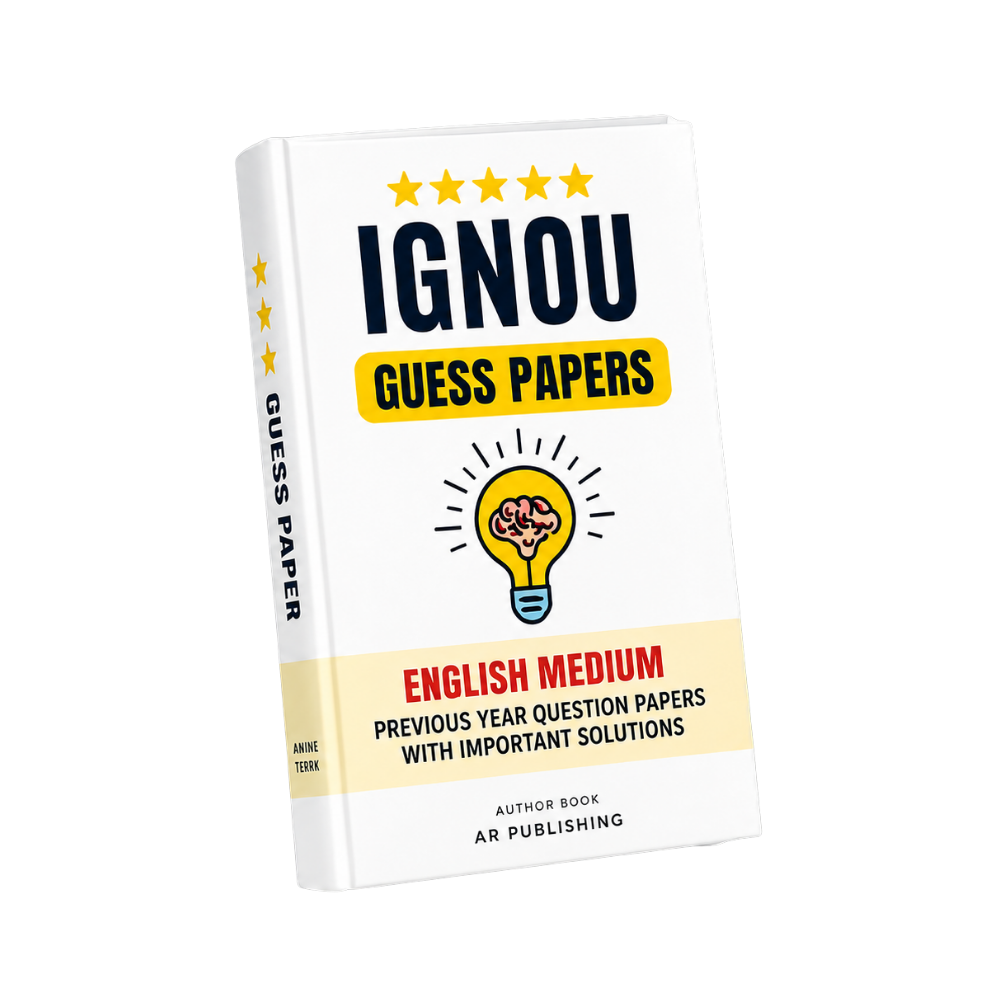
MCS-063 IGNOU Guess Paper 2026-27
Click to view offer details & terms
Get 10% OFF Instant Discount
Apply this coupon code at checkout to claim your academic discount instantly.
- Applicable on all university study materials
- Valid for up to 8 item(s) per order
- Valid till Oct 31, 2026
Enrolled in other IGNOU subjects?
Link your Enrollment No. to auto-map all your semester courses & free question papers.
Frequently Bought Together
Popular course materials frequently ordered together

Syllabus & Overview
Course Scope and Syllabus Overview for MCS-063: Data Structures Using Python
MCS-063: Data Structures Using Python is a core course under the IGNOU CBCS curriculum for the M.Sc. (Data Science and Analytics) programme, designed to equip students with foundational and advanced knowledge of data structures implemented in Python. This course bridges theoretical concepts with practical applications, emphasizing efficiency, scalability, and algorithmic problem-solving. Through hands-on coding exercises and theoretical analysis, students learn to model real-world problems using dynamic data structures like trees, graphs, and hash tables, while mastering Python’s built-in libraries for optimal performance. The syllabus aligns with the School of Computer and Information Sciences (SOCIS) standards, ensuring rigorous academic grounding in computational thinking. Topics range from fundamental data structures (e.g., arrays and linked lists) to complex algorithms (e.g., sorting and graph traversal), preparing students for advanced data analytics and software development roles.Key Syllabus Units and Topics
- Block-1: Introduction to Python: Covers Python’s syntax, data types, control structures, and basic programming paradigms, including functions and modules, to establish a robust foundation for implementing data structures.
- Block-2: Arrays, Stacks, Queues, Linked Lists, and Trees: Explores linear and non-linear data structures, their time-space complexity, and Python implementations (e.g., `collections.deque` for queues, doubly linked lists for dynamic resizing).
- Block-3: Maps, Hash Tables, Skip Lists, Search Trees, and Sorting Algorithms: Delves into hash-based structures (e.g., `dict` in Python), self-balancing trees (AVL, Red-Black), and sorting techniques (e.g., merge sort, quicksort) with empirical comparisons.
- Block-4: Text Processing, Graph Algorithms, Memory Management, and B-Trees: Integrates string manipulation, graph representations (adjacency lists/matrices), traversal algorithms (DFS/BFS), and advanced structures like B-trees for database indexing.
Frequently Asked Questions
Q: How is the marking scheme structured for the MCS-063 Term-End Examination (TEE), and what weightage does each section carry?
A: The TEE for MCS-063 typically allocates 80 marks for theory (including short-answer and long-answer questions) and 20 marks for practical/programming components, focusing on Python implementations of data structures and algorithmic efficiency.
Q: Are there specific pass marks or grading criteria students should target to ensure eligibility for the next semester?
A: IGNOU requires a minimum of 40% aggregate marks in the TEE to pass, though higher scores (60%+) are recommended for competitive programs like MSCDSA, given the course’s role as a prerequisite for advanced analytics modules.
Why buy from us?
-
Verified by top professors and 99th percentile students.
-
Always updated to the latest university curriculum.
-
High-quality, printable PDF formats with clear diagrams.
License & Terms
By purchasing this item, you agree to our standard academic license terms. You may use this product for personal study, but you may not resell or redistribute the files online.