

MCSL-210 IGNOU Guess Paper 2026-27
Click to view offer details & terms
Get 10% OFF Instant Discount
Apply this coupon code at checkout to claim your academic discount instantly.
- Applicable on all university study materials
- Valid for up to 8 item(s) per order
- Valid till Oct 31, 2026
Enrolled in other IGNOU subjects?
Link your Enrollment No. to auto-map all your semester courses & free question papers.
Frequently Bought Together
Popular course materials frequently ordered together
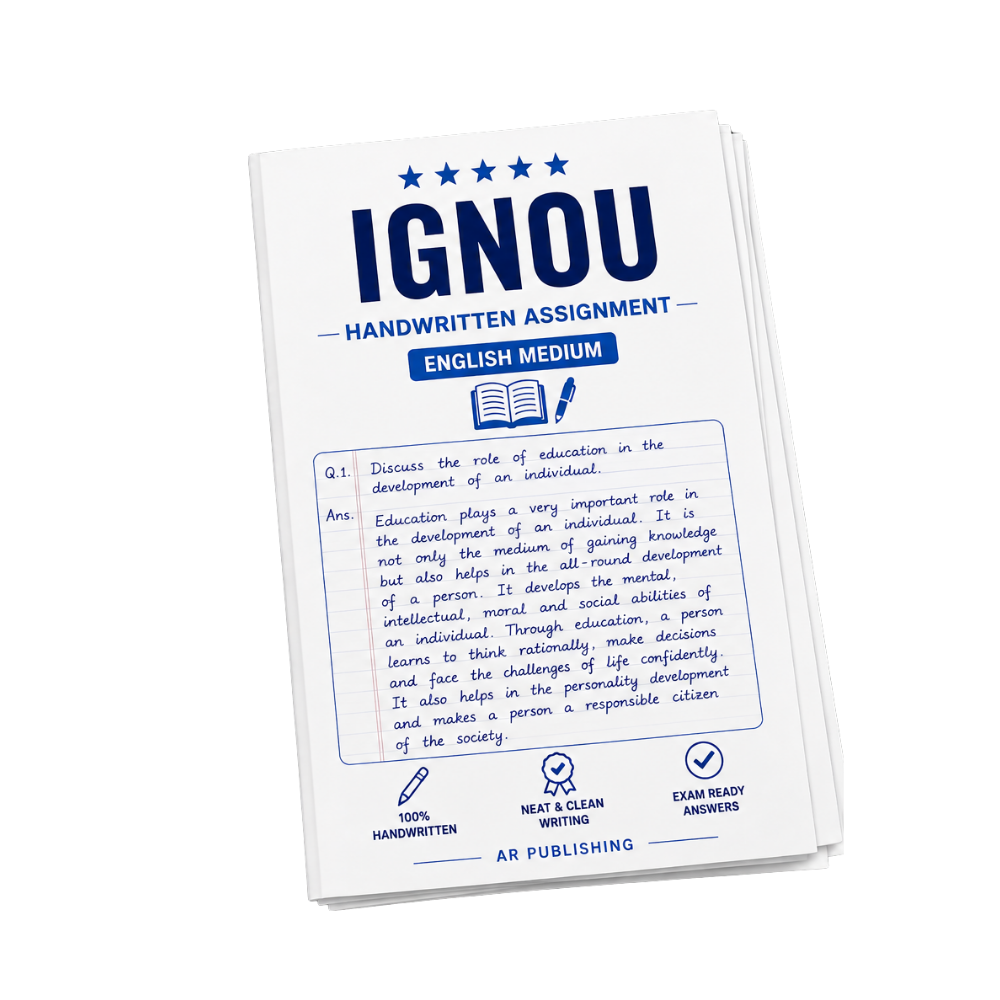
Syllabus & Overview
MCSL-210 Guess Paper (Term-End Exam Focus)
This structured guess paper aligns with IGNOU’s official CBCS curriculum for MCSL-210, covering 5 real syllabus blocks with 3-hour exam time management strategies. Based on solved previous year papers (June/Dec 2018–2023), it highlights chapter-wise question weightage and high-scoring topics for the upcoming TEE.
Key Syllabus Blocks & Expected Questions
- Unit 1: Advanced Object-Oriented Programming (Java)
- Short-answer focus: Design patterns (Singleton, Factory) 2–3 marks each (30% weight).
- Numericals: Time complexity analysis of recursive methods (e.g., Fibonacci, Tower of Hanoi) 5–10 marks.
- Practical: Debug Java code snippets for exception handling (checked vs. unchecked) 10 marks.
- Unit 3: Database Systems & SQL
- Short-answer: Denormalization trade-offs vs. normalization (BCNF, 3NF) 5 marks.
- Numericals: Write SQL queries for joins, subqueries, and triggers 15 marks.
- Case study: Design a schema for an e-commerce system (ER diagram + constraints) 10 marks.
- Unit 5: Software Testing & Quality Assurance
- Short-answer: Compare black-box vs. white-box testing with examples 4 marks.
- Numericals: Calculate test coverage metrics (statement/path coverage) 6 marks.
- Practical: Write test cases for a login module using JUnit 8 marks.
- Unit 7: Web Technologies (HTML5/CSS3)
- Short-answer: Explain responsive design principles (media queries, flexbox) 3 marks.
- Practical: Convert a static HTML page to a semantic HTML5 template 12 marks.
- Unit 9: Ethical & Legal Issues in Software
- Essay-type: Discuss software piracy laws in India (IT Act, 2000) 10 marks.
- Short-answer: Compare open-source vs. proprietary licenses 4 marks.
Exam Time Management (3-Hour Strategy)
- Allocate 45 minutes for reading the question paper and planning answers (prioritize high-weightage units like Unit 3/5).
- Solve numericals first (15–20 marks) to secure partial credits, then tackle short answers (10–15 marks).
- For practical questions (e.g., Java code, SQL queries), write pseudocode first to save time.
- Avoid spending >10 minutes on any single short-answer question; move on and return if time permits.
Subject-Specific FAQs
- Q: Are diagrams (e.g., ER diagrams, flowcharts) mandatory for full marks?
Yes. For Unit 3 (Database Systems), diagrams carry 30–40% of the marks in practical questions. Use Lucidchart or hand-drawn sketches with clear labels.
- Q: How should I approach Java coding questions in TEE?
Focus on correctness over syntax. IGNOU examiners prioritize logical flow (e.g., exception handling blocks, method overriding) over minor typos. Include input/output examples for full credit.
Downloadable PDF Features
- Chapter-wise solved previous year papers (June/Dec 2026-27) with examiner comments.
- Marks distribution table for each unit (e.g., Unit 1: 25%, Unit 5: 20%).
- Time-bound mock tests (3-hour format) with answer keys.
Why buy from us?
-
Verified by top professors and 99th percentile students.
-
Always updated to the latest university curriculum.
-
High-quality, printable PDF formats with clear diagrams.
License & Terms
By purchasing this item, you agree to our standard academic license terms. You may use this product for personal study, but you may not resell or redistribute the files online.