

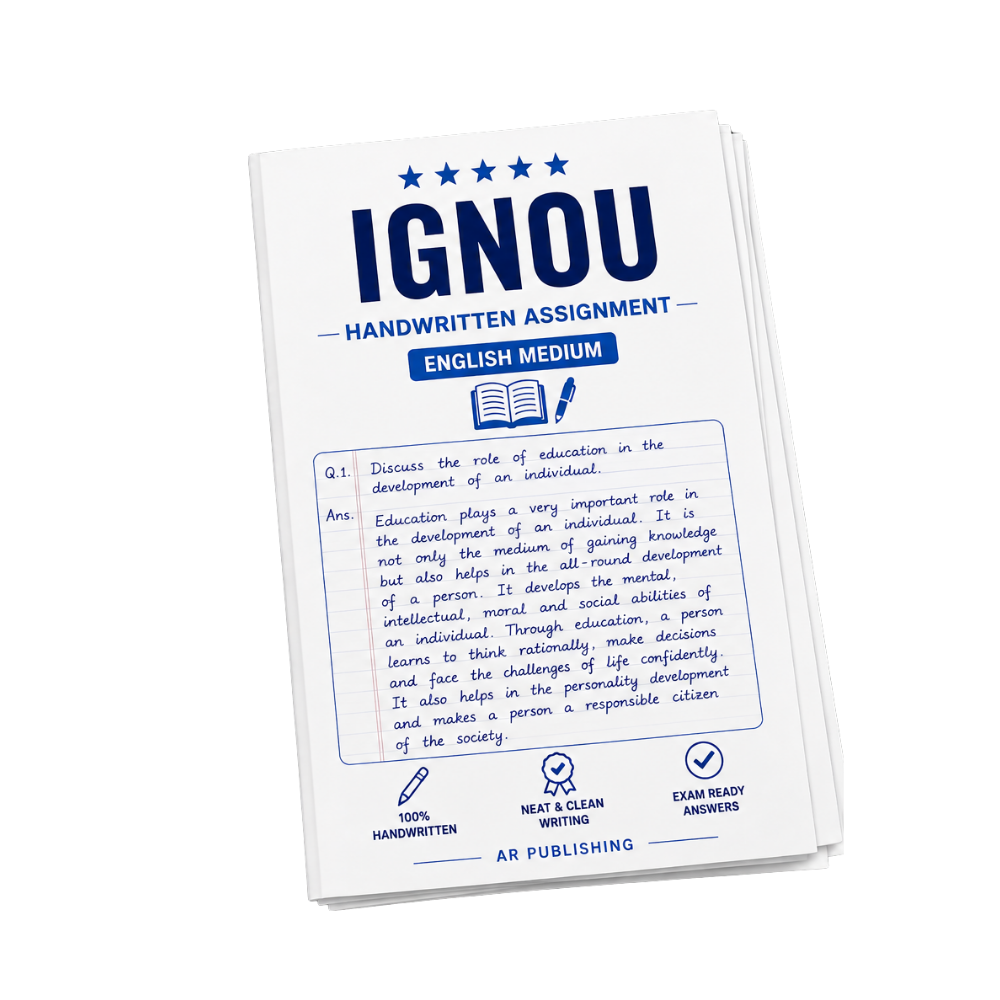
MCSL-216 IGNOU Handwritten Assignment 2026-27
Click to view offer details & terms
Get 10% OFF Instant Discount
Apply this coupon code at checkout to claim your academic discount instantly.
- Applicable on all university study materials
- Valid for up to 8 item(s) per order
- Valid till Oct 31, 2026
Enrolled in other IGNOU subjects?
Link your Enrollment No. to auto-map all your semester courses & free question papers.
Frequently Bought Together
Popular course materials frequently ordered together

Syllabus & Overview
Course Scope and Syllabus Overview for MCSL-216: DAA and Web Design Lab
MCSL-216: Design and Analysis of Algorithms and Web Design Lab is a core practical course under the IGNOU Master of Computer Applications (MCA)-New curriculum, designed to bridge theoretical knowledge with hands-on application. This course focuses on implementing algorithmic concepts and designing responsive, user-centric web interfaces, aligning with the School of Computer and Information Sciences (SOCIS) standards. Students engage in practical exercises to optimize algorithms for efficiency, analyze time-space complexity, and develop front-end web components using industry-relevant tools like HTML5, CSS3, and JavaScript frameworks. The curriculum ensures students gain proficiency in both algorithmic problem-solving and modern web development techniques, preparing them for real-world software and web application challenges.Key Syllabus Units and Topics
- Unit 1: Algorithm Design Techniques: Covers fundamental algorithmic paradigms including greedy algorithms, dynamic programming, and divide-and-conquer strategies. Students apply these techniques to solve computational problems while analyzing their efficiency through complexity analysis.
- Unit 2: Graph Algorithms and Applications: Explores graph representation, traversal algorithms (BFS, DFS), shortest path algorithms (Dijkstra’s, Floyd-Warshall), and network flow problems. Practical implementations emphasize real-world applications like route optimization and social network analysis.
- Unit 3: Web Design Fundamentals and UI/UX Principles: Introduces responsive web design principles, CSS3 layout techniques (Flexbox, Grid), and accessibility standards. Students design interactive web interfaces using semantic HTML and modern CSS frameworks, ensuring cross-device compatibility.
- Unit 4: Front-End Web Development with JavaScript: Focuses on client-side scripting, DOM manipulation, and event handling. Students build dynamic web pages using JavaScript libraries (e.g., jQuery) and frameworks (e.g., React basics), integrating interactive elements like forms and animations.
- Unit 5: Project-Based Web Application Development: Requires students to develop a complete web application integrating algorithmic logic (e.g., sorting visualizations) with front-end design. Emphasis is placed on modular coding, debugging, and version control using tools like Git.
Frequently Asked Questions
Q: What is the marking scheme for the internal assessment in MCSL-216, and how are practical submissions evaluated?
A: The internal assessment for MCSL-216 carries 30 marks, with 20 marks allocated to practical assignments (including lab exercises and project submissions) and 10 marks for continuous evaluation based on participation and problem-solving. Submissions are evaluated on correctness, efficiency of algorithms, adherence to web design standards, and clarity of documentation.
Q: What are the minimum pass marks required for MCSL-216, and how does the examination pattern differ from theoretical courses?
A: The minimum pass marks for MCSL-216 are 40% overall, with 30 marks from internal assessment and 40 marks from the terminal examination (which includes both theoretical and practical components). The terminal exam typically includes algorithmic problem-solving questions (20 marks) and web design/project-based evaluation (20 marks), emphasizing hands-on application over rote learning.
Why buy from us?
-
Verified by top professors and 99th percentile students.
-
Always updated to the latest university curriculum.
-
High-quality, printable PDF formats with clear diagrams.
License & Terms
By purchasing this item, you agree to our standard academic license terms. You may use this product for personal study, but you may not resell or redistribute the files online.