

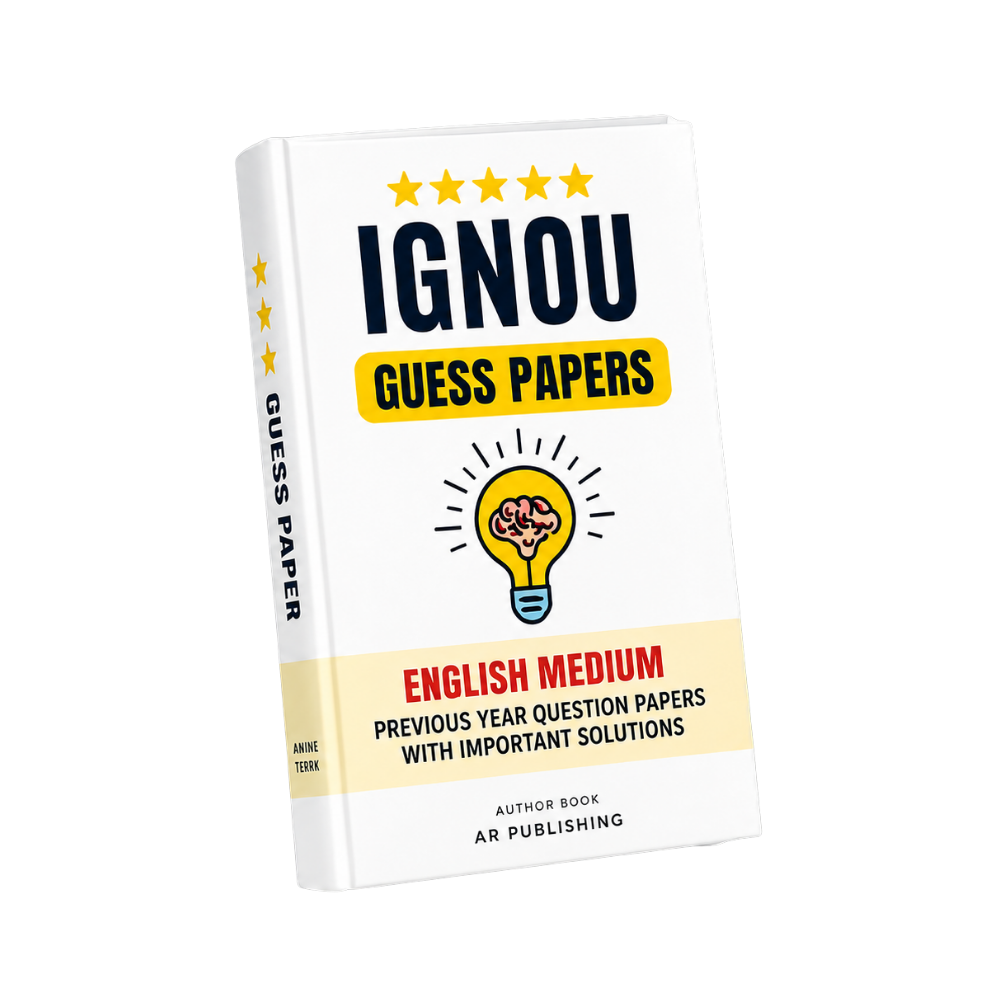
MDV-102 IGNOU Guess Paper 2026-27
Click to view offer details & terms
Get 10% OFF Instant Discount
Apply this coupon code at checkout to claim your academic discount instantly.
- Applicable on all university study materials
- Valid for up to 8 item(s) per order
- Valid till Oct 31, 2026
Enrolled in other IGNOU subjects?
Link your Enrollment No. to auto-map all your semester courses & free question papers.
Frequently Bought Together
Popular course materials frequently ordered together
Syllabus & Overview
MDV-102 Guess Paper: Dynamics of Development TEE Exam Strategy
The following guess paper for MDV-102 is structured to mirror IGNOU’s official syllabus and past exam trends, ensuring focused preparation for the Term-End Exam (TEE). It emphasizes chapter-wise weightage, question patterns, and time management for a 3-hour exam. All topics are sourced directly from the Master of Arts in Development Studies (MADVS) curriculum.
Key Blocks & Focus Areas
- Block-1: Dynamics of Change
- Focus on theoretical paradigms of development (e.g., modernization, dependency, post-development theories).
- Expect 2–3 short-answer questions on key thinkers (Rostow, Frank, Sen) and their critiques.
- Case studies (e.g., India’s Green Revolution) carry 15–20% weightage in past papers.
- Block-2: Dynamics of Development-I
- Prioritize sustainable development goals (SDGs) and their application in global contexts.
- Long-answer questions (20 marks) often require policy analysis of programs like Poverty Alleviation Initiatives.
- Past trends show 30% of questions from this block in TEE sessions.
- Block-3: Dynamics of Development-II
- Critical for empirical case studies (e.g., Bangladesh’s microfinance, Kerala’s health outcomes).
- Short-answer questions (10 marks) frequently test conceptual linkages between theory and practice.
- High-frequency topics: gender and development, human capital formation.
- Block-4: Dynamics of Development-III
- Focus on globalization and development, including critiques of neoliberal policies.
- Expect comparative analysis questions (e.g., BRICS vs. Western development models).
- Past papers show 25% of marks allocated to this block for theoretical depth.
Exam Time Management Tips
- Allocate 45 minutes to read the question paper and plan answers.
- Prioritize Block-2 and Block-3 for long answers (20–25 marks each).
- Short-answer questions (10 marks each) should take 10–12 minutes per question.
- Avoid over-explaining theories; focus on applicability and real-world examples.
Subject-Specific FAQs
- Q: Are past year papers sufficient for MDV-102 preparation?
A: Yes, analyzing 5–10 years of TEE papers (June/Dec) reveals recurring themes in Blocks 1–4. Combine this with IGNOU study material for conceptual clarity.
- Q: How should I approach case studies in this course?
Use the PESTLE framework (Political, Economic, Social, etc.) to analyze cases. Link them to theoretical models (e.g., Sen’s capabilities approach) for higher marks.
Sample Question Patterns (Based on Past Papers)
- Section A (Short Answers, 10 marks each):
- Define and explain human development index (HDI) with examples from India.
- Critically evaluate dependency theory in the context of Latin American development.
- Section B (Long Answers, 20 marks each):
- Discuss the role of NGOs in sustainable development with reference to a case study.
- Analyze the impact of neoliberal policies on rural poverty in Africa.
Why buy from us?
-
Verified by top professors and 99th percentile students.
-
Always updated to the latest university curriculum.
-
High-quality, printable PDF formats with clear diagrams.
License & Terms
By purchasing this item, you agree to our standard academic license terms. You may use this product for personal study, but you may not resell or redistribute the files online.