


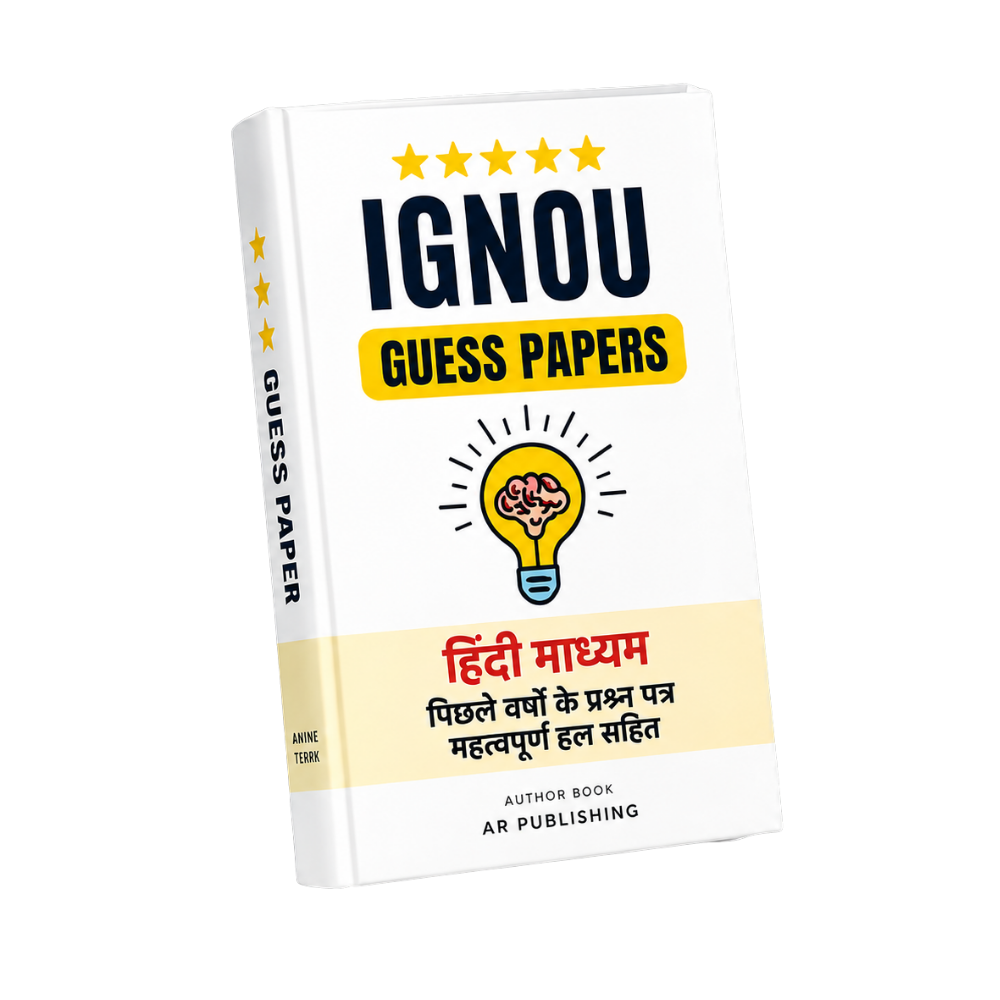
MEC-203 IGNOU Guess Paper 2026-27
Click to view offer details & terms
Get 10% OFF Instant Discount
Apply this coupon code at checkout to claim your academic discount instantly.
- Applicable on all university study materials
- Valid for up to 8 item(s) per order
- Valid till Oct 31, 2026
Frequently Bought Together
Popular course materials frequently ordered together
Syllabus & Overview
MEC-203 Mastering Environmental Chemistry for IGNOU’s Term-End Examination
MEC-203, a core course under IGNOU’s Master’s in Environmental Science program, examines the fundamental principles of environmental chemistry, focusing on pollution dynamics, analytical techniques, and remediation strategies. This study material aligns with the CBCS curriculum by synthesizing theoretical frameworks with practical applications, ensuring students grasp both the quantitative analysis of pollutants and their qualitative impacts. The guide distills complex concepts into actionable insights, prioritizing high-yield topics that consistently appear in June and December TEE cycles, while also addressing the nuances of numerical problem-solving—critical for achieving distinction.Core Syllabus Units & Focus Areas
- Unit 1: Fundamentals of Environmental Chemistry: Covers stoichiometry, thermodynamics, and kinetics as they apply to atmospheric, aquatic, and terrestrial systems, with emphasis on equilibrium constants and reaction rates in natural environments.
- Unit 3: Analytical Techniques for Pollutant Detection: Details spectroscopic (UV-Vis, IR), chromatographic (GC-MS, HPLC), and electrochemical methods, including their calibration, sensitivity, and limitations as tested in past TEE papers.
- Unit 5: Remediation Technologies: Explores physicochemical (adsorption, coagulation) and biological (bioremediation, phytoremediation) approaches, with case studies on real-world applications like groundwater treatment and hazardous waste management.
- Unit 7: Environmental Forensics: Introduces isotopic tracing, source apportionment, and regulatory compliance frameworks, often examined through scenario-based questions in examinations.
Frequently Asked Questions
QHow are numerical problems weighted in MEC-203’s TEE, and which units are most likely to include them?
A Numerical questions typically account for 30–40% of the total marks, with a strong focus on Unit 1 (stoichiometry) and Unit 3 (analytical method calculations). Prioritize practice on problems involving pollutant concentration calculations, Beer-Lambert law applications, and kinetic rate determinations.
QWhat is the minimum passing mark for MEC-203, and how does assignment submission impact the final grade?
A The passing threshold is 40% aggregate, with assignments contributing 30% to the final score. Submit assignments on time to avoid penalties, as late submissions are often marked down, and assignment scores directly influence eligibility for re-evaluation.
Why buy from us?
-
Verified by top professors and 99th percentile students.
-
Always updated to the latest university curriculum.
-
High-quality, printable PDF formats with clear diagrams.
License & Terms
By purchasing this item, you agree to our standard academic license terms. You may use this product for personal study, but you may not resell or redistribute the files online.