

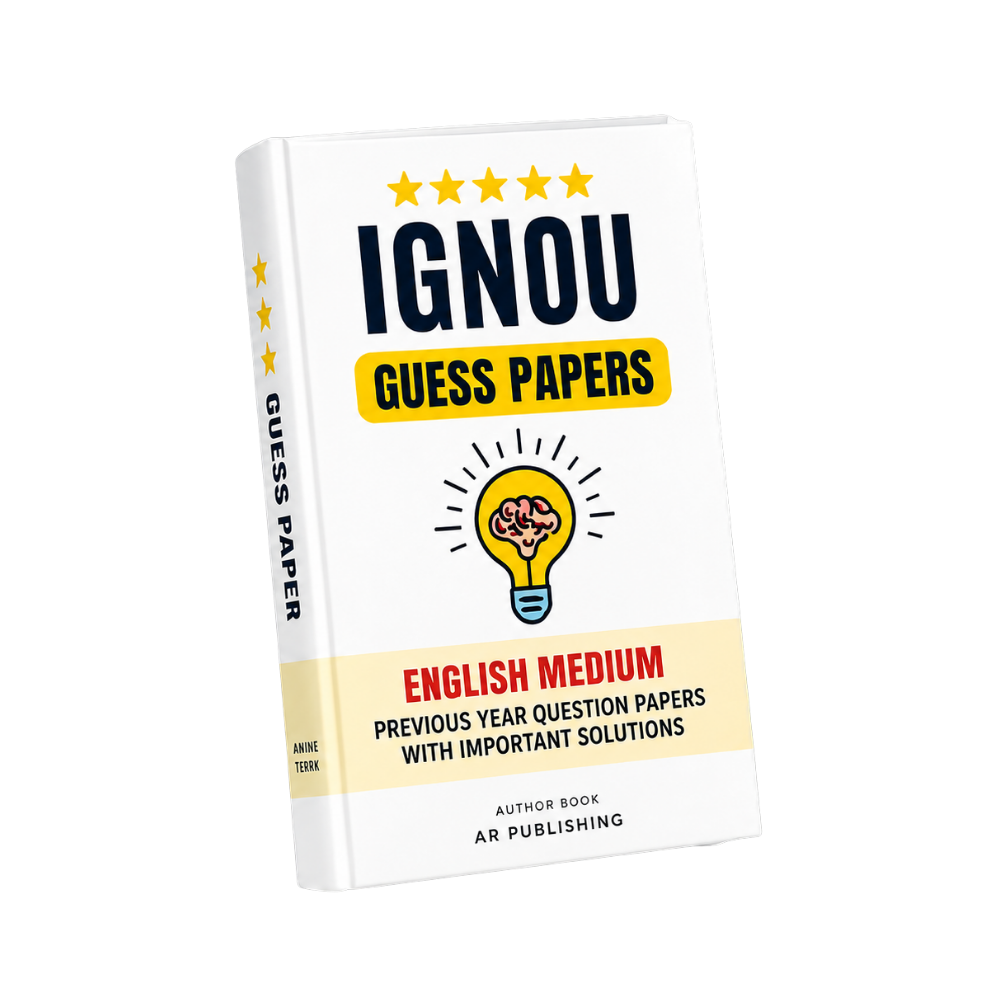
MECE-101 IGNOU Guess Paper 2026-27
Click to view offer details & terms
Get 10% OFF Instant Discount
Apply this coupon code at checkout to claim your academic discount instantly.
- Applicable on all university study materials
- Valid for up to 8 item(s) per order
- Valid till Oct 31, 2026
Frequently Bought Together
Popular course materials frequently ordered together

Syllabus & Overview
Course Scope & Syllabus Overview for MECE-101: Introductory Econometric Methods
MECE-101 is a core course under the Master of Arts (Economics) programme, designed to equip students with foundational econometric techniques essential for empirical economic analysis. Aligned with IGNOU’s CBCS curriculum, this course bridges theoretical economics and applied statistical methods, emphasizing hypothesis testing, model specification, and interpretation of regression outcomes. It prepares students to critically evaluate economic data, assess causal relationships, and apply econometric tools to real-world policy challenges, ensuring rigorous analytical proficiency.Key Syllabus Units & Topics
- Block-1 Introduction: Covers the foundational principles of econometrics, distinguishing it from descriptive statistics and regression analysis. Students explore the role of econometrics in economic research, data types, and the importance of model specification.
- Block-2 Classical Regression Model: Focuses on the linear regression framework, including the Gauss-Markov theorem, ordinary least squares (OLS) estimation, and interpretation of coefficients. Topics extend to multicollinearity, heteroscedasticity, and the assumptions underpinning OLS reliability.
- Block-3 Violations of Basic Assumptions: Analyzes deviations from classical regression assumptions, such as autocorrelation, heteroscedasticity, and endogeneity. Solutions like generalized least squares (GLS), instrumental variables (IV), and robust standard errors are discussed for model correction.
- Block-4 Extensions of Regression Models: Introduces advanced techniques like logit/probit models for binary outcomes, time-series econometrics, and panel data analysis. Emphasis is placed on practical applications in development economics and policy evaluation.
Frequently Asked Questions
Q: What is the marking scheme for MECE-101’s Term-End Examination (TEE), and how are internal assessments weighted?
A: The TEE carries 100 marks, accounting for 70% of the total course grade, while assignments and other internal evaluations contribute the remaining 30%. Focus on mastering regression analysis and assumption violations for maximum TEE score potential.
Q: Are there repeated questions in past MECE-101 exams, and how can I identify high-weightage topics?
A: Past TEE papers (June/December cycles) frequently revisit core concepts like OLS assumptions, model diagnostics, and logit/probit applications. Reviewing solved papers from the last 5 years reveals recurring themes, prioritizing Blocks 2 and 3 for effective revision.
Why buy from us?
-
Verified by top professors and 99th percentile students.
-
Always updated to the latest university curriculum.
-
High-quality, printable PDF formats with clear diagrams.
License & Terms
By purchasing this item, you agree to our standard academic license terms. You may use this product for personal study, but you may not resell or redistribute the files online.